




Northern Territory Aboriginal leaders are calling on the Federal Government to restore direct funding for homeland communities, arguing years of underinvestment have worsened social, housing and health outcomes for First Nations people.
Led by NT independent politician Yiŋiya Guyula, a delegation travelled to Canberra this week to meet with ministers and MPs across a range of portfolios, seeking long-term funding for homelands administered by an independent Aboriginal-controlled organisation and a renewed commitment to genuine partnerships with Aboriginal communities.
Mr Guyula said governments had failed to listen to Aboriginal communities and instead pursued policies that encouraged people to move from homelands into larger regional centres.
"Homelands have always been the solution to many of the problems our communities face," Mr Guyula said.
However, the senior Liya-Dhälinymirr Djambarrpuyŋu leader argued those policies had contributed to overcrowding, incarceration, poor health and disconnection from Country.
"Being forced off our ancestral country is damaging our physical and mental health, and leaving us weak in spirit, because we lose the protection that living on country provides," he said.
The Mulka MLA also criticised the Northern Territory Government for ending the treaty process and Local Decision Making, accusing governments of repeatedly failing to properly consult Aboriginal communities.
"We are tired of governments telling us, 'We know what is best for you,'" Mr Guyula said.
"I went to Canberra to tell the Federal Government it's time to listen and work with us to protect our people and our culture."
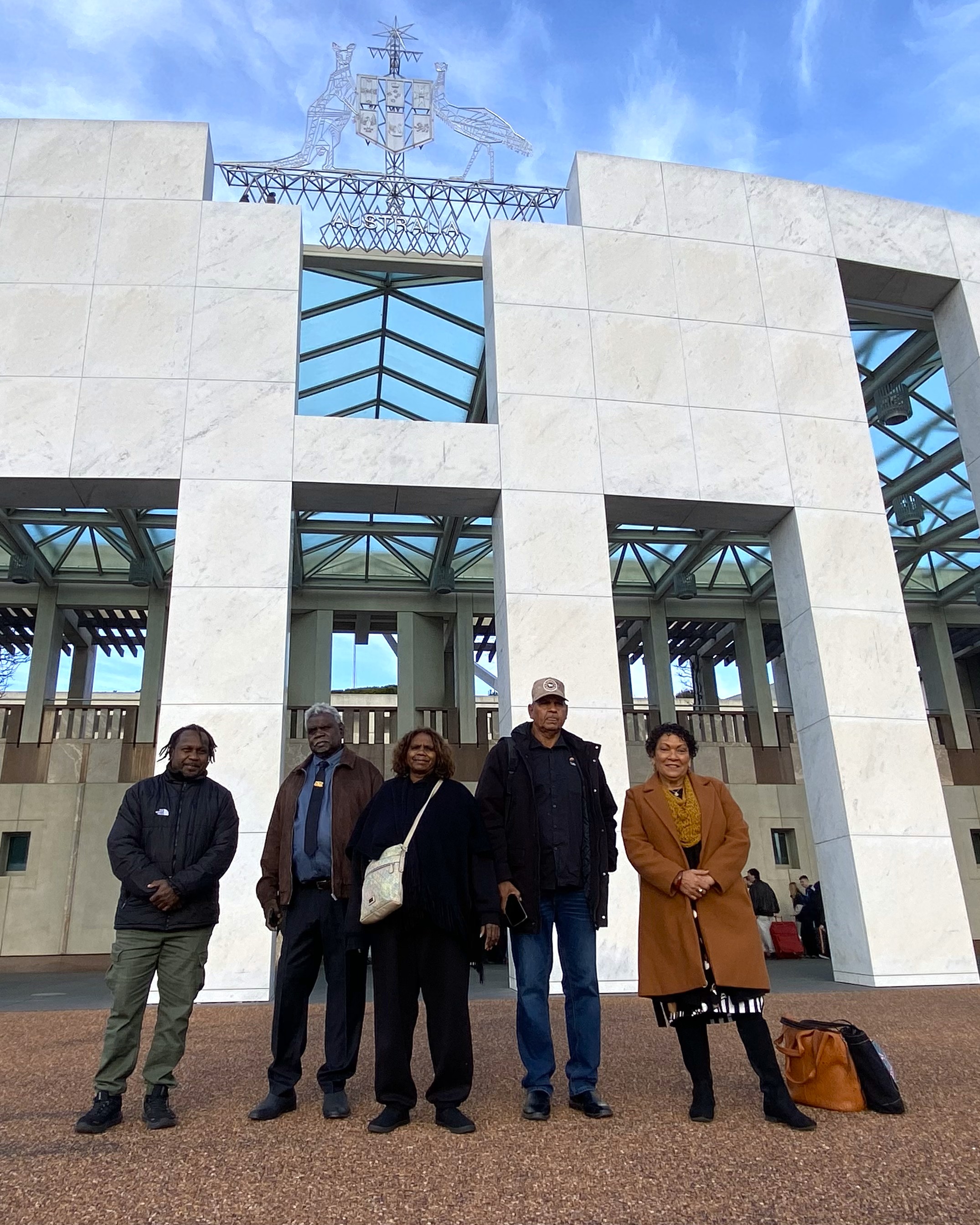
Traditional Owners representing homelands across north-east Arnhem Land, west Arnhem Land and Urapuntja (Utopia) in Central Australia joined the delegation, alongside Aboriginal Housing NT (AHNT) chief executive Leeanne Caton.
AHNT said there are more than 500 recognised homelands across the Territory, with about 394 currently funded for municipal and essential services, but warned decades of underinvestment had left communities with ageing infrastructure, overcrowded housing and significant unmet demand.
The Commonwealth's $220 million, five-year investment in homeland repairs and infrastructure is due to expire in June next year, prompting calls for funding certainty beyond 2027.
"The future of Northern Territory homelands is at risk and needs certainty beyond 2027," Ms Caton said.
"We cannot continue to fund critical housing work and essential infrastructure with short-term arrangements. We need to recognise homelands as critical components of the NT's housing continuum, as equal and legitimate housing geographies with vast capacity."
The delegation also called on the Commonwealth to reverse its 2015 decision to transfer responsibility for Northern Territory homelands to the Territory Government, describing the move as a "backroom deal" that deprived homelands of essential resources and would have been rejected by local communities.
Mr Guyula pointed to the recent violent deaths in Galiwin'ku and Milingimbi as evidence that concentrating investment in larger hub communities was failing.
"I stood in those towns when those young men died and I am devastated that I couldn't stop those deaths," Mr Guyula said.
"We are desperate to fix these problems and protect our people. Enough is enough! We know the solutions for our people, but the government must work with us."
He called on governments to "start listening to what Elders are saying" by respecting self-determination and including homeland communities in the "vision for strong, safe, Aboriginal communities".
"We need a strong partnership with the Federal Government, with secure, long-term funding for our homelands that can be administered by an independent Aboriginal-controlled organisation," he added.



