




The Australian Army has been building relationships, sharing skills and participating in cultural exchanges with Indigenous communities across Australia for decades.
In Pitjantjatjara, the first language of the Aṉangu people of Amata, an Aṉangu Pitjantjatjara Yankunytjatjara (APY) Lands community in north-western South Australia, this practice of mutual exchange is known as Ngapartji Ngapartji.
In the Amata community the exchange has taken many forms, including training and mentoring provided by the 2024 Army Aboriginal Community Assistance Program (AACAP) in collaboration with TAFE SA and the local Community Development Program (CDP).
The program includes on-the-job training in basic welding, carpentry, and safe food handling.
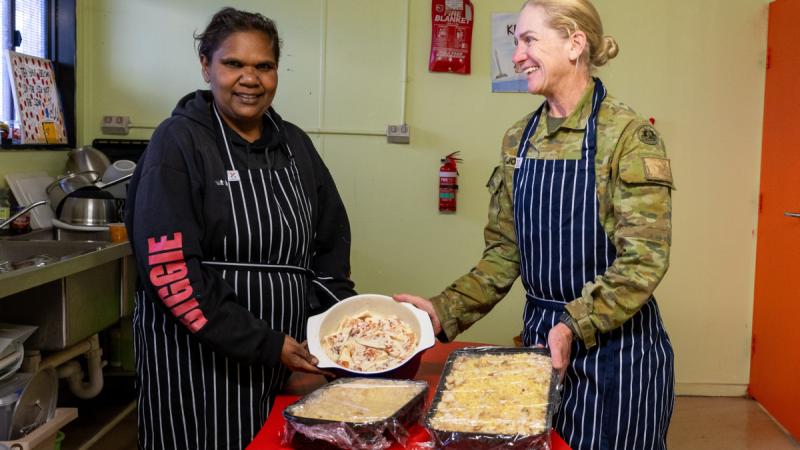
In the CDP kitchen, Amata resident Judith Walker highlighted the impact of the training, noting the women learned to cook a wider variety of meals they could prepare in bulk and freeze.
"Normally they would eat the same meal every day, like sandwiches, pasta or spaghetti bolognaise; just easy stuff," Ms Walker said.
"Now we have better time management and do the bulk of the cooking on a Monday.
"We've also changed the rules now that we've done a safe food handling course with TAFE."
Roslyn Mervin, CDP's administration clerk, said the changes have positively affected her daily routine.
"I have more time for painting, and I've been able to learn sewing from Debra [Captain Johnson] instead of being in the kitchen all day, cleaning up and going back home and doing it again for my family," Ms Mervin said.
Ms Mervin also used her new sewing skills to create a larger jumper for her granddaughter, with guidance from Captain Johnson.
Captain Debra Johnson said members of the 2024 AACAP felt privileged to be involved in Ngapartji Ngapartji with the men and women in Amata.
"Last year, I travelled to Amata to meet with the elders, community representatives, and key stakeholders to discuss what training we could deliver under AACAP 2024," Captain Johnson said.
"When I deployed as the AACAP 2024 training development officer in May, I came in with a shell concept of what could be achieved.
"However, the ideas evolved, and Ngapartji Ngapartji was a big part of it."
To support employment pathways in the community, Captain Johnson arranged for tradespeople from the 6th Engineer Support Regiment to install a commercial espresso coffee machine at the local TAFE facility.
"We purchased a coffee machine suitable for the dry environment here, and TAFE South Australia purchased a reverse osmosis filter to prolong the longevity of the coffee machine," Captain Johnson said.
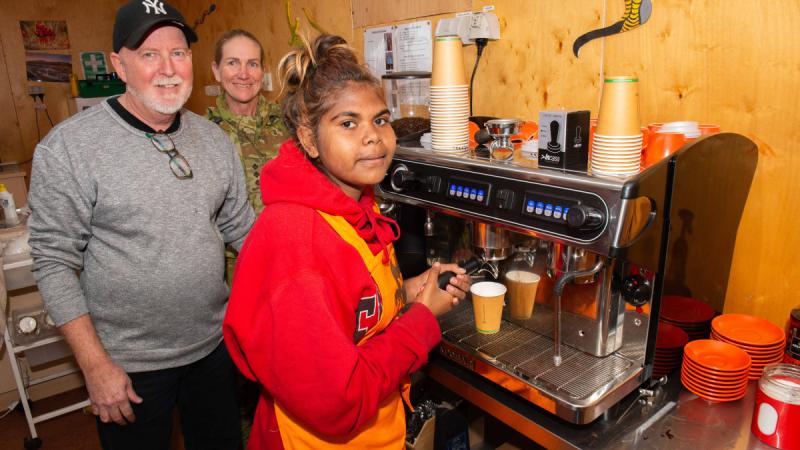
Four members of the Amata community earned two units of competency just in time for the Amata Career Expo, where they applied their new coffee-making skills.
Six community members, including two local NORFORCE members, completed a two-day White Card course, enabling them to work in construction.
"A White Card is one of the essential elements that the employees at the local CDP needed to open up additional employment pathways," Captain Johnson said.
In the spirit of Ngapartji Ngapartji, the women of Amata also taught the AACAP contingent how to hand-weave baskets with braided raffia.



