


The clenched fists of boxer Shaun Thomas reconfigure to tell a story of Aboriginal art so deadly that it packs a wallop stiffer than the punches that knock out his opponents.
The designs originate from the 41-year-old's sense of community growing up among the few hundred Lumaranatana mob on Cape Barren Island.
But the very personal artwork had been put on hold between a decorated career with the gloves until Melbourne's lockdowns left Thomas stranded in his Keilor East home.
"COVID brought that out in me again," Thomas said.
"I have always been an artist, I have always painted, and I have always been gifted in that space, but it had never been a priority in my life before boxing."
So when gyms closed, public gatherings were shunned, limits were put on travel and the single father's two sons weathered the COVID storm at their mother's home, art reconnected the Palawa man back to his roots.
It all came at a low point for the eight-time Tasmanian champion's life.
"I lost my job, I lost my car, I lost my phone, I lost my laptop – I really lost everything," Thomas said.
"Then COVID happened and we were in lockdown.
"This was a healing space, basically. If I don't have boxing, my art was there for me."
Worse was to come for his boxing from the onset of the pandemic where a punching bag under the carport and his free weights inside were left idle.
He was lucky to find a challenger for a Pacific title in July 2021, but bouts in the future were scuttled after a botched vaccination injection caused nerve damage in his shoulder.
"Within two days, my arm collapsed," Thomas says.
"I lost feeling in three fingers for two to three months."
The only way Thomas could ease the pain and stop crying was to try to keep his elbow above his head or apply ice and heat packs regularly to the aching spot.
It took nearly five months to gain full strength amid a delicate rehabilitation before, on top of everything else, catching COVID-19 floored him like a flush hit on the chin.
"That's when I became comfortable (with) being alone because of my art," Thomas says.
"That was my biggest strength with my culture in my paintings. It was phenomenal to be alone for so long and be able to say I'm okay.
"To have my paintings there for my culture, even though I was so disconnected from the world. But if I didn't paint, I was lost."
It was no longer just on canvases - his prints have been all over boots, t-shirts, backpacks, coffee cups, and mobile phone and laptop cases.
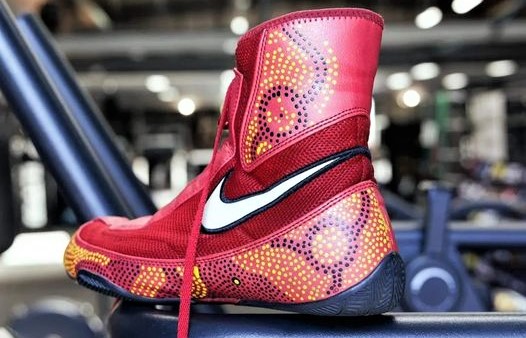
The ochre colours were more recently dropped in favour of black and whites that captured a more personal "cultural connection to building relationships".
The art was so acclaimed at the time that Thomas was asked to come up with his first outside art mural.
The 12-metre high piece at Wantirna College, on the other side of Melbourne presented more challenges than his arm reaching up high to paint.
"I'm scared of heights," he laughs, "because I had to get up on a no-bolt scaffold and that thing was rattling like I was in a cyclone."
While the art has continued to flourish both culturally and commercially, Thomas has also stepped back in the ring.
There is still one more fight and one more title in the works for April, but there is also optimism for the boxer turn teacher.
Under his watch, a dozen up-and-coming boxers including two state champions and another on their way to the junior world titles hang on his every word.
"My goal as a coach is to be one of the best coaches this country has produced – that's it period," Thomas says.
"I believe I can be because I am always open to taking criticism and open to learning and not having the ego to believe I know everything."
Thomas is passionate about lifelong learning and receptive to advice.
The best came from trainer, manager and promoter Pierre Karam, who is one of the very few Australians to have spent time in the iconic Kronk gym out of Detroit where the cream of the crop breath and live boxing.
"He gave me the love back and the passion for boxing again," he says.



