


Sitting in her modern ground-floor apartment in Perth's eastern suburbs, Whadjuk Noongar woman Joanne Ugle's smile beams with pride for the life she is leading.
Ms Ugle is employed in a job she loves, has a stable roof for her family and feels part of a community living in her eight-unit complex.
But her path to get here is an all too familiar tale of addiction, incarceration and desperation.
"I'll be quite honest, I used (drugs) because I couldn't deal with grief," she said.
"There were days where I wanted to get off it because it didn't make me happy... but it was just a release of dealing with issues in your life such as being homeless."
Ms Ugle's addictions compounded her criminal record: by age 12 she was already well-acquainted with the justice system and can rattle off a long list of prisons she's familiar with.
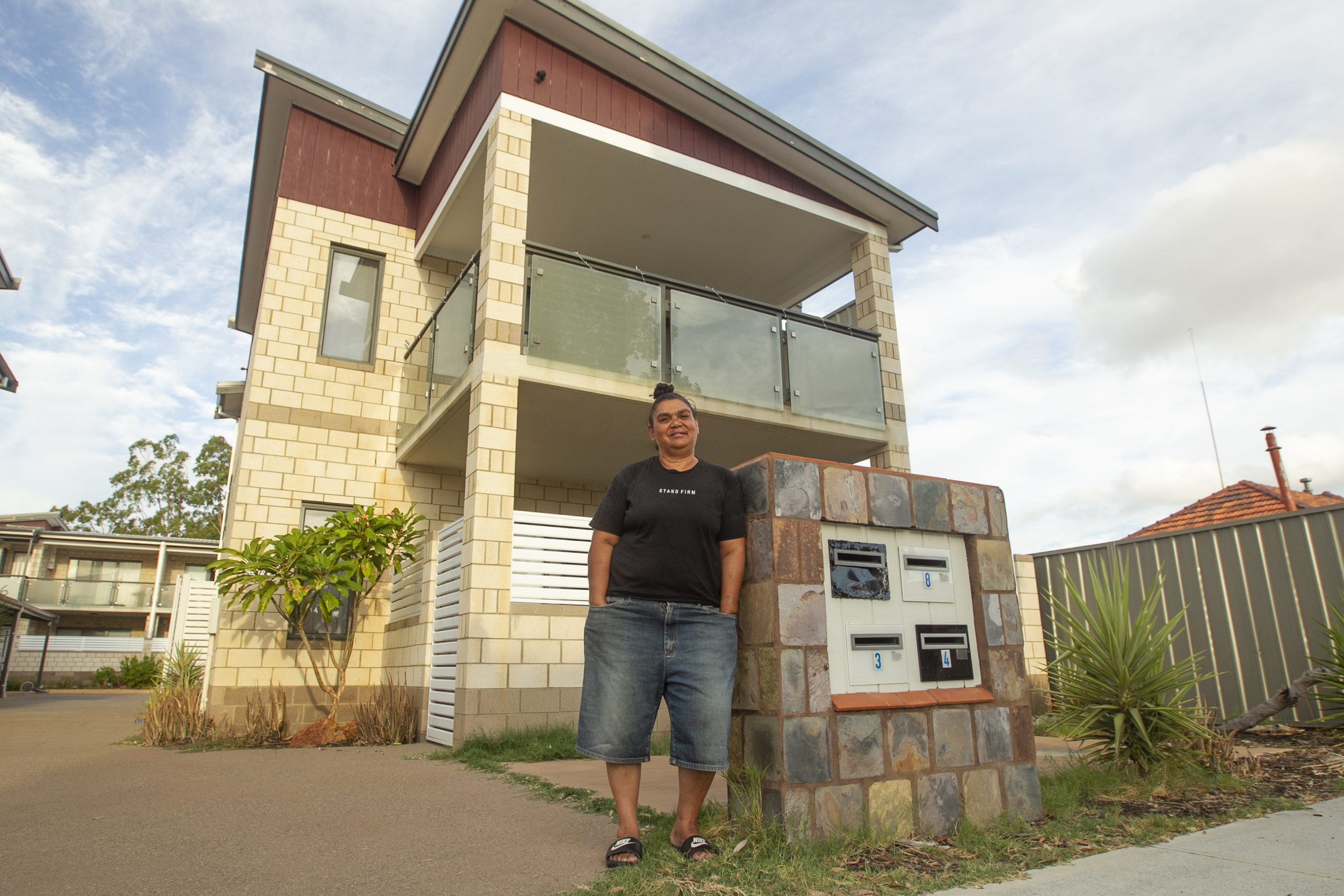 Joanne Ugle out the front of her Koolark-provided home in Perth.
With the exception of her strong grandmother, Ms Ugle lacked role models, and was desperate to fit in with siblings who were "all doing it".
Having already lost her children to the Department of Child Protection, the turning point came when Ms Ugle's brother died while she was in Bandyup Women's Prison.
"All this grief, just building up where I thought, nah, I can't do this no more - I'm sick of broken promises to my children," she said.
Ms Ugle's newfound faith in god and promise to herself bore fruits - she got out, and stayed out. But as her life got on track one big housing-shaped storm cloud remained.
Her income made her ineligible for public housing, she couldn't access Foundation Housing, Keystart rejected her over a 2017 phone debt, and her past made competing in the hot rental market near-impossible.
That's where Project Koolark stepped in.
The Aboriginal Housing Recovery Centre-led program has 14 homes and works with about 50 people to help them move forward.
"There's a lot of Aboriginal women in the prison that are very strong women, but... just need someone to believe in them" - Joanne Ugle
Of the 15 adults in Project Koolark homes, five have found stable employment and the rest are full time carers for the children.
Project Koolark sociologist Jacqueline De Grussa said the program's success lay in doung away with punitive measures for addressing behavioral issues.
"We actually work from an understanding that all of this is trauma based, and then work individually with members of the family to figure out what they need in order to help them move forward," she said.
"So we don't have any kind of three strikes and your out policy or anything like that.
"We want to provide stability and advocacy for our residents in working with organizations so that they stay engaged and they stay doing the courses doing the counseling and all of those kinds of things with other organizations."
Ms De Grussa said another core element of Koolark's success was the well-appointed homes which would not look out of place in any modern apartment complex.
That is a point Ms Ugle backs up. She said the quality of the homes gave the tenants of her complex a sense of pride and ownership.
"It makes you feel important, it makes you feel part of the community, and makes you feel like 'hey, I deserve this too'," she said.
"Part of being here is a recovery place, a community that can believe in itself, and it can be handed down to the next generation.
"It speaks so loud to your children, to their children, to your siblings, to your people thinking well, 'where Joanne come from, she used to go to the park and drink her life away and whatnot, and look what she's doing now'."
As for the justice system Ms Ugle's close relationship with it continues, only now it is a source of pride.
"It speaks so loud to your children, to their children, to your siblings, to your people" - Joanne Ugle
She works in outcare helping other Indigenous female prisoners find their feet, a job she describes as a high much greater than any drugs could give her.
"It is a high of feeling like a strong woman," she said.
"I think a lot of my sister girls come out of prison who change their life around for the better.
"We are called to do strong things in our lives - to be the Elder, the leader... we play a special role with our families.
"There's a lot of Aboriginal women in the prison that are very strong women, but... just need someone to believe in them."
And the child taken from her during those dark years, he now lives happily with Ms Ugle in her apartment.



