


Sunday, 15 October marks the 70th Anniversary of the first nuclear weapons test on Australian soil at Emu Field, South Australia, the lands of the Anangu Pitjantjatjara Yankunytjatjara (APY) people.
The testing left an aftermath of environmental, health and social outcomes that persist in the community today. Communities and groups have urged Australia to sign the Treaty on the Prohibition of Nuclear Weapons.
Conducted under the name Operation Totem, no consent was sought or given by the Anangu when a 10kt atomic bomb elicited two explosions with force similar to that at Hiroshima, raining Black Mist and a toxic smell over sacred country, poisoning the ground, animals and people.
Yankunytjatjara Anangu woman Karina Lester, Chairperson-Yankunytjatjara Native Title Aboriginal Corporation, said the testing impacted her grandmother and left her late father, Yami Lester, blind.

Karina and Larissa Lester. (Image: supplied)
"Today is a very emotional day for my family. We carry the pain of what happened to my family and community as a result of those tests. Our communities are still suffering the health impacts from radiation poisoning," she told National Indigenous Times.
"This has been a generational journey for us, and a generational story of talking about the traumas and the suffering and the scars that have been left not only on our traditional lands, on Yankunytjatjara and Pitjantjatjara country, but also in Western Australia as well. Our stories are stories that have been passed on from generation to generation. They're sad stories, but they're true stories. This is about truth-telling, and this is our story.
"This is why I am urging the Australian government to sign and ratify the TPNW, as Prime Minister Anthony Albanese promised to do when in government. They must listen to First Nations voices who never want to see these most destructive, indiscriminate weapons ever be used again."
In an effort to prevent this happening to communities again Ms Lester and the International Campaign to Abolish Nuclear Weapons Australia (ICAN), with support from more than 130 civil society organisations, including the Australian Red Cross, Public Health Association of Australia, Health Services Union, Oxfam and Catholic Religious Australia, has called for Prime Minister Anthony Albanese to sign the Treaty on the Prohibition of Nuclear Weapons.
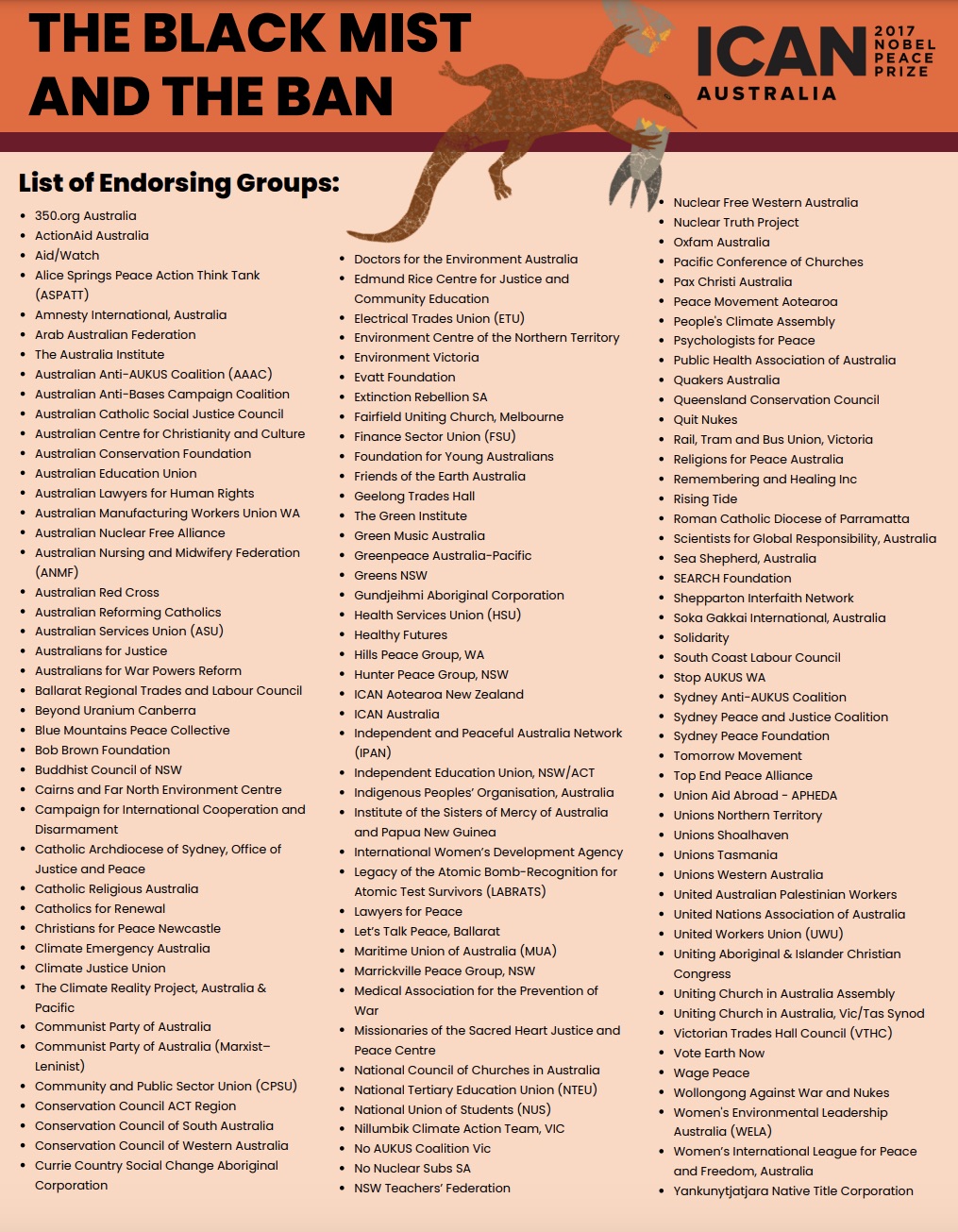
The organisations that endorsed the call (Image: ICAN)
ICAN released a civil society statement which raises concern with Australia pursuing nuclear submarines under the AUKUS Agreement. In March 2023, Prime Minister Albanese, US President Biden and UK Prime Minister Sunak announced the Optimal Pathway for Australia's acquisition of conventionally-armed, nuclear-powered submarines.
Following on from the Prime Minister's announcement, Richard Marles, Deputy Prime Minister and Minister for Defence, called the agreement "a historic event in our nation's history".
"The acquisition of this formidable capability is the single biggest leap in Australia's defence capability," he said.
"It will see Australia become one of only seven nations to operate nuclear-powered submarines. It will strengthen our capacity to defend Australia and its national interests."
Minister Marles confirmed the location of where the next-generation submarines will be built by Australian workers, which is in Osborne, South Australia.
He also said Australia would meet its non-proliferation obligations and commitments under the Treaty for the Non-Proliferation of Nuclear Weapons.
"The Government has been clear throughout this process: Australia does not want to, and will not, acquire nuclear weapons," he said.
The Mass Society Civil Statement released by ICAN reiterates the need for, and strongly urges the Australian Government to sign, the treaty on the Prohibition of Nuclear Weapons to ensure that nuclear powered submarines do not lead to "nuclear weapons stationed in or acquired by Australia, and that our nation ceases to contribute to the justification, threat and possible use of nuclear weapons by AUKUS members or others".
Ms Lester told the ABC that part of her job as a member of her family and community is to keep this story alive. She said that there were community members with scars, burns and skin rashes, and that her Nanna also died of cancer.
The Treaty on the Prohibition of Nuclear Weapons was created in 2017 and has been signed by 93 signatories and 69 states.



