




Wiradjuri and Kamilaroi artist, Jonathan Jones, is set to headline the first exhibition at Artspace at The Gunnery from December 15, 2023, to February 11, 2024, marking the reopening of the venue before the exhibition embarks on a national tour.
His exhibition, Jonathan Jones: untitled (transcriptions of country) explores colonial transport, trade and the acclimatisation of Indigenous plants, animals and objects along with the colonisation of local knowledge.
Artspace has collaboratively commissioned an extended presentation that includes new companion works, a 550-page publication, public programs and community engagement initiatives, building on Jones' original exhibition, initially showcased at the Palais de Tokyo in Paris in November, 2021.
Untitled (transcriptions of country), delves into the colonial dynamics of transporting, trading, and translating Australian native flora, fauna, Aboriginal portraits, objects, and music.
Specifically, it scrutinises the French expedition, led by Captain Nicolas Baudin under Napoleon Bonaparte's commission from 1800 to 1803.
"This project, in a way, is just putting a spotlight on one particular story, which was this French voyage that came to Australia in 1800 to 1803," Mr Jones said.
"There's a few interesting things about it in relation to, A, what they collected, and a bit of a reflection of the mindset of the French at the time."

Notably, this expedition amassed an extensive collection of Australian plants, animals, and Sydney Aboriginal artefacts housed at the Château de Malmaison, the private residence of Napoléon and Joséphine Bonaparte.
"They made one of the biggest collections of Australian material ever, historically," he said.
"While they were traversing around Australia, they only stopped in a handful of places, but they collected thousands and thousands of plant specimens."
Jones's meticulous research in both Australia and France reveals a somber reality—the once-intact collection is now fragmented.
"I do think our communities have been coming up with creative ways and successful ways of processing history to sort of, not rise above it, but just to live with it, he said.
"When we think about repatriation, we think about ancestral remains, we think about objects, but we often don't really think about all that scientific data that's also been harvested from our country and how we come to terms with that loss and how we get it back."
Many of the animals, plants, and cultural artefacts collected by Baudin's naturalist team have either dispersed, vanished, or been forgotten over time.

The piece features diverse elements such as embroideries, sculptures, a soundscape and video, reimagining over 300 plant specimens from Baudin's expedition preserved at the Muséum national d'Histoire naturelle in Paris, transformed into handmade embroideries in partnership with the ACE Embroiderers Collective.
The collective, comprising migrant women organised through Arts & Cultural Exchange in Parramatta, includes Anaita (Asana) Abdul Azim, Anamika, Rabia Azizi, Khyati Niket Gathani, Lida Heidari, Shabnam Mukhi, Zahra Nawabi, Ayusha Prasad, Fariba Rahimi, Junghee Seeto, Sharadha Sivaraman, and Seethalakshmi Srinivasan.
"We also worked with a number of women from Western Sydney, predominantly, there was a number of other temporologists that came up, but the bulk of the work was done by these migrant women living in Western Sydney," Jones said.
"There's this really beautiful moment where these women from, migrant communities are embroidering the plant specimens to sort of repatriate them.
"So they're learning about those plants from elders. And there's this sort of really beautiful exchange that's to occur through that moment of bringing people together, which is great."
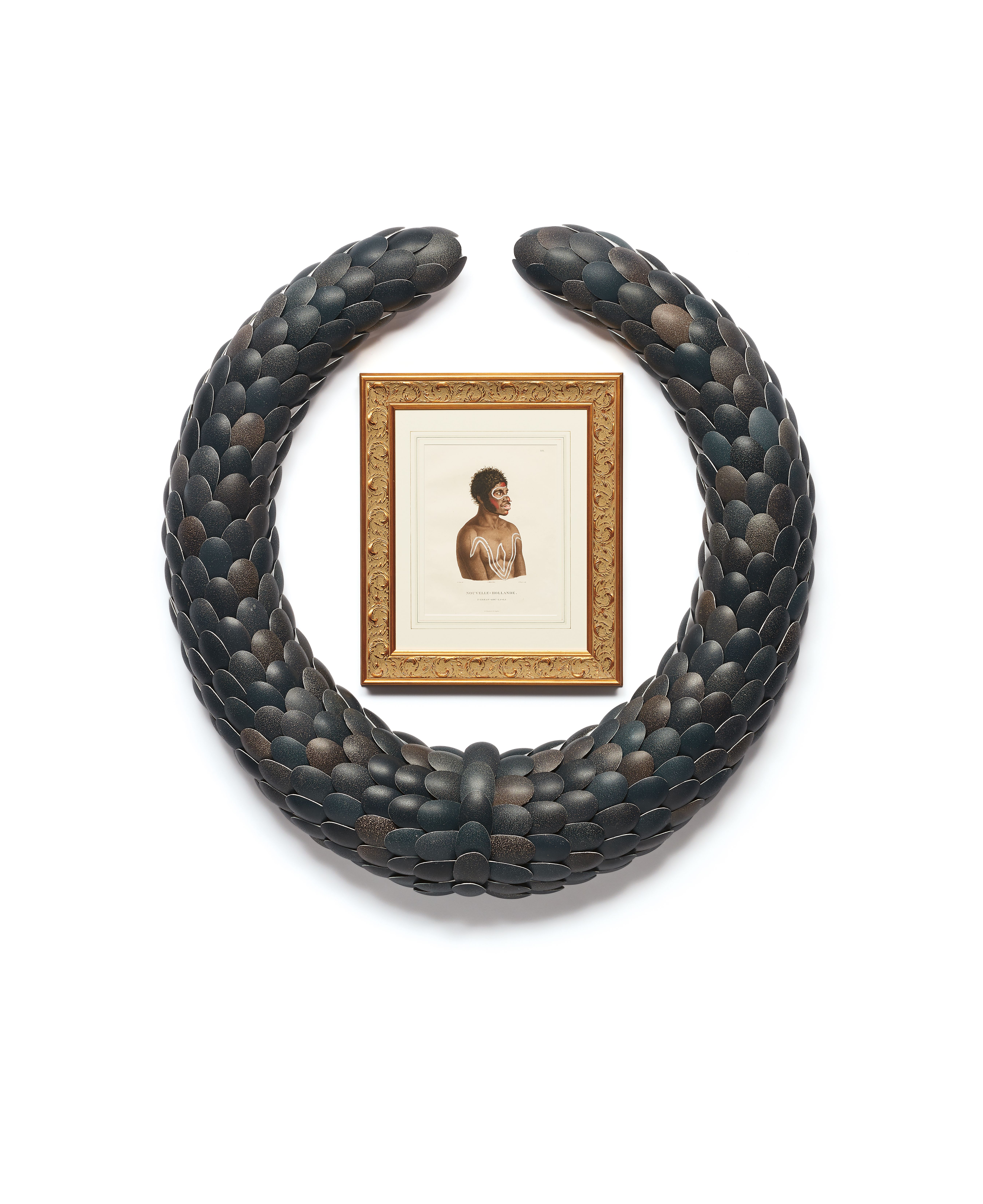
The exhibition further showcases six wreaths adorned with portraits of Eora people, while a captivating soundscape by Arrernte, Bundjalung, and Kalkadoon woman Lille Madden translates notations from Baudin's voyage and recordings from the Sydney region.
Additionally, a compelling video work by Wiradjuri poet and filmmaker, Jazz Money narrates the project's story and context, complemented by a series of ceramic objects created in collaboration with Somchai Charoen and carved emu eggs.
Artspace Executive Director Alexie Glass-Kantor paid tribute to Jones' works ahead of the exhibition's opening.
"It is extremely important to acknowledge First Nations artists with our opening exhibition, and Jonathan Jones is one of the most important First Nations and Australian artists of our time," she said.



