


Stuck with just an unmistakable six-foot board peeking out of the unforgiving ocean, Steve Parker gets caught inside a cultural pipeline where the Indigenous surfer slips into a very personal Dreamtime.
The 45-year-old has called the Wye River swell home for more than half of his life, but the lifeblood of his ancestors looked further north than the Victorian coastline.
"I look around and I feel like I'm connected to the water," Parker says.
"Where I come from, my people are from the Torres Strait Islands and are the Yorta Yorta, the river people.
"I'm also part of the Birrarung, and all of these have water elements to their lives – especially my island side."
He may be soothed in the surrounds of gushing water, but he snaps back to reality as a curly wave rolls in fast. The danger it poses does not escape his attention.
"That's sometimes a bit scary," Parker says.
"When you're inside one of those tubes, time just stops."
Growing up on Bunwurrung country – across the other side of the bay that the Kulin nation knew as the Narm-Narm – he'd hardly seen another Blackfulla take to a board anytime, anywhere.
Because inland Warragul then felt like a world away from the distant Port Phillip Bay breaks out to the horizon and before any surfboards touched the water, Parker tried to find his place on a skateboard.
He was good on the wheels, admired by his peers, but something was amiss.
It was only from watching his dad – a classic surfboard shaper – for hours on end that a budding love of the surf grew and reconnected him to a lost heritage.
After stripping the fibreglass off the first gifted board his hand quickly turned to the shaping their dimensions.
Artwork is then hand painted from scratch that blends traditional Indigenous design to the bold surfing world that also captures the free spirit with which Parker rides the waves.
"That's where I have been on my own journey," he says.
"I was adopted when I was a baby, but I later found my mum when I was 11. So being able to do this for surfing takes me back to my real community.
"I'm constantly meeting cousins and family everywhere I go. Not being around your community when you're growing up and then reaching your community is like finding family."
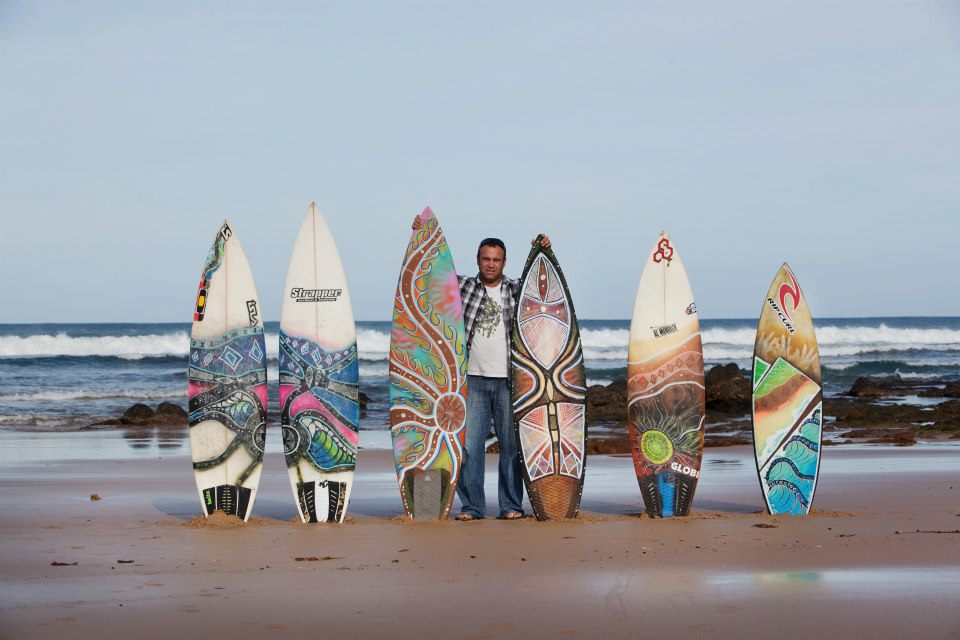
That first came from the gravitation to the Phillip Island scene before later the appeal of the aptly-named Surf Coast lured Parker to the undulating rips across a swathe of Wathaurong country.
Thousands of young Indigenous faces come there – and nearly all for the first time – to learn how to surf under Parker's wise guidance.
"Over those years, I've done programs when no one's turned up, but we've always kept coming back."
Though on reflection, there is a hint of embarrassment to confessing that it took more than 18 months before he was capable of catching a first wave with his best mate.
"No one ever taught us," Parker says.
"We might have got a few tips off my dad and a couple of the old men, but really none of them every came out with us.
"It was all up to us to learn."
That is what makes all the hard work of building an Indigenous surfing community worth copping a few rough wipe-outs.
The unique Surfing Victoria program that is the first of its kind and is more than just about staying upright also builds their self-esteem and promotes a healthy lifestyle.
The innovator of the Woorrangalook Victorian Koori Surfing Titles that evolved from his teachings and the reinventor of the Australian Indigenous equivalent – revived in 2012 after a 16-year hiatus – changed the pastime in the mind of many of his culture.
It makes the serene Yorta Yorta side of his roots beam.
"I've had kids come down from the Murray (river) region, who've had no experience in the ocean or haven't ever seen it, and they've jumped out on the boards just like a duck to water," Parker says.
"It was like they had been doing it for 10 years or something."
That brings out the convincing pitch to sell a spot in a prestigious Koori development squad based in Geelong to the well-meaning parents.
Families have over the years have relocated and swapped not only the river for the ocean, but also for footy or basketball once the talented kids excel in the surf.
Parker has even, in his own admission, bribed some with free wetsuits the moment he's sensed the trepidation of the coast's cold temperatures nine months of the year.
At the worse, they have left with accredited coaching certificates like ripple effects in the water.
At best, the objective is always to have Indigenous surfers on the professional circuit.
The very idea fills Parker with unmistakable pride.
"Bloody oath it does," he says, "my chest would swell out."



