




More than 90 women have died in domestic and family violence incidents in the Northern Territory since the year 2000.
According to a 2020 inquiry, taken from census data, Aboriginal women account for 89 per cent of domestic, family and sexual violence victims in the Territory.
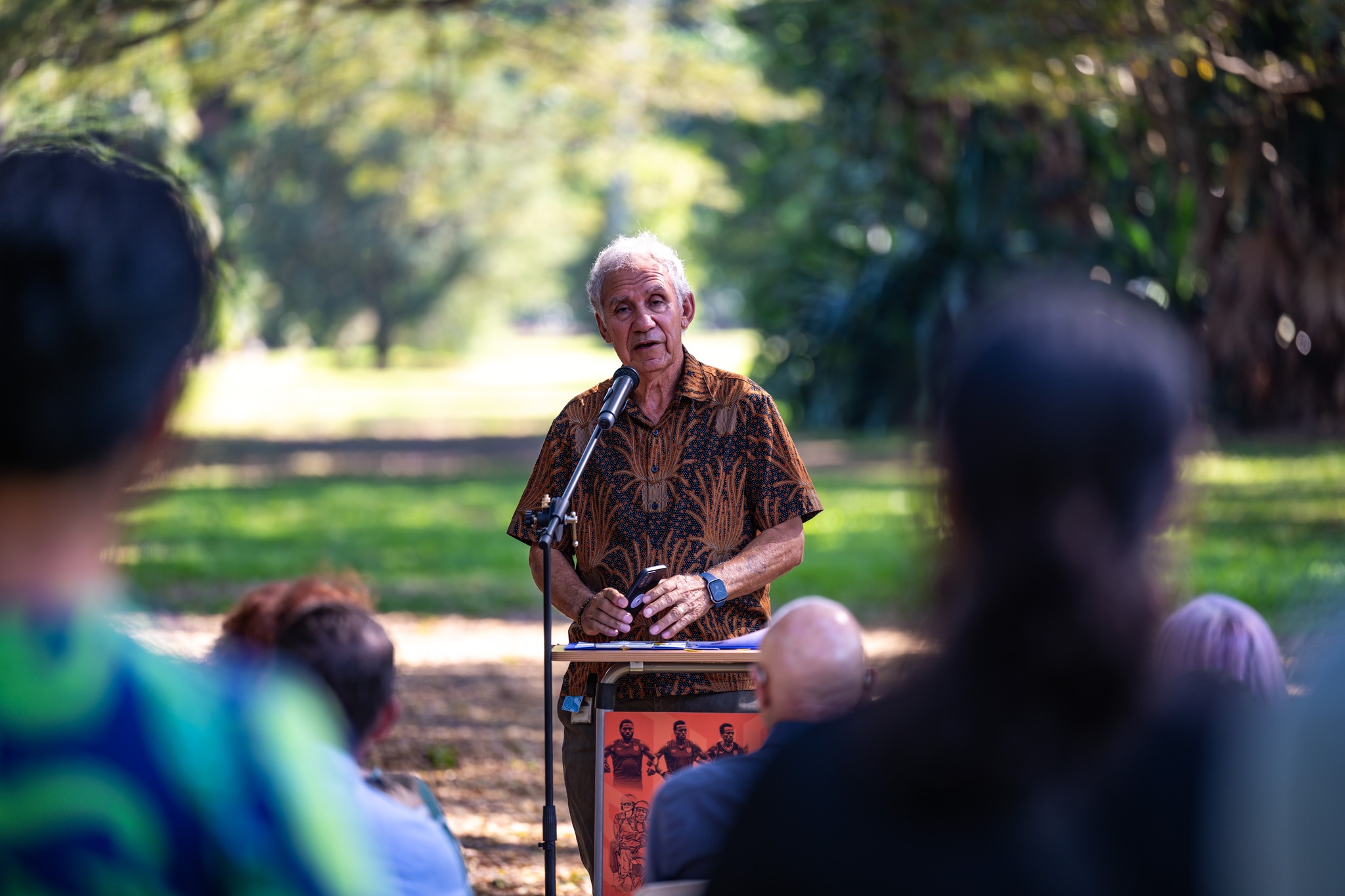
An Indigenous-led and founded organisation is working to bring this to an end - for all people. Sports commentator and family violence advocate Dr Charlie King founded NO MORE in 2006.
The organisation has launched THE STAND campaign; calling for 90 Domestic Violence Action Plans created by clubs, workplaces, community groups and remote communities in 90 days, one for each of the women who have lost their lives in domestic and family violence in the Territory this century.
"Their names may not be known to us all, but their lives mattered," the organisation wrote following the recent launch.
On day one of the 90, ten plans had already been signed.
Dr King said the plans are more than words on a page; "they're real, practical steps that make a difference".
"I'm proud to introduce THE STAND — our invitation to all people to play a role in ending domestic and family violence," he said.
"Because change doesn't just come from the top. It comes from all of us. In our workplaces. In our sporting clubs. In our communities."
NO MORE noted that domestic violence rates are three times higher in the NT compared to the national average, and in some communities up to eight in ten women have experienced it.
"DFV doesn't discriminate. It affects people of every race, gender and background," the organisation wrote, "and ending it will take all of us".
Domestic Violence Action Plans (DVAPs) include:
- Hosting a NO MORE Round to raise awareness in your sporting club
- Doing a DFV safety audit in your workplace
- Making sure your team knows about DFV leave and support options
- Offering DFV training through Lifeline, PART or the NO MORE team
Support and resources and are available online.
CatholicCare NT director Jayne Lloyd said the initiative creates collective action in addition to raising awareness.
"While Aboriginal women are disproportionately impacted in the NT, domestic violence affects people from every culture, background and suburb," she said.
Administrator of the Northern Territory, Professor Hugh Heggie, who participated in its launch, called THE STAND "the campaign's most ambitious initiative yet to end domestic and family violence across the Northern Territory".
This week, legal services and advocates highlighted concerns with protections against family abuse in place for older people in the NT, with a "gap in legislation" noted as a factor.
The ABC reported advocates suggest elder abuse across the country is underreported, no specific elder abuse laws are in place in the NT, and that, according to Darwin Community Legal Service's senior aged care advocate Ramnik Walia, "financial abuse, coercion, neglect — these don't meet the current legal threshold".
DCLS chief executive Rachael Bowker told the ABC that despite broader domestic violence laws: "Neglect laws often come into play too late for the elderly victim, and few perpetrators are held to account."
"The Advance Personal Planning Act (APP) allows people to nominate substitute decision makers for if or when they lose capacity, but is open to misuse," she said.
Mr Waila also noted police are often not able intervene without physical or sexual abuse being involved.
He added "This is not a policing issue" but instead "a gap in legislation".
• 15 per cent of Territorians experience older persons' abuse.
• 70 per cent of victims of elder abuse are women.
• The most prevalent types of abuse are financial abuse, psychological/emotional abuse, and/or neglect.
• 90 per cent of perpetrators are a family member.
The previous NT Government and Department of Territory Families Housing and Communities outlined intent to "tackle the abuse of older persons" in their 2021-26 Seniors Policy.
The Territory's minister for Children and Families and Prevention of Domestic Violence recently said all people in abusive situations are protected by the law, but that specific abuse of older people was an issue and challenge mixed into the domestic violence space.



