




Aboriginal Community Controlled Registered Training Organisations (ACC-RTOs) play a critical role in delivering culturally safe training and meeting workforce demands, the Victorian TAFE Association (VTA) says, backing calls to remove funding barriers facing the organisations.
The VTA has signed a position statement led by the Victorian Aboriginal Community Controlled Health Organisation (VACCHO), calling on the Australian Government to establish a standalone classification for ACC-RTOs within the vocational education and training (VET) system.
The campaign is seeking a dedicated ACC-RTO classification that would provide providers with fairer access to public funding while recognising their role in supporting Aboriginal communities and the broader VET system.
It is also calling on the Victorian Government to be prepared to implement the reform at a state level.
VTA chief executive Alex White said ACC-RTOs and Victoria's public TAFE network shared a role in training workers for critical positions.
"Just like Victoria's public TAFE network, ACC-RTOs are doing important work training skilled workers to fill critical in-demand roles in Aboriginal Community Controlled Organisations, while empowering individuals at the same time," he said.
"Providing ACC-RTOs with a fair and practical classification that acknowledges the unique role they play, will help ensure the sector is financially sustainable and continues to meet the needs of their Communities."
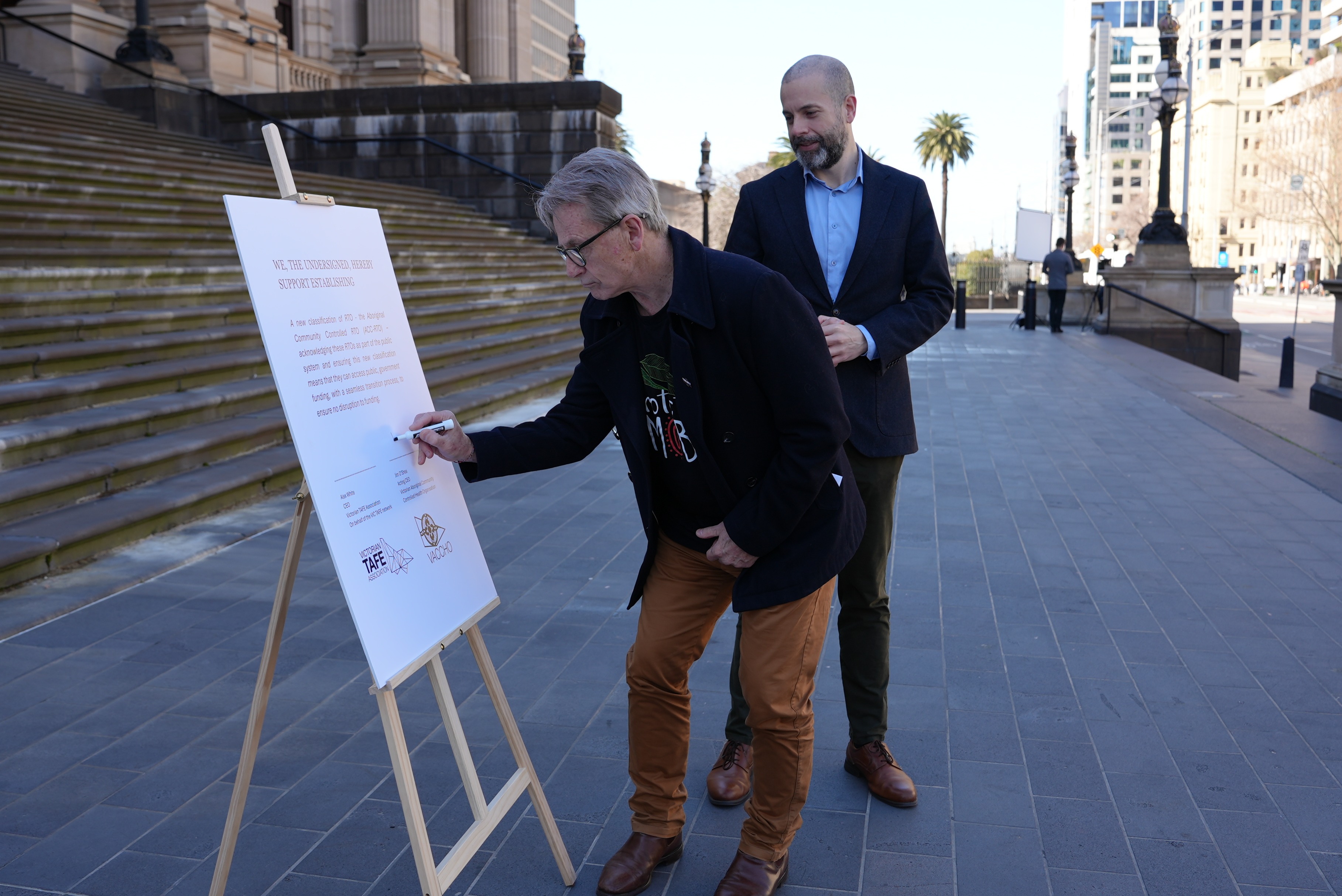
VACCHO Acting CEO Jim O'Shea welcomed the VTA's support for the campaign.
"A bespoke, well-resourced classification will allow fairer access to funding, will support self-determination, and will strengthen the VET sector through equity, not competition," he said.
ACC-RTOs are currently classified as private providers despite operating as not-for-profit organisations and providing free training to students. According to VACCHO, the classification limits their ability to access public funding, with around 60 per cent of ACC-RTOs currently operating in deficit.
There are currently three ACC-RTOs in Victoria providing culturally appropriate education and training programs aimed at meeting skills needs across Aboriginal Community Controlled Organisations (ACCOs).
VACCHO says ACCOs provide essential services for and within Aboriginal communities, with ACC-RTOs helping train workers to fill those roles.
Research conducted by the Human Services Skills Organisation found approximately 95 per cent of ACC-RTO students would not have participated in mainstream VET if ACC-RTOs were not available.
ACC-RTOs also have completion rates nearly three times higher than mainstream providers for Aboriginal students.
The campaign has warned potential students could miss out on training if funding barriers remain.
Yorta Yorta man Shane Charles, a graduate of VACCHO's nationally accredited Diploma of Community Services, said financial and practical support from the organisation helped him complete the qualification.
VACCHO covered Charles' travel and accommodation expenses associated with attending classes.
"'I honestly don't think that I would have been able to complete this Diploma if it was not for VACCHO," he said.
The position statement has also been signed by Aboriginal education and community organisations including the Institute for Aboriginal Development, AbSec, Bubup Wilam Aboriginal Child and Family Centre, Gallang Place and the Victorian Aboriginal Community Services Association Ltd (VACSAL).



