



Public submissions on plans for a large-scale artificial intelligence data centre and renewable energy hub on Karajarri Country close Wednesday, November 4, amid environmental concerns and questions about the project's potential impacts.
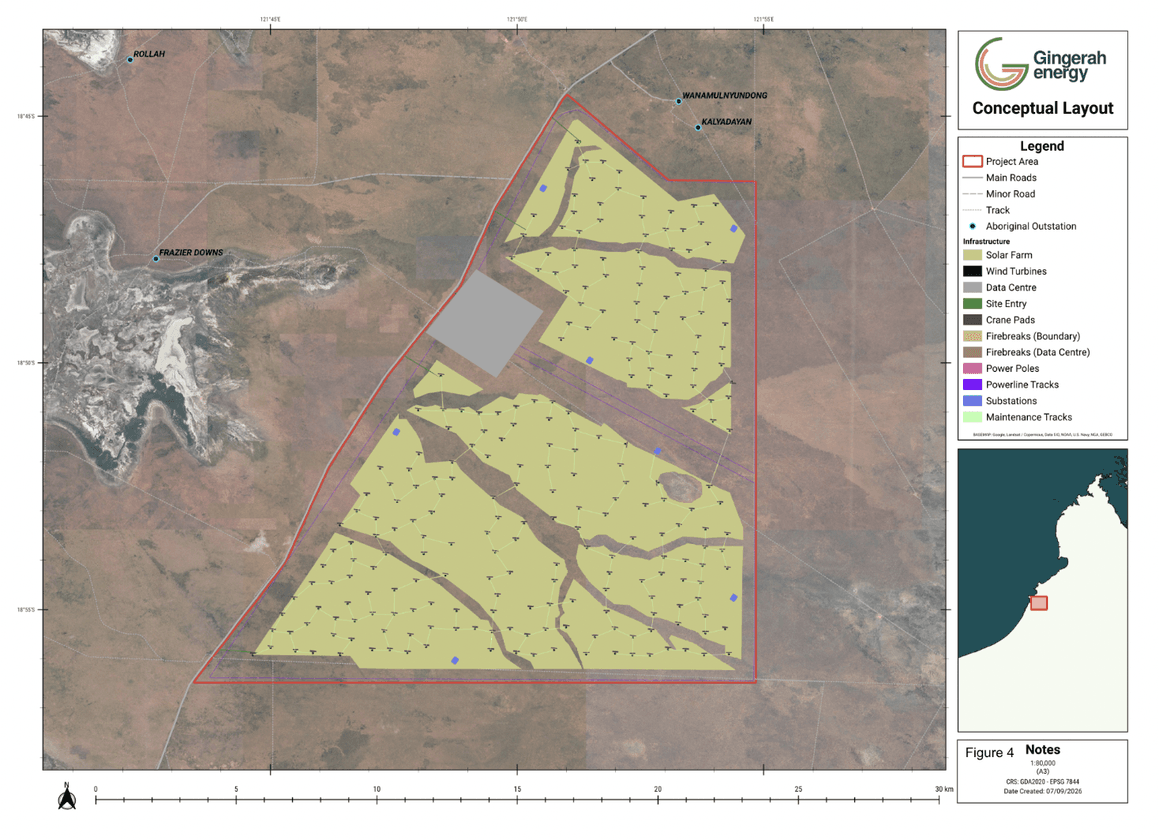
Known as Project Meridien, the proposed development is planned for a 27,520-hectare site in the Great Sandy Desert, approximately 100 kilometres south of Broome.
Referred under the Environment Protection and Biodiversity Conservation (EPBC) Act by proponent Gingerah Energy, the project would include a 1,000-megawatt (MW) data centre, 5,200MW solar farm, 1,500MW wind generation, 1,500MW gas-fired power station and battery storage.
Referral documents identify 18,200 hectares of vegetation proposed for clearing.
Gingerah Energy is a joint venture involving the Karajarri Traditional Lands Association, Longreach Capital Investments and Dutch company Fugro.
Environmental watchdog Environs Kimberley is calling on the Commonwealth to reject the proposal, arguing further information is needed to assess its environmental impacts.
Environs Kimberley executive director Martin Pritchard said the referral lacked sufficient information about potential impacts on migratory birds, threatened species and Ramsar-listed wetlands.
"The Minister must reject the proposal and insist the proponent provide all the essential project information in the referral," Mr Pritchard said.
Threatened species recorded within the proposed footprint include the Greater Bilby, while the region also supports 75 recorded reptile species, including the critically endangered Northern Bluetongue Skink.
"This AI data centre proposal is gigantic and would involve mass land-clearing and the destruction of a vast area of one of the most pristine large deserts in the world in the southern Kimberley," said Mr Pritchard.
In a joint response, Gingerah Energy and Karajarri Traditional Lands Association (KTLA) told National Indigenous Times the Karajarri People have "direct ownership and participation in the company, with two Karajarri directors and a Karajarri employee within the project team".
"In October 2024, KTLA, Fugro and Longreach Capital Investment signed a Joint Venture Agreement following extensive consultation and a community vote on an Indigenous Land Use Agreement for renewable energy development on Karajarri Country."
"The project site was selected in consultation with the community and endorsed by the KTLA board following assessments of environmental, cultural, technical and logistical considerations.
In the shared statement the proponents said "cultural assessments and workshops with Karajarri Elders, cultural advisors and anthropologists helped identify areas unsuitable for development. Community engagement continues through information sessions, cultural workshops and updates to KTLA directors."
Environs Kimberley has also questioned the proposed gas-fired power station, which would have approximately 37 times the generating capacity of Broome Power Station.
Longreach Capital Investments owns Theia Energy, which previously applied to undertake fracking in the Kimberley before withdrawing its application.
Mr Pritchard said the project's gas supply arrangements required clarification.
"The proponents have not said where the gas supply would come from; this is a major concern as one of the companies, Longreach Capital Investments, owns Theia Energy which previously applied to undertake fracking in the area."
In response, Gingerah Energy and KTLA told National Indigenous Times, "gas would be sourced through the WA domestic market, consistent with the WA Domestic Gas Policy".
However, potential suppliers and transport arrangements remain under consideration, with the source and supply route yet to be determined.
The proponents said the project aimed to "maximise the West Kimberley's renewable energy resources and reduce gas requirements as renewable generation increased. Renewable energy is expected to supply approximately 85 per cent of the data centre electricity requirements."
The referral identifies groundwater requirements of up to 1.5 gigalitres annually, which Environs Kimberley says is equivalent to approximately a quarter of Broome's annual water consumption.
Mr Pritchard questioned the proposed demand in a relatively dry part of the Kimberley.
"This is a very high level of water use in this part of the world, a quarter of Broome's annual use is proposed in an area of the Kimberley that's much drier."
Gingerah Energy and KTLA clarified the figure represents maximum anticipated annual groundwater demand for construction activities over approximately 10 years.
Extraction would require a water licence administered by the Department of Water and Environmental Regulation under the broader La Grange regional water allocation framework.
The proponents said all relevant environmental factors would be assessed by the Western Australian Environmental Protection Authority.
The development would also require approximately 400 kilometres of new fibre-optic infrastructure to connect the facility with international telecommunications networks.
Public submissions on Project Meridien close tomorrow, November 4.



