


The AIATSIS Summit, being held this week on the Gold Coast, has brought together Aboriginal and Torres Strait Islander leaders, organisations, researchers and community voices under the theme 'Our Truth. Our Power. Our Future'.
Among the keynote speakers has been Shas Jurud, a non-binary Bardi and Kija person from the Kimberley in Western Australia, who addressed the summit on reclaiming education through First Nations leadership.
Jurud is the inaugural chief executive officer of the National Aboriginal and Torres Strait Islander Education Corporation (NATSIEC), the national peak body for Aboriginal and Torres Strait Islander education and training.
Their presentation introduced NATSIEC's work, the current national First Nations Education Policy process, and the structural changes they said were needed to shift power in education systems.
Jurud began by locating themselves through Country, family and history, including their Bardi bloodline from Jurdud of Pender Bay, their connection to Bardi Country and community, and their family's links to Turkey Creek, Frog Hollow and Beagle Bay Mission.
They told the summit those connections were central to how they introduced themselves and understood their responsibilities.
"My people survived missions, removals, government control, and education systems that were never built for us, but who kept carrying knowledge, family, Country, and responsibility anyway," they said.
"And I stand here today as the inaugural Chief Executive Officer of the National Aboriginal and Torres Strait Islander Education Corporation, NATSIEC."
Jurud also paid tribute to Professor Peter Buckskin, a Narungga man, former NATSIEC chair and long-time leader in Aboriginal and Torres Strait Islander education.
They said Professor Buckskin's work continued to guide NATSIEC's focus on authority, accountability and community-led decision-making.
The keynote placed NATSIEC within a wider push to build First Nations governance across early childhood, schooling, vocational education and higher education.
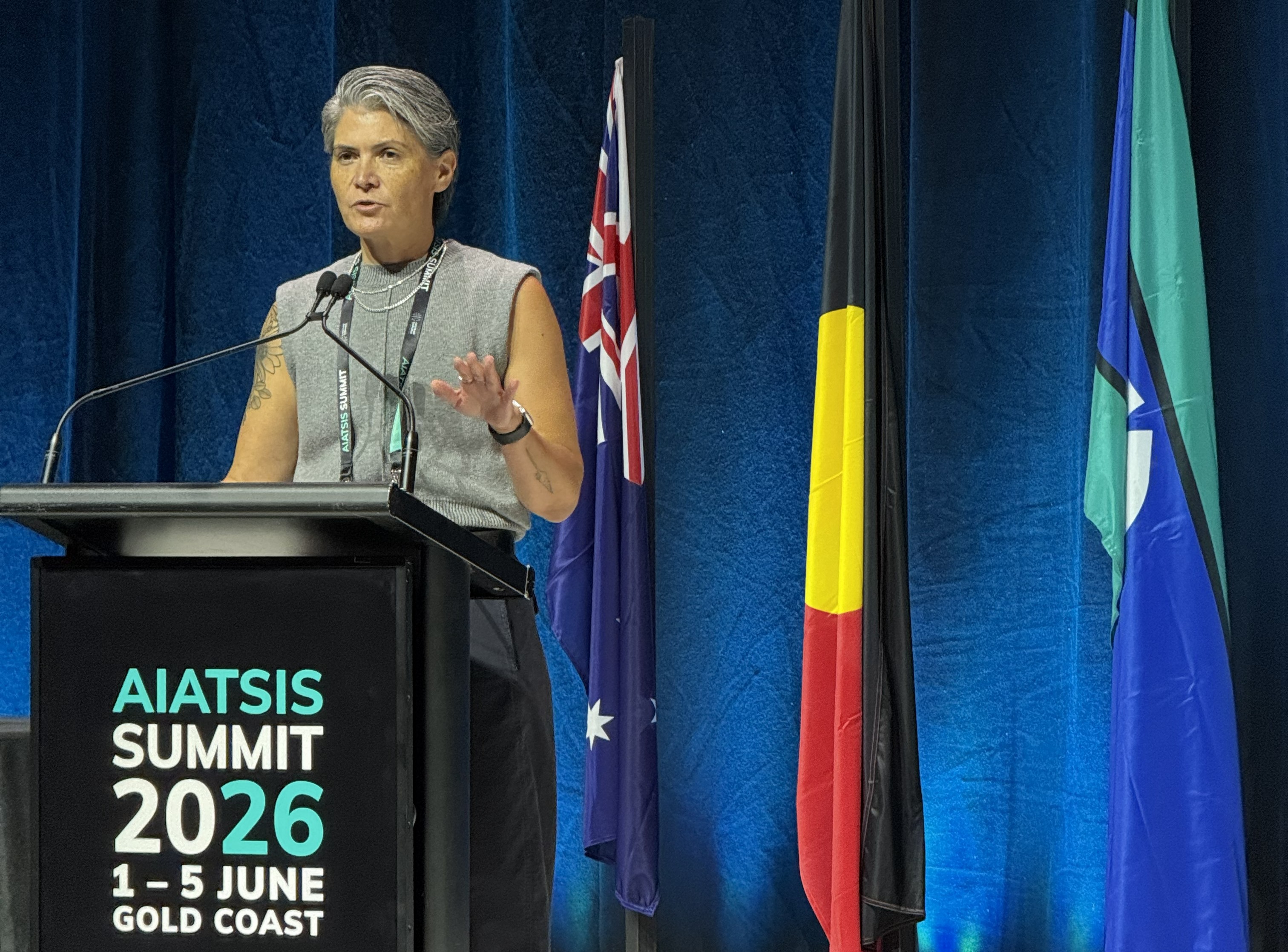
Jurud said the organisation existed because Aboriginal and Torres Strait Islander people had been spoken about in education for too long, rather than being able to lead the decisions that shaped it.
NATSIEC now has a formal role in national education decision-making, including through Education Ministers Meetings and senior official processes.
Jurud said that role mattered because those national rooms shaped curriculum, funding, workforce, data, accountability and reform.
However, they said a seat at the table was not enough if the table itself remained unchanged.
"We are there, at the table, to change what is being served," Jurud said.
"We are asking who has been fed, who has been starved, who has been doing the cooking, and who has been making money from the meal.
"We are there because self-determination cannot depend on invitation, permission or goodwill."
The keynote then turned to NATSIEC's role in the First Nations Education Policy consultations.
More than 800 First Nations people registered to take part in more than 50 in-person workshops, online workshops, forums and interviews, while more than 300 survey submissions were received.
Jurud said NATSIEC's engagement was limited to Aboriginal and Torres Strait Islander people, organisations and communities because the policy was about First Nations learners, families and futures.
They said communities had raised consistent concerns about weak governance, racism, cultural unsafety, workforce pressure and the way data was used in education.
Those findings were also reflected in Jurud's presentation, which listed concerns that governance was too weak, racism was not being addressed, culture, language, Country and identity were treated as add-ons, First Nations staff were carrying colonial load, and data measured learners more than systems.
Jurud said communities were clear that advice and authority were not the same thing.
"Advice lets us comment, authority lets us decide," Jurud said.
"Self-determination in education has to mean more than being asked for feedback."
They also centred the idea that First Nations learners should not have to lose parts of themselves to be recognised as successful.
Jurud said one line from the consultations had stayed with them.
"We don't want our children to sacrifice who they are to become successful," Jurud said.
"That line carries a whole education policy inside it.
"Because underneath it is a deeper question: who gets to define success?"
Jurud said the future of First Nations education had to be built through governance, data sovereignty, properly resourced community-controlled structures and systems that could be held accountable by communities.
They said the new national policy could not become another document that used the right language while leaving power in the same place.
"Our truth has been spoken," Jurud said. "Our power must be built into the structure. Our future will be led by us."



