




The outcome of a WA death in custody inquest could hinge on WA coroner Philip Urquhart's ability to decipher a "poor quality" audio tape in which the victim could allegedly be heard telling police he could not breathe.
WA Coroner Philip Urquhart on Thursday questioned the internal investigation into Noongar man Roderick Narrier's death on the final day of the inquest.
Mr Narrier's died in hospital in October 2019 three days after being arrested by police called out to an alleged domestic violence incident.
That incident saw Mr Narrier restrained in the prone position for nearly 30 minutes due to what WA Police described as "erratic" and "aggressive" behaviour.
Mr Narrier later lost consciousness while being treated by paramedics before dying at Royal Perth Hospital after being in a coma for three days.
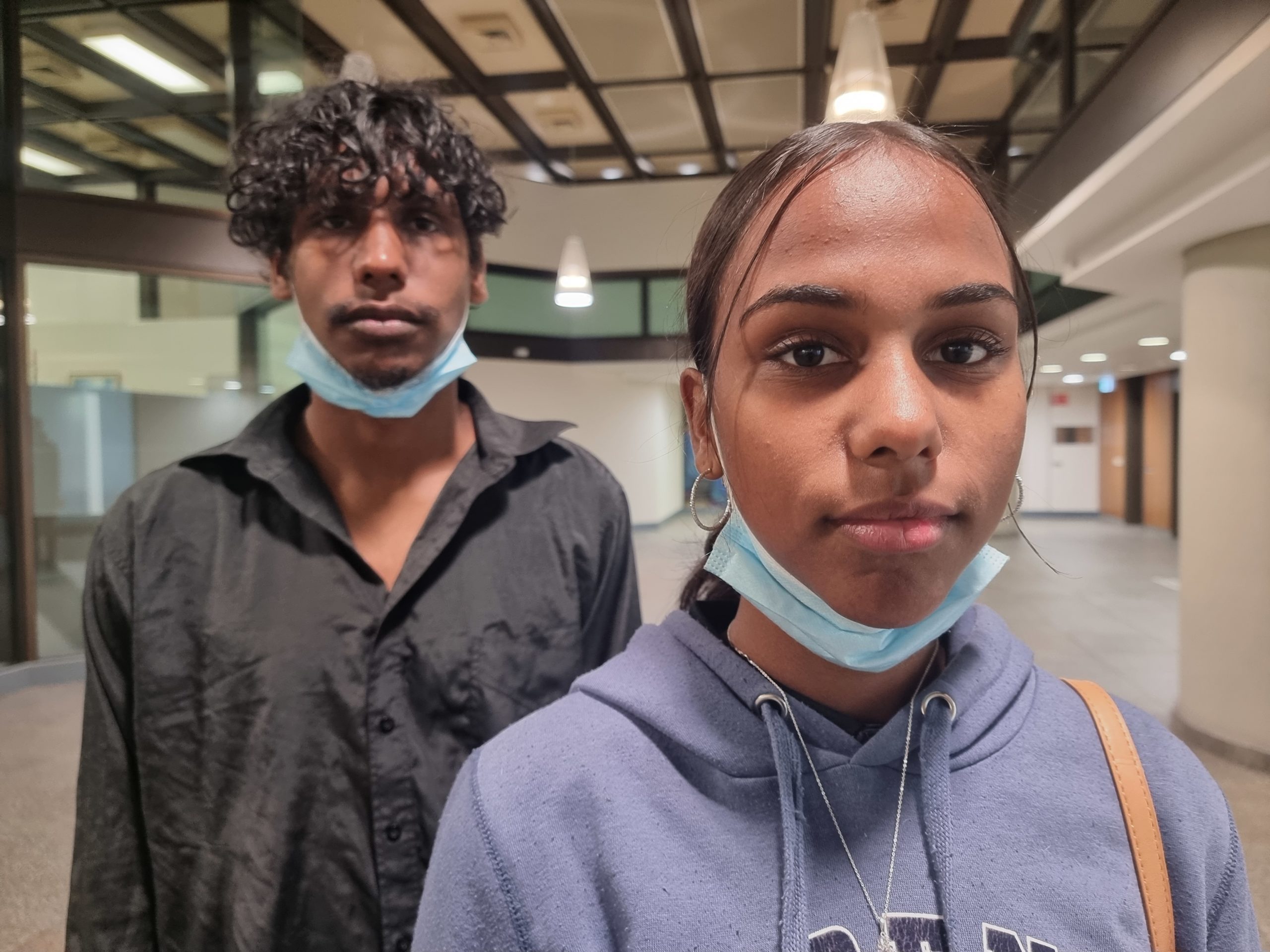 Roderick Narrier III and Leshanti Narrier at court on Wednesday. Photo by Giovanni Torre.
On the final day of the inquest on Wednesday, Mr Urquhart said the deceased's family recognised his voice and believed they could heard him say "I can't breathe" in an audio recording of the call made by police to St John Ambulance.
"The question is should it have come to light much earlier... (via) the investigation?" he asked.
Medical evidence suggested Mr Narrier died of cardiac arrest. It has also been found he was under the influence of methyl-amphetamine at the time.
National Justice Project barrister Anthony Crocker, representing Mr Narrier's sister, Monica Narrier, said it was not possible to exclude respiratory distress as a contributing factor in the death.
"The court has been deprived of the best evidence by failings of the investigation, particularly by the (Internal Investigations Unit)," he said.
"(Mr Narrier) was never asked about his ability to breathe.
"There was no information given to (paramedics) about how long he had been prone and restrained.
"There was no inquiry from the second set of police officers (to arrive on the scene) about how long he had been prone and restrained."
Mr Crocker said claims it had not been possible to take Mr Narrier out of the prone position were dubious given their were four police officers at the scene.
Reforms urged by Mr Crocker included equipment improvements and training to ensure people are take out of the prone position as quickly as possible.
Mr Urquhart said he did not think the officers were exaggerating the difficulty involved in restraining Mr Narrier, but did foreshadow recommending adoption of the above reforms.
Lawyer Joshua Berson, acting for the WA Police, said the audio recording in which Mr Narrier could allegedly be heard saying "I can't breathe" was poor quality and police could not enhance it sufficiently to hear clearly what was being said in the background.
Mr Berson said witnesses reported hearing Mr Narrier say "don't leave" and "don't leave me" and suggested this may be what is heard on the recording.
Mr Urquhart said he would continue to listen to the recording himself to form a view. He also acknowledged while others had been focussing on what was being said by the police officer making the call, the family had listened carefully to what could be heard in the background.
He also said the length of time since the incident had complicated matters.
"This all comes back to when this was investigated and when they should have been asked questions," Mr Urquhart said.
Outside the court, Mr Narrier's sister Monica said the family hoped the inquiry could bring peace.
"Closure and truth, in order for my brother to be able to rest in peace, knowing the truth," she saidl.
"We are more at peace for knowing more."
St John Ambulance also took to the stand on the final day. Lawyer Thomas Pontré said response time for paramedics attending the scene fell within acceptable parameters.
"Unfortunately and sadly it can't be said that a priority one (classification) would have saved his life," he said.
It was found sedatives administered by paramedics did not contribute to Mr Narrier's death.
The recommendations of the coronial inquest are expected after the coroner receives additional information over the next month.



