




All inmates currently held in Northern Territory watch houses should be removed "as a matter of urgency," the Territory's Ombudsman has found, describing the facilities as "unacceptably poor" and "inhumane".
The report, tabled in parliament last week, saw acting ombudsman Bronwyn Haack argue "no prisoner, regardless of their offence, should be held in such conditions" and were welcomed by the North Australian Aboriginal Justice Agency (NAAJA), which said it highlighted the "failure" of the Country-Liberal Party (CLP) Government to "ensure that basic human rights of people in custody are met".
Ms Haack's investigation included images showing 17 people crowded into a single Palmerston watch house cell, lying on mattresses on the floor, with one detainee sleeping between two toilets. She noted "prisoners were kept in these conditions for weeks" and that in both Palmerston and Alice Springs, "the only opportunity most Territory prisoners had to leave their crowded cells were to shower at most once every two days".
"I didn't know how many days I'd been there until after the fact," one inmate said.
Another described the disorienting environment.
"Because you don't get any outside time so you use meal times," they said. "It sort of affected my concept of time and it sort of made my brain really hazy. ... The only light you get is from the actual lights. At the Palmerston watch house, specifically the lights never turn off. That's why it was really hard to gauge the time. You don't know when it's night time."
A second detainee told the Ombudsman: "[I shared with] 14, 15 including myself ... but there's only enough bench space for five inmates, and the rest is floor space. And with 15 people you're sort of sleeping shoulder to shoulder. ... Sometimes it would go over maximum capacity and there would be people sleeping in between the toilets. It was pretty gross."
The four-month investigation, covering the Katherine, Palmerston and Alice Springs watch houses between November 2024 and February 2025, also heard from women who reported male corrections officers watching them shower, and from inmates who said they lacked adequate bedding to keep warm.
Access to drinking water — a 'guiding principle' in corrections — was also inadequate, with several detainees reporting they had to drink from the water bubbler positioned above the toilet.
"We had to get the water next to the toilet, toilet was blocked and we had to drink water from that bubbler, it was disgusting," one inmate said. "It stinks. We kept asking the officers for a cup of water and they said no."
In response, Ms Haack stated, "In such conditions, it does not appear to me that prisoners could be said to have had continual access to clean drinking water."
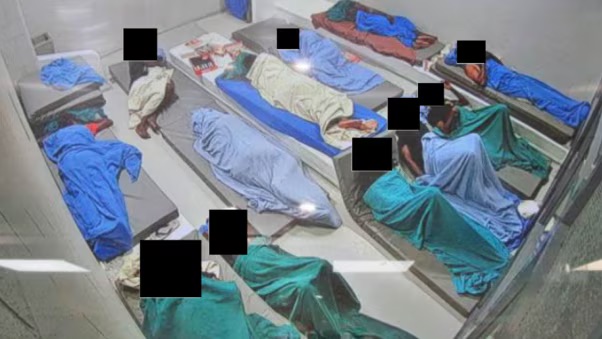
The report noted watch houses have been used as de facto prison cells since 2023 because of severe overcrowding in NT correctional facilities.
Family members also reported being unable to reach detainees or even confirm where they were being held. One partner said she immediately faced financial stress after her partner was taken into custody but was provided no information.
"I had no idea, we weren't allowed to call, we weren't allowed to obviously visit, and we weren't allowed to know [where he was]. His mother wasn't allowed to know, his father, just nobody," she said.
"That was the first time I had gone without [my partner]. I was a stay at home mum. I didn't have an income. I didn't know how to get into his finances. So I had a whole another situation on the outside of where the heck is [my partner] — just trying to get food in the fridge!"
NAAJA said the report confirmed what clients and frontline staff had been warning about for months. Chair Theresa Roe argued while some of the imagery might be "normal business for this government," it "should not be normal in any first-world justice system that claims to be fair".
"How would you feel if it was your child or family member sleeping on a mattress on the floor, shoulder to shoulder with fifteen other people, next to a filthy toilet that never stops flushing, under lights that never get turned off, for weeks at a time?" she asked.
"Our clients have told us about infections, lice, scabies, people losing track of days because the lights never went off, and the mental health harm of being stuck in a noisy, overcrowded cell with no fresh air and no space."
Incarceration rates in the NT have climbed sharply since the CLP took office last year. With the age of criminal responsibility lowered to 10 and bail laws tightened, more than 1 per cent of the Territory's population is now behind bars.
Almost 90 per cent of inmates are Aboriginal, and multiple reports have warned of extreme overcrowding.
.jpeg)
NAAJA CEO Ben Grimes said the report revealed the consequences of pushing an "ideological agenda without properly considering and planning for the implementation and flow-on impacts".
"When governments rush tough on crime laws through on urgency, tighten bail and increase penalties, but don't properly fund courts, interpreters, legal services, housing, supported bail accommodation, youth work, alcohol and other drug services and mental health, this is what happens," he said.
"People, including children, end up stuck in watch houses in unacceptable conditions for weeks because there is nowhere else for them to go. What we are doing now is clearly not working and it is costing taxpayers substantial amounts of money, setting the Territory up for failure in the future."
The Corrections Department accepted Ms Haack's recommendation to remove prisoners from watch houses, the report said, noting it is "committed to reducing reliance" on them.
Ms Haack issued 15 further recommendations for the "highly undesirable" scenario in which watch houses continue to be used for detention.
These included setting minimum standards such as dimmable lighting, access to clean drinking water, and ensuring detainees can shower, brush their teeth, and spend at least one hour a day outside their cells.
She also recommended that Corrections and NT Police report all instances of detainees being held for more than seven days over the next 18 months.
Corrections Minister Gerard Maley responded by blaming the previous Labor government's "neglect" for the conditions outlined in the report. He said the CLP would continue its tough-on-crime agenda.
"We make no apologies for restoring the rights of victims and the community and I've said many times, if you do the wrong thing, we will find you a bed," he said.



