


The country's only Indigenous co-owned medical imaging provider has marked a significant milestone for regional healthcare in Western Australia.
Spartan First Imaging has celebrated the installation of a Siemens Healthineers SOMATOM go.Top CT scanner at its Kalgoorlie clinic.
The investment would help deliver advanced, high-resolution diagnostic imaging to the expansive Goldfields region, while advancing a sustainable, community-first approach to care.
The installation represented a growing demand for high-quality, sustainable diagnostic imaging services in the Kalgoorlie region, where Indigenous and non-Indigenous communities face distinct healthcare challenges, compounded by the demands of a dense mining workforce and the prevalence of acute injuries and complex chronic conditions.
Spartan First Imaging invested in the SOMATOM go.Top CT scanner – a system purposefully selected for its advanced clinical capabilities and strong environmental credentials – to ensure local access to world-class imaging technology, without compromising cultural relevance or long-term sustainability.
Nuclear medicine practitioner Peter Tually told National Indigenous Times the scanner is "a first for the region, it is incredible technology for early diagnosis, particularly for cardiovascular diseases and also for lung scans and screening, for the mining sector and the general community".
"It is very high precision technology for lung scanning, and it is low (radiation) dose.
"Another feature of this scanner is that it is a world first, one of the most green CT scanners on the planet. It is fully battery operated and a first for Siemens-SOMATOM. It will soon be 100 per cent solar powered.
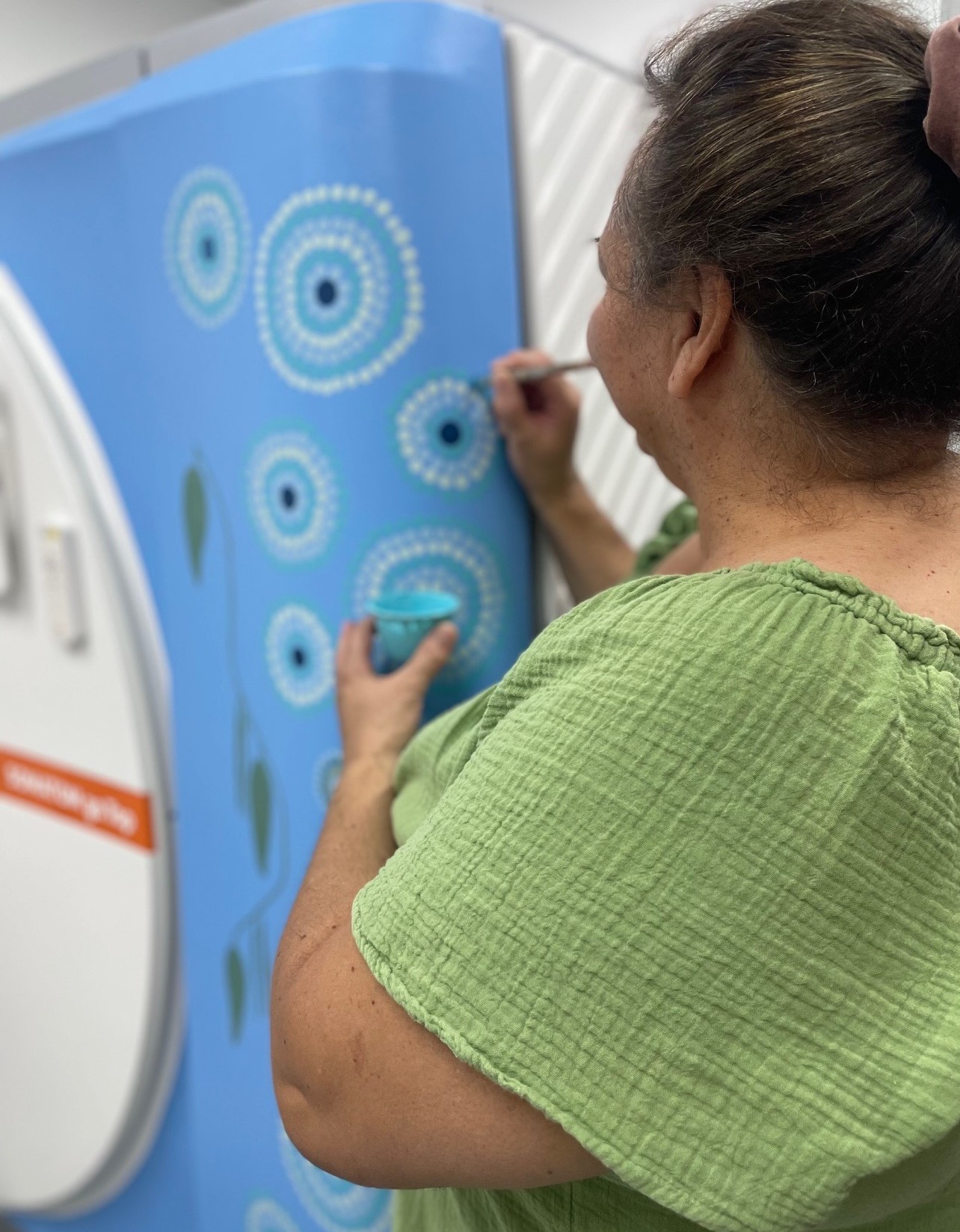
"Another major feature of this is it's the first time a CT scanner has been hand painted with an Indigenous artwork that will be showcased globally to promote culture. It was made by local artist Carol Thompson. It speaks of calmness and healing, the artwork, which is having a profound impact on our patients. Clinical scanners and the clinical process for some people can be confronting, and we have found the artwork is really helpful, particularly for our more anxious patients.
"We are hoping this will help attract more specialists to the region, new technology can be a pull factor for specialists.
"It is also an ultra-low dose scanner, very low radiation dose for our patients. It is brilliant to have this cutting edge technology 700km from Perth."
Spartan First director and chief executive Des Headland told National Indigenous Times it is an opportunity for Spartan to "enhance our capability in healthcare".
"It is a game-changer for our business in the sector.
The SOMATOM go.Top CT scanner delivers fast, low-dose, high-resolution imaging that supports early disease detection, efficient treatment planning, and improved patient outcomes, benefits t especially critical in rural and remote settings where access to specialist diagnostics is limited.
The scanner's advanced imaging capabilities also position Spartan in a significant position to support the future rollout of Australia's National Lung Cancer Screening Program, enabling timely and potentially life-saving intervention.
Beyond lung health, the system also played a crucial role in early detection of cardiovascular disease, one of the leading causes of morbidity and mortality in Australia, particularly First Nations people, where the disease occurs earlier and with greater severity.
The SOMATOM go.Top provided non-invasive CT coronary angiography (CTCA), offering high-resolution imaging of the heart and arteries that supported faster diagnosis and earlier intervention in communities where timely cardiac assessment could be lifesaving.
Adjacent to its clinical strengths, the scanner is among the most environmentally advanced CT systems available, delivering up to 58 per cent average energy savings during standard examinations, and 48 per cent lower detector power consumption compared to earlier-generation models.
The system also set a new benchmark for sustainability in diagnostic imaging, significantly reducing environmental impact while meeting the complex demands of rural imaging centres by being composed of up to 99 per cent recyclable materials
"It's a symbol of what's possible when healthcare is designed with community and culture at its heart," Mr Headland said.
"For many of our patients, especially those from Indigenous backgrounds, clinical environments can feel cold and unfamiliar and have historically been associated with illness rather than healing.
"In what we believe is an Australian first, we have incorporated contemporary Aboriginal artwork painted directly onto the scanner, we've created a space that feels safe, welcoming, and grounded in culture."
Mr Headland added the system and its design was also about providing a sense of dignity in healthcare.
"It's making sure every person who walks through our doors feels seen, respected, and cared for," he said.
Siemens Healthineers ANZ's Nathan Bamford said the installation marked a significant step advancing equitable access to care for all Australians, regardless of location or complexity of illness.
"Innovations like this show how technology and sustainability can work hand in hand to strengthen healthcare delivery," Mr Bamford said.
"We are committed to supporting providers in expanding access to advanced, patient-centred care by delivering intelligent, low-dose, high-resolution imaging systems with automated workflows that enable faster, more accurate diagnoses and treatment planning.
"We are proud to see our technology in action at Spartan First Imaging, where it is helping to transform healthcare in rural and regional communities—supporting clinicians in delivering earlier diagnoses and better outcomes for the patients who need it most."



