



Sabrina, which is not her real name, thought she was doing the right thing by taking her daughter to hospital following innocent injuries.
Soon after, it would mean her two two daughters were separated from one another, their mother and family.
"It was my daughter's fifth birthday. She had two innocent injuries, one from the boot of the car, another from a playground ride. The next morning, she had some swelling on her head, so, being what I thought was protective, I took my daughter to the hospital," she told National Indigenous Times.
"Despite my daughter consistently explaining what had happened and expressing that she was happy and safe at home, DCJ made up their own narratives and she never came home.
"At the time, I was in a DV situation, it was escalating but wasn't yet physical, and I was actively planning to leave, safely. When they intervened, they used this against me, made up a narrative that I had lied, that he had hurt her, even though there was absolutely no evidence to support their own lies.
"Despite the lack of substantiated evidence, interim orders were made under the narrative that I was unprotective because I had not seen the 'red flags'. They separated both of my daughters, from me and from each other, and from the rest of my family. "
Recent findings indicate a disproportionate number of Aboriginal kids enter out-of-home care - 10 times the rate of non-Indigenous children.
Less than half are reunified with their birth parents.
In New South Wales, the last decade has seen the number of Indigenous children placed in out-of-care increase by 48 per cent.
The state has a reunification rate of just 15.2 per cent according to AbSec - NSW's peak for Aboriginal children and families. It's the lowest of any jurisdiction across the country.
Research and data collated by multiple bodies and sources outline similarly extreme findings, and have done for years.
In their tenth annual family matter report SNAICC, a national peak, found Indigenous children make up 45 per cent of those in out-of-home care while only seven per cent were reunified with family, compared with 10 per cent of non-Indigenous children.
As of 30 June 2024, the Australian Institute of Health and Welfare (AIHW) outlined 20,000 Aboriginal and Torres Strait Islander children (50 per 1,000 children) were in out of home care nationwide.
AIHW also found 85 per cent of Indigenous children who were reunified with their family in 2022-23 did not return to out-of-home care in 2023-24.
Per 2025 Closing the Gap data, "Three in five Aboriginal and Torres Strait Islander children in out-of-home care continue to live with relatives, kin or Aboriginal and Torres Strait Islander carers", while "Over four in five Aboriginal and Torres Strait Islander children in out-of-home care have a cultural care plan, where required".
On Thursday, AbSec is due to launch new online resources to support First Nations families intertwined with the child protection system, resources designed to prevent experiences such as those endured by Sabrina and her daughters.
.png)
Know Your Rights has been built by and for Aboriginal and Torres Strait Islander people.
AbSec calls it a "groundbreaking" piece of information, support, advice, guidance and stories of live-experience "to equip families at critical moments".
"I needed to be strong for them and fight back."
Sabrina explained the impact her daughters' removal had and how Know Your Rights could have made a difference for them.
"The greatest harm our family ever experienced is from the system, from the case workers and everyone involved in the removal of my girls. It is really important to emphasise that when my girls were removed under interim orders, there was a safety plan in place. My Mum had agreed to live with me while he agreed to move out. But they still removed the girls," she explained.
"My whole family experienced deep grief and trauma.
"The grief you feel when your child is removed from your arms is as if they have died.
"With no one in the home, he returned. The court provided my evidence, a letter of support of my plan to leave him, and they just gave it to him. The DV escalated, I was physically assaulted, my life was threatened numerous times. I was scared and deeply hurting.
"I reached a point where I didn't think I could survive the grief. I attempted to take my life. I survived and that survival became the turning point. I realised if I was suffering this deeply, my girls must have been too. I needed to be strong for them and fight back.
"So, I gathered every bit of courage I had, and I left. I dealt with short term homelessness, leaving most of my belongings behind. I was grateful for the support of friends, family and community.
"I should not be here today, but I am, because of the love I have for my girls. It is the impact on them that drives me."
National Indigenous Times contacted the New South Wales Department of Communities and Justice for comment.
Sabrina says she was blindsided by her children being taken away.
"An Aboriginal Family Worker from an Aboriginal Organisation advocated for my family and the case for my youngest was transferred to another office with an Aboriginal case worker. After almost 3 years, my youngest was restored. We were not so fortunate with my eldest. She was never restored. After seven long years of waiting for her voice to be heard, she learned her own rights, she learned that if she wanted to be home, she could make that happen herself, that no one could physically stop her - she voted with her feet," Sabrina said.
"My youngest has no memory of being removed, but she remembers missing her sister, she would cry often for her. My eldest, she had to process all of her feelings that she had held on to for years. She was angry, she disengaged from school, from peers, teachers. She was suicidal. But now, she is healing, and she is starting to thrive. She is beginning to be a kid again - she is reclaiming her own story."
She continues: "When my girls were removed, I had been blindsided. I was naive, I thought I could trust that if I was compliant, if I did everything they asked, they would fix what they did and return my children. I was wrong.
"During an earlier contact visit with my girls, an Aboriginal case worker expressed how angry she was that my girls were removed, that this was a 'soft case', that there are kids that actually need help in more dangerous situations and they get ignored, that case workers take advantage of parents like me, and take their kids, because it was easy. I will never forget that."
"A few months after the case had begun, I decided to enroll in a Bachelor of Social Science, I wanted to understand how this could possibly happen, and how I could prevent it from happening with my girls if they become Mums one day. I have built on my personal lived experience with professional experience of the sector. Knowledge is power, and I needed to learn the system I was fighting."
Looking at Know Your Rights, Sabrina hopes the resource "will make a difference to other families going through this".
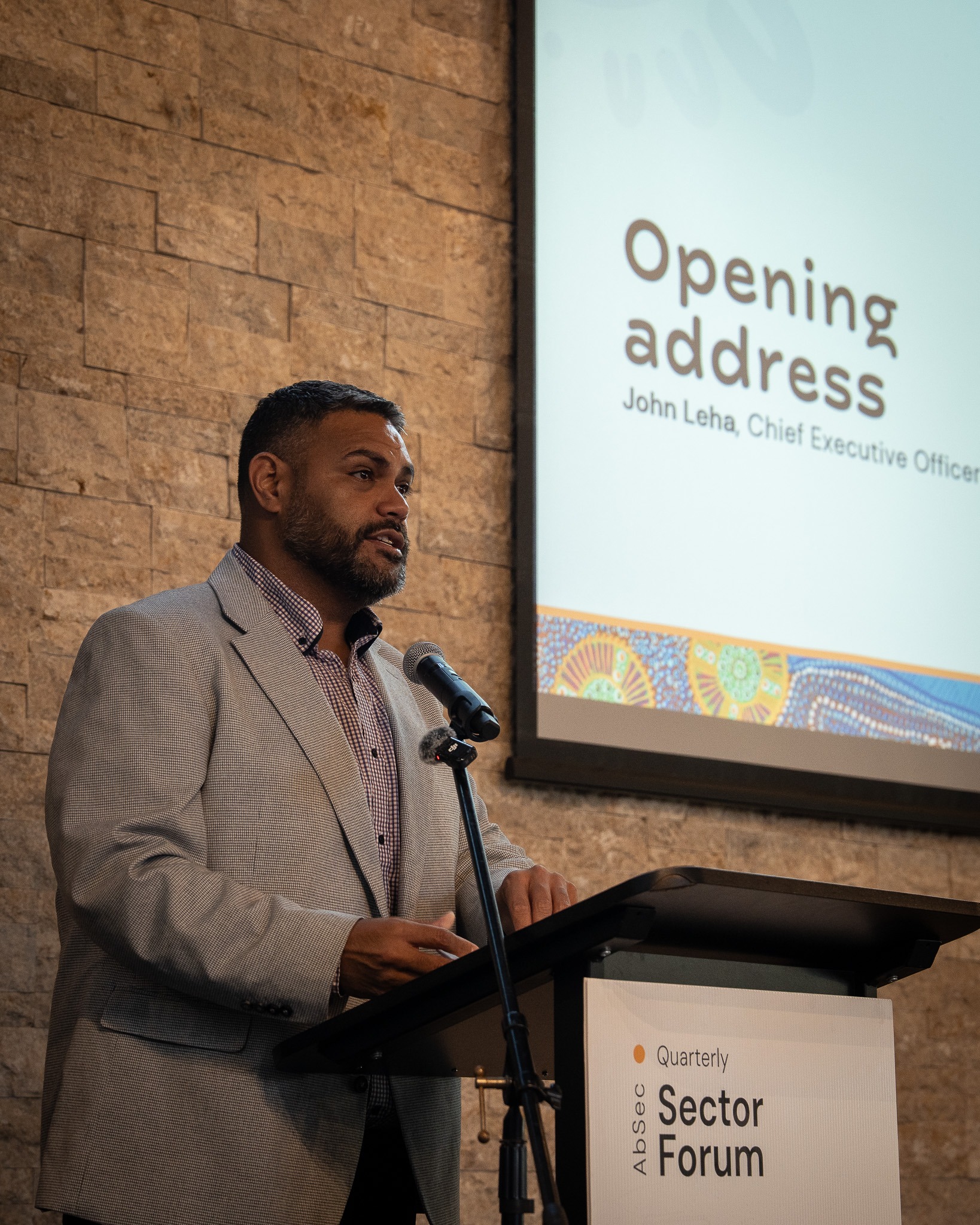
AbSec chief executive, John Leha, said the resource is a direct response to what families have been saying for years.
"Time and again, our families report being denied information about their rights and told they're powerless within the system," Mr Leha said.
"Know Your Rights changes that by empowering families with the knowledge, tools, and community voices they need to engage with a system that has disempowered them for too long."
The resources cover step-by-step explanations of what to do at every step, a family's options when there, with accompanying videos, and journals to put evidence into documentation.
"This site is for any Aboriginal parent or family who is worried about child protection involvement, as well as workers, advocates, ACCOs, and supporters walking alongside families," it reads online.
"I had no idea the rights I had, but I do now. And I really hope that Know Your Rights will make a difference to other families going through this. If I had something like Know Your Rights available for me back then, maybe, just maybe, my girls could have had more of their childhood protected from the system, they could have been raised together, and they would both carry less emotional scars from the many years that were taken from them," Sabrina said.
"My girls had the right to be raised together, and we had the right to be supported to be safe together. For anyone reading this, don't wait for someone to save you, don't wait for the system to change - it won't happen quick enough. Know your rights, learn the system, and make noise."
"The system targets Aboriginal families"
Held in Dubbo this week, AbSec's quarterly sector forum sees the launch of Know Your Rights.
It comes after collaboration between seven organisations — UNSW Social Policy Research Centre, South Coast Women's Health & Wellbeing Aboriginal Corporation Waminda, South Coast Medical Service Aboriginal Corporation, Illawarra Aboriginal Corporation, Aboriginal Legal Service NSW/ACT and the University of Technology Sydney — including the peak body.
UNSW's centre acted as lead research partner, while Waminda conceptualised the resource.
Since 2022, Aboriginal-led research project Bring Them Home, Keep Them Home, out of UNSW, has been developing a stronger understanding of challenges faced by Aboriginal families impacted by out-of-home care.
Know Your Rights is informed by their work.
Associate Professor BJ Newton leads the research.
"In Australia, Aboriginal children are 10 times more likely to be removed than other children. The system targets Aboriginal families, and once children enter care it is very difficult to get them back home," Associate Professor Newton said.
"Through the research we know there are many children in care that should not have been removed, and there are many families desperately trying to get their children home. Know Your Rights arms Aboriginal families and their supporters with the knowledge needed to navigate and the child protection system. It is one way to shift the power imbalance between child protection systems and Aboriginal families and communities".
Aboriginal Community-Controlled Organisations, local events and roadshows will help roll out Know Your Rights to community.
"Remember, that you are still their Mum, their Dad. No one can take that away from you. A piece of paper doesn't make you a parent," Sabrina said.
"Love your kids as much as you can, create memories, be consistent, stay strong, remember who you are, learn your rights, learn the system, understand your story and do what you can, so that you can fight for your kids. And never, ever give up."



