


Fifty Native Title holders from coastal regions including La Perouse, New South Wales South Coast and Eden met at Bingie, New South Wales, this month to discuss the South Coast Fishing and Diving Rights Class Action which, after a forty-year battle, is due to ramp up with new support of JGA Saddlers Lawyers, experts in class action lawsuits.
National Indigenous Times attended the gathering and spoke with Walbunja Elder Uncle Wally Stewart.
"We have been battling with fisheries for the last forty years. They have nearly destroyed our way of life, by ignoring our law and discriminating against our rights," he said.
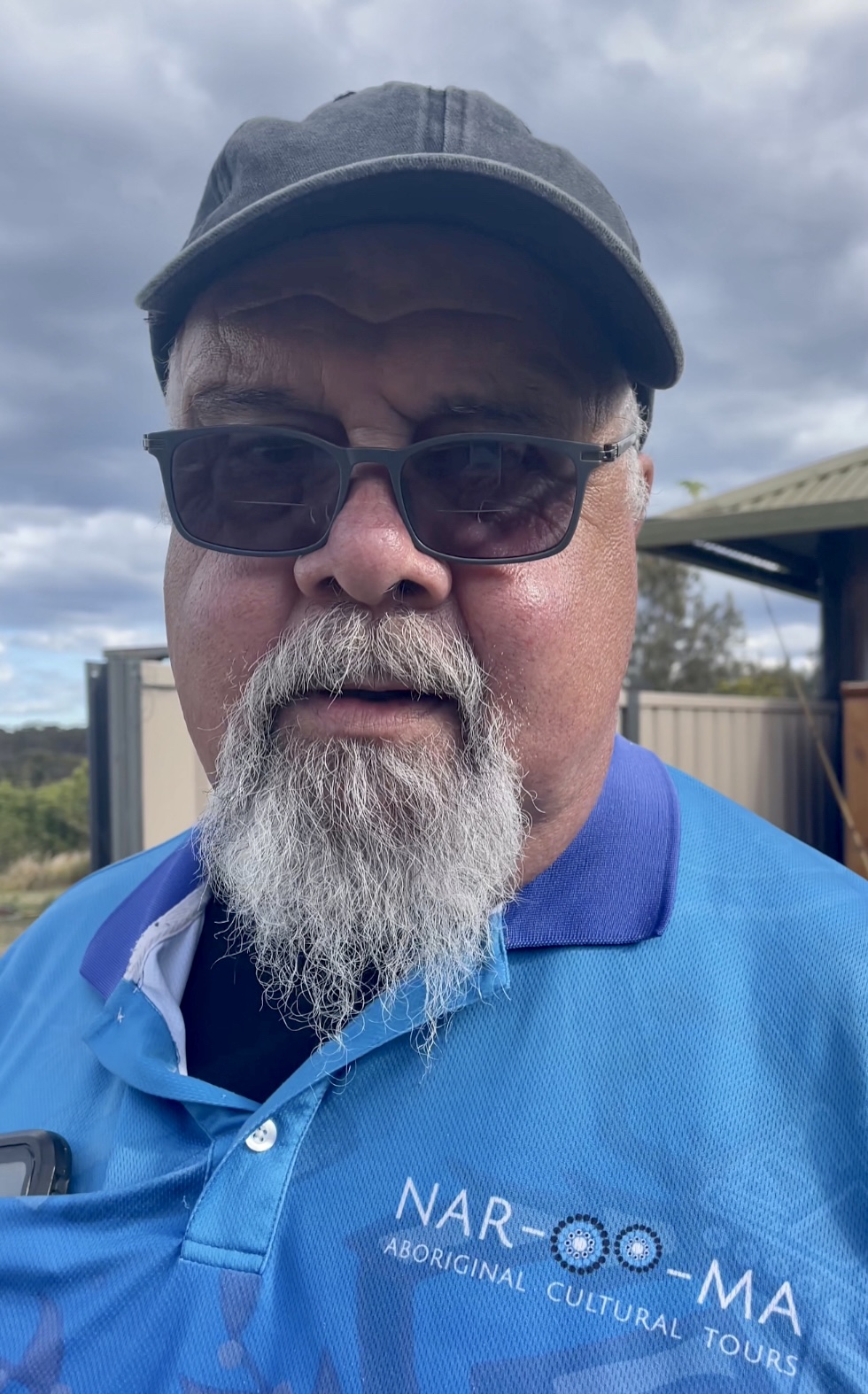
Uncle Wally Stewart in Bingie speaking with National Indigenous Times. (Photo: Jess Whaler)
Uncle Wally mentioned the infamous Narooma Lobster case four decades ago, in which lawyer Jim McCrudden said: "These Aboriginal people, they were living on these things for thousands of years, then all of a sudden our government said, 'Yes, you can have them, enough to feed yourself, but not your family. It seemed to me to be very, very unfair."
"People have been sent to jail, most people got their first criminal record from fishing. We don't see it as a crime we see it as our culture and our way of life" said Uncle Wally.
Uncle Wally is heavily invested in advocating for and supporting his community. He is involved in several sea conservation research projects with the University of New South Wales and with the DPI, and is currently working with local high schools exploring the concept of a Junior Sea Rangers program.
He provides education opportunities and hopes to build skills of youth to grow economic opportunities for his community and shared plans of cultural tours via a charter boat. He said he is already taking high school teachers and staff on ocean and sea cultural awareness activities.
"A lot of young people got their first criminal offence by exceeding bag limit while taking our traditional food," he said.
"it's been a real struggle to keep our culture alive."
Uncle Wally Stewart yarning with National Indigenous Times. (Video: Jess Whaler - National Indigenous Times)
Uncle Wally referred to the success of Mabo in 1992 and how the government was then required to amend the Fisheries Act '93 to accommodate the Native Title Act.
"(Section 211) gives us our rights to hunt and gather and fish which is Commonwealth Law that sits on top of the states. But fisheries NSW have ignored it for the last twenty years," he said.
"They have discriminated against us by ignoring that law and placing our people under the state regulations. So all those prosecutions for the last thirty years should never have been.
"It's very heavy handed how they police our people and enforce that law, some of our mob have tried to explain that they are native title holders and they are exempt from the Fisheries Management Act, but they choose to ignore it and still police our mob under their state regulations, but they have been misinformed."
Uncle Wally raised significant concern with the inability of Department of Fisheries officers, who are unable to identify a native title holder from another Aboriginal person, who might be visiting the country: "They don't get trained in that field they don't get trained or learn about section 211 of the Native Title Act."
A NSW Department of Primary Industries spokesperson told National Indigenous Times that Fisheries Officers undertake extensive cultural awareness training and are familiarised with the Native Title Act, whilst adding that: "NSW DPI recognises the cultural and spiritual importance of fisheries resources to Aboriginal people, who have been harvesting from and caring for the rivers and ocean for thousands of years."
"'Cultural fishing' is defined in the Fisheries Management Act as: "fishing activities and practices carried out by Aboriginal persons for the purpose of satisfying their personal, domestic or communal needs, or for educational, ceremonial or other traditional purposes, and which do not have a commercial purpose". The definition is consistent with the Commonwealth Native Title Act.
"The core role of NSW DPI Fisheries Officers is to monitor and protect NSW fisheries resources and the aquatic habitats that support them. Compliance action focuses on illegal fishing or activities harming or damaging aquatic habitat, not cultural fishing," they said.
National Indigenous Times asked Department of Fisheries if any psychometric testing was a requirement to determine suitability for an employee to undertake authoritative role that allows a person to deliver fines. This question remains unanswered.
As recently as 2018, a Yuin elder Kevin Mason was chased into the water and charged as he was practicing his cultural right, the disturbing was captured on video and released by ABC. NSW Government later dropped the charges in September 2022.
The NSWALC Chairperson at the time, Councillor Danny Chapman called for a Moratorium on Aboriginal and Cultural Fishing Prosecutions.
"The treatment of Mr Mason and other community cultural fishers across NSW is unnecessary and traumatic, and not in the spirit of the NSW Government's commitments to Closing the Gap," he said.
At the Fishing and Diving Rights meeting in Bingie, Uncle Wally spoke of the devastating impact this 'over policing' has had on community and how people have been sent to jail who were simply exercising their right to practice culture that was taught to them.
People are too scared to teach their kids to fish now, so there has been a significant loss of culture, he told National Indigenous Times.
"When some of these people get sent to jail, their families are breaking down while they're in jail. That's usually the breadwinner who feeds that family and the rest of the elders in their community. Then they come home with mental health issues."
Due to the loss of culture, diets have also changed which has led to higher rates of heart disease and diabetes, and they are missing the protein and iodine that is in fish and other seafood. This has been documented in the 2018 Aboriginal Fishing Values of the South Coast of NSW publication provided by the Australian Institute of Aboriginal and Torres Strait Islander Studies (AIATSIS).
"We're overweight because we can't do that fishing exercise. No one even knew what abalone was, it was just like bread and butter. It was part of our diet. You could just go for a walk around the lake type pick them up," he said.
Uncle Wally said that by allowing overfishing by commercial industry, the Department of Fisheries have "damaged our waters as well. They've destroying our reefs".
The individual bag limit for NSW fisheries is two abalone, for Aboriginal people the bag limit is 10 however: "Abalone industry's gone from 350 tonne down to 200 and now they're down to 100 and they call it sustainable."
Uncle Wally described how the practice of diving has been passed down and their connection to the locations.
"They weren't just places we go dive, they were handed down by our grandfathers," he said.
"We see today that 50% of our reefs and our native title boundary are destroyed, there's nothing there, the sea is barren.
"So when they go diving now there's no more kelp there and there's no more lobster, there's no fish there's nothing and it's all taken over by sea urchins.
"We're doing our project on these sea urchins now, measuring some areas and removing the sea urchins and then see if that kelp grows back, we can plant it. We are looking at restoring country again."
Uncle Wally said that through the Sea Country Plan, he hopes to continue to work side by side with the Government and research groups to fulfill community aspirations and look after the environment by continuing to build on partnerships that enable Traditional Owners to care for land as the core of best practice.
The NSW Department of Primary Industries spokesperson said there are plans to work with community and provide business opportunities.
"A new Aboriginal Fisheries Business Development Program is supporting Aboriginal community organisations and community-led businesses to develop three new economically viable fisheries businesses that provide a strong connection between Aboriginal communities and management of aquatic resources," they said.
"DPI Fisheries staff and project partners will work with the successful applicants, selected via an Expression of Interest process, to create feasibility studies and business cases for their chosen business, before helping them explore funding and investment options."



