



The innocent actions of an eight-year-old Arrernte boy falling out of a tree set in place the motions for a trailblazing life as one of South Australia's Indigenous heroes on the football field.
The consequence of the incident in 1953 altered the life of Sonny Morey's journey for the next seven decades that is best summed up by daughter Kim Morey-Hure in one of a series interviews to honour the AFL's Sir Doug Nicholls Indigenous Round honouree.
"I think the story of Sonny Morey is about strength and resilience, about commitment and determination, and just someone who wanted to succeed against all of the odds," she said.
But before the 79-year-old is paraded towards greatness in a state that resembled the ascension of Sir Doug Nicholls in Victoria, there's a sad, compelling narrative to tell first.
Morey recalls how he was born in a dry creek bed on Yambah station – nearly an hour's drive north of Alice Springs – and years later high above the same creek, he and his cousin would turn to climbing the river gums until Morey fell, badly injuring an arm.
That was that. Everything would change.
The welfare department of the time somehow "got wind they had this Aboriginal lad of mix race" was in danger living out of a telegraph station.
Effectively, the authorities forcibly removed Morey from his mother's grasp, never to embrace again, as he became another statistic of the Stolen Generations.
The law protected the intervention as the Aboriginal Children's Act of 1913.
"I just been dragged, taken away, and that was just another action carried out by the welfare and the system," Morey explained.
The next steps was totally foreign to the kid whose life had at that point revolved just around family, mob and the local Arrernte language, Aranda, of his people.
"In terms of our Aboriginal culture, it's a maternal culture, particularly when you are young," Morey said.
"The mums, the aunties and grandmothers rule the roost.
"So I believe I let my mother down and the worst part of that I never saw her again."
Morey didn't understand a lick of English, being one of a few thousand speakers of his Aranda dialect when first arrived at the St Mary's Mission hostel of Alice Springs.
What some of the authorities either didn't know or care that he didn't speak the same language of any of the other Aboriginal kids, leaving him feeling totally isolated.
"I can recall first day of going to the Alice Springs school where I was placed facing a corner because I didn't understand what the teacher was asking me," Morey said.
Coming into the orbit of government power, the South Australians who administered everything in Alice Springs before Northern Territory was given self-governance at a moment's notice sent Morey and others down to the St Francis hostel in Adelaide.
There by chance, Morey connected most notably with Charlie Perkins, Harold Thomas and John Moriarty, who later on all became strategic Indigenous luminaries.
While Perkins is largely known as an academic and most famously, a political activist, he also had an uncapped stint with Everton in the round-ball game after trialling with Liverpool and Manchester United, while Moriarty, a cousin of Perkins, went on to be the first Indigenous man to represent Australia in the same sport.
Thomas, who was also an avid footballer, became an artist who years later designed the Aboriginal flag.
That involvement with the trio opened Morey to the wider world, as did his adopted parents, Roy and Ada Maguire, and their three children, Maureen, Joan and Alan.
That coincided with a move to Gawler in Adelaide's northern suburbs where Morey would start a fitter and turner apprenticeship in the state's growing manufacturing hub.
Around that age of just 16, he was playing in his club's junior colts footy in the morning, and because of his innate ability to learn the game off his own back quickly, in the A grade games in the afternoon.
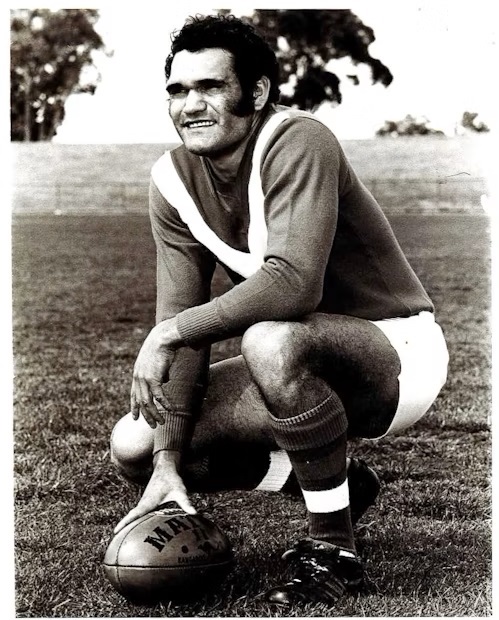
By the end of the 1961 season, Morey won both of the Gawler Central best and fairest awards that year, and unremarkably again the A grade in 1962 and 1963.
That was just before a new SANFL club, based in nearby Elizabeth, under the banner of Central District, joined the 1964 SANFL senior competition.
The teenager was ready, almost becoming an overnight sensation against iconic names of the local game in one of the nation's strongest Australian rules football leagues.
"Sixty years ago this year, I was first playing for Central District, I got the (the club's senior) first kick ever," he reminisced about his famous role in the Bulldogs initial history.
"I kicked it and it would have been a goal if it wasn't for a (opposition) back pocket marking the ball on the line."
From that point, the hype of one of just a handful of Aboriginal regulars playing in the SANFL would remain through to his last performance for the Bulldogs in 1976.
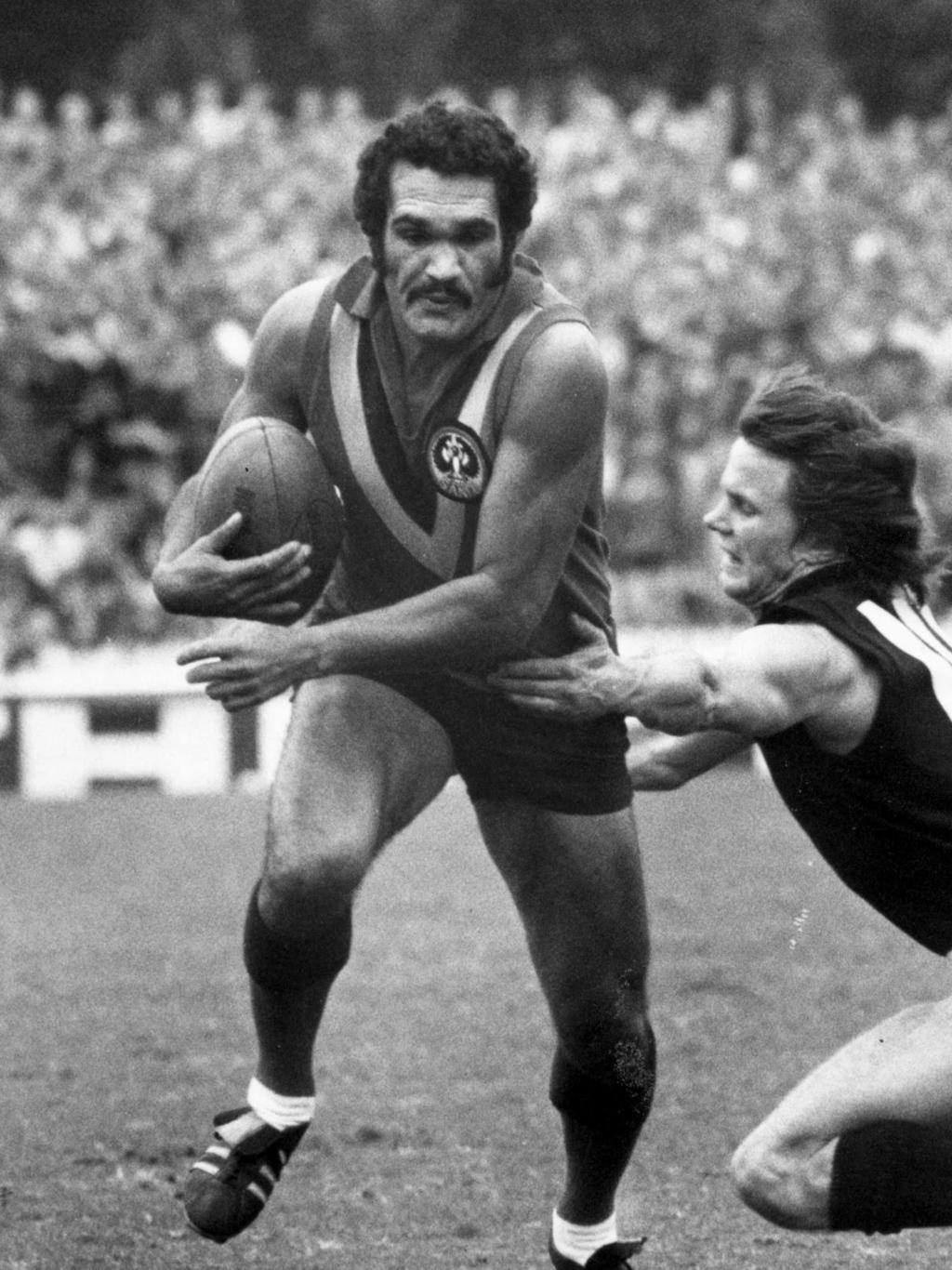
Those who watched Morey's football career play out marvelled at his sublime skills, deft balance and blistering speed, but also a penchant to graft hard against the stars of the South Australian game.
Perhaps Morey's most memorable performance was representing the Croweaters against Victoria and in his later years when he switched from a silky half-forward flanker into a resolute but rebounding back pocket player against Leigh Matthews after state coach Michael Patterson told his charger to play his natural game on arguably footy's greatest player in the making.
"The result of that was Leigh Matthews didn't kick a goal and never got a kick on me," Morey said.
That hype, for two watchful Aboriginal prospects, lasted longer than just the 14 years of his time at Elizabeth.
It lasted a lifetime and still does, Sydney Swans great Michael O'Loughlin, who idolised Morey's Centrals' teammate Wilfred Wilson, who in turned idolised Morey, will vehemently argue.
"You're talking legend status, the icon of the North – that terminology fits comfortably well on Uncle Sonny," O'Loughlin said.
O'Loughlin started his senior career at Centrals before Sydney drafted the Kaurna and Ngarrindjeri man in the 1994 AFL draft, but he said that Morey was the player any young Aboriginal hopeful of his generation or earlier wanted to be like.
Nevermind that the future AFL Indigenous Team of the Century member was only born in the year of Morey's farewell season.
"He was one of the first pioneers when Centrals joined the league, SANFL – he was in that team," O'Loughlin said.
"So when you're a young kid and you see someone who looks like you, plays like you, well, you form a connection."
He could relate directly more with Wilson – nicknamed Wilbur to acquainted fans of the SANFL – as his uncle by blood during O'Loughlin's formative years.
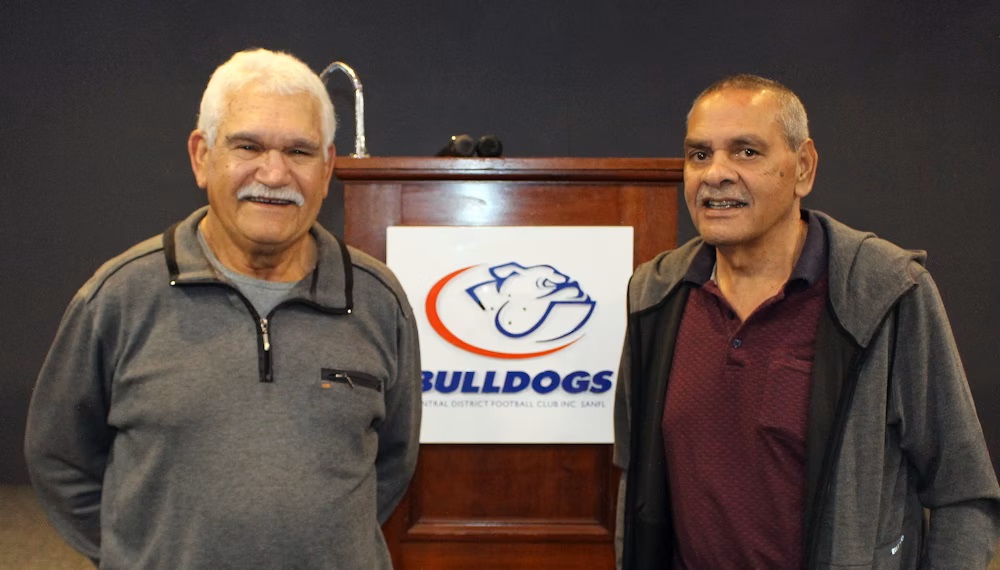
A complete decade after debuting, Morey found an ally on the ground in Wilson, who admits the very mention, the very thought of his absolute childhood hero "gets me all emotional".
Even an entire 50 years on, fidgeting around and nervously recalling what Morey had done for Wilson, the emotion was brimming out like their first encounter at Elizabeth Oval.
"When I first seen Sonny, I was a bit intimidated, by the fact just that there was Sonny Morey in front of me," Wilson said.
"He was an Aboriginal bloke that has done just so well, and I was an Aboriginal bloke aspiring to do just as well."
They were admiring teammates for just the four seasons until Morey passed on the proverbial torch for Wilson to carry the legacy at their proud club.
That included carrying the fight against the scourge of racism on both sides of the fence.
The respect at Central District for the cult figure was so great that before Wilson's time, some rival clubs back in the 1960's would not allow Morey to attend post-match functions and invariably teammates, administration and supporters of the working-class club would routinely walk out in protest.
"Where I've come from and what I have been through, I wanted to open up the gates for what was to come in the future," Morey said of future Aboriginal talent to play for Centrals.
"I wanted to leave a legacy so they can look up in the future," pointing off into the distance towards the club's bar, "if they go into the Sonny Morey Lounge, they can see what did this bloke achieve and how did he get to this point in time."
The SANFL Hall of Fame member was always creating history, including the first-ever Bulldogs player to pass 200 league games for the club.
Morey returned to the club in 1981 to become the Bulldogs' first Indigenous coach in the under-17s where the kid from an outback station mentored that first premiership, nurturing a number of his once-proteges to turn out to play in their Centrals' maiden senior premiership in 2000.
"He basically didn't have to say anything or preach to anybody; just his presence had highlighted the respect we had for who he was," O'Loughlin said from what he witnessed on the outside.
"Being a proud Aboriginal person, people recognise that in Sonny, playing footy and making a contribution to his club."
Morey was held in such high regard in many quarters that the South Australian Police Force even recruited the champion footballer to become a 'special constable' to visit Indigenous communities, including his own mob in Alice Springs when the state was in charge of the Territory.
"We didn't see too many Aboriginal or Torres Strait Islanders in the police uniform – not where I grew up – but he played a powerful figure there, really making sure that we were okay," O'Loughlin said.
Morey never believed he was on duty to rule over troublemakers.
He wanted to unify his people, not cast an iron fist.
It was a beat of a difference.
"The key really was to help people and give them some guidance, some understanding of what can we do as a group of people to get us working towards the same purpose," he said.
Morey-Hure, one of his two daughters, said being honoured in the game's national competition in one of the AFL's two Indigenous rounds was possibly her dad's proudest moment.
"I think for dad, he was a trailblazer in many ways of his life, but also in footy where he played South Australian state football and, at one stage, he might've been the only Indigenous (man) that was a coach in a league club," she said.
"I think it's a really nice acknowledgement of what he has contributed to football, but also to the broader community.
"To have dad's name in the same sentence as Sir Douglas Nicholls is pretty fantastic and we're very proud."



