


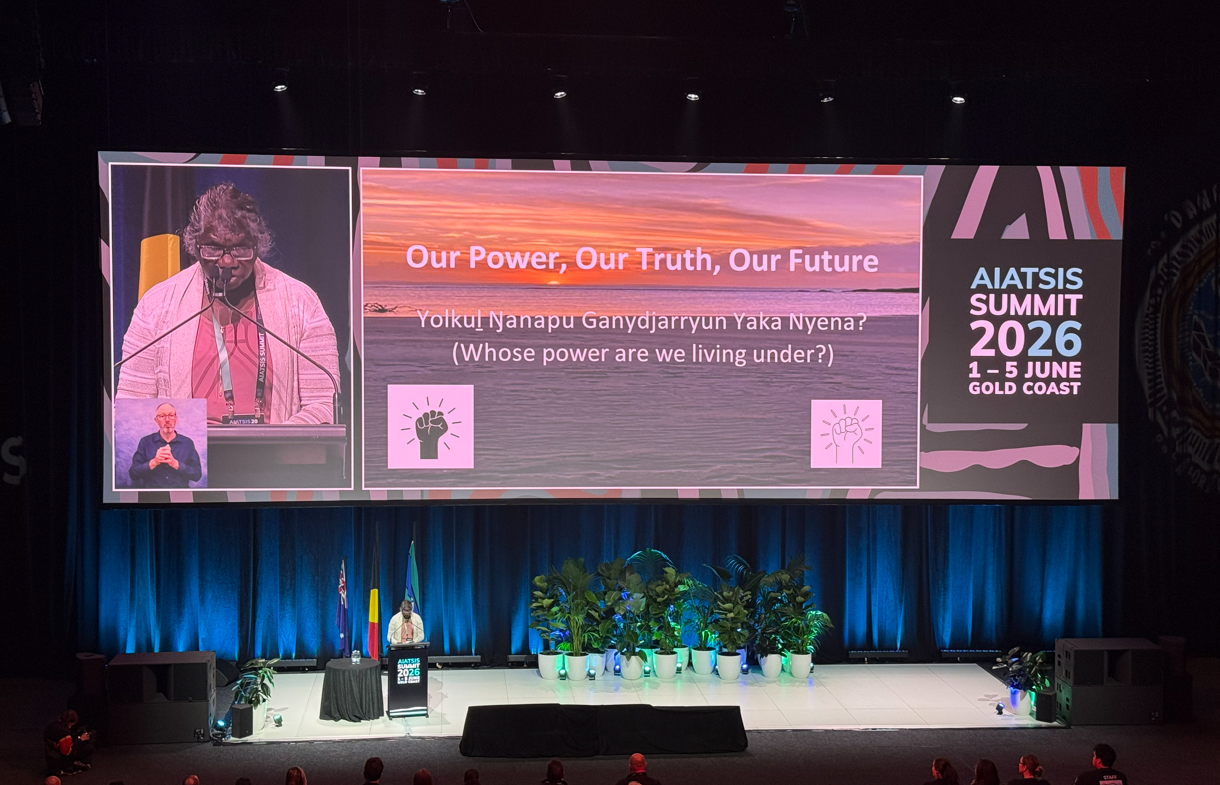
The AIATSIS Summit on the Gold Coast has heard from Yolŋu leader Professor Yalmay Marika-Yunupiŋu, who drew on language, culture and lived experience while speaking about truth, power and shared responsibility.
Professor Marika-Yunupiŋu, from Northeast Arnhem Land, delivered a keynote address on Tuesday as part of the Summit's education-focused program, alongside Mx Shas Jurud.
The 2026 Summit theme, Our Truth. Our Power. Our Future, was used by Professor Marika-Yunupiŋu to speak about the need for people to understand and respect each other before decisions are made.
Her address centred on the idea of walking in two worlds, a long-held part of Yolŋu approaches to learning, leadership and responsibility.
Professor Marika-Yunupiŋu used ŋathu, the cycad palm and its fruit, as a metaphor for the care required when knowledge, power and responsibility are handled.
In Yolŋu culture, ŋathu belongs to the Yirritja moiety and carries cultural, spiritual and physical importance.
Its bright orange fruit can sustain people, but it is also poisonous if it is not prepared through the right process.
Professor Marika-Yunupiŋu drew on that knowledge to show why policy making must also follow proper steps.
Her point was not simply that ŋathu can be made safe, but that cultural knowledge comes with law, responsibility and patience.
Professor Marika-Yunupiŋu's message to the Summit was that power can become harmful when people rush, ignore process or fail to respect the knowledge systems already in place.
When handled properly, she argued, shared decision-making can support fair outcomes for everyone.
Professor Marika-Yunupiŋu has spent more than four decades in education, including as a teacher linguist at Yirrkala Bilingual School, where she worked before retiring in March 2023.
The University of Melbourne's Indigenous Knowledge Institute describes her as a Yolŋu leader from Northeast Arnhem Land, an Indigenous Knowledge Fellow, and the 2024 Senior Australian of the Year.
Speaking to National Indigenous Times, Professor Marika-Yunupiŋu said the recognition reflected the work of her community and the importance of language.
"It was a very good acknowledgement for the work that I do for the community but also for the education," Professor Marika-Yunupiŋu said.
"Good acknowledgement for me but also to keep our language and culture strong because we teach Yolŋu Matha at the school and still today."
Professor Marika-Yunupiŋu is known for her work in bilingual education, and was named Senior Australian of the Year in recognition of her lifetime contribution to community, education and language.
Her work at Yirrkala Bilingual School helped keep Yolŋu Matha at the centre of learning, alongside English, through a two-way model.
The model begins with young children learning mainly in Yolŋu Matha before gradually increasing the use of English through schooling.
Professor Marika-Yunupiŋu said that approach came from Elders and remained tied to identity.
"Important about the two-way learning is because we have language and culture," she said.
"We bring to the school and it was our elders who wanted our school to be a bilingual school."
"We say thank you to them, for keeping us strong, keeping our language strong, and our identity."
Her keynote connected education work to broader questions of power at the Summit.
The central point was that Indigenous knowledge systems already hold processes for balance, responsibility and shared decision-making.
Professor Marika-Yunupiŋu said the staircase model used at Yirrkala showed how both languages could be taught with structure and purpose.
"Staircase model is how we change the languages when we are teaching in the classroom," she said.
"So it starts up from preschool. We teach preschool 90 per cent Yolŋu Matha and 10 per cent English right up to secondary year 12."
"In year 12, it changes. There we teach them 90 per cent English and 10 per cent Yolŋu Matha."
Professor Marika-Yunupiŋu's address brought her life's work in education into the Summit's wider discussion about truth, power and future decision-making.
Her message placed Yolŋu language, women's authority and cultural process at the centre of how fair outcomes can be built.



