


Australia is once again feeling the sting of global conflict at the petrol pump. A fast‑escalating war in the Middle East has pushed crude oil back above US$100, and in a country almost entirely dependent on imported fuel, the consequences arrive quickly and hit hard.
In the first days of March, average petrol and diesel prices sat at around 181 cents per litre. Within a week, as shipping through the Strait of Hormuz tightened, they surged above 200 cents, with early signs of wholesale rationing.
While price spikes are not new, this one lands differently. It exposes a structural weakness we have spent a decade building: Australia's addiction to heavy, fuel‑hungry SUVs and utes. These vehicles dominate driveways and car parks from Perth to Penrith, yet they expensive choices beholden to global energy markets. The question, then, is not just whether oil markets are stable. It is whether our household budgets are.
The Strait of Hormuz carries around 20 per cent of the world's traded oil and 25 per cent of global gas LNG. When conflict involving the US, Israel and Iran intensified, tanker insurance was withdrawn, producers trimmed output, and freight queues surged. Brent and WTI crude jumped into triple‑digit territory almost immediately — a replay of 2022 but faster, deeper, and more geopolitically complex.
Australia watched the price boards change in real time. For households, the pain is not theoretical. It is a direct, measurable increase in the cost of kilometres — and kilometres are how Australians actually buy their transport.
The car market we created is not built for fuel shocks. The Ford Ranger, Toyota RAV4 and Toyota HiLux were Australia's top three selling vehicles in 2025. Passenger cars barely featured. What dominates instead is weight, bulk and status: utes and large SUVs that often exceed two tonnes before passengers or cargo - and predominately used in urban settings.
These vehicles may offer comfort and the appearance of rugged capability, but most spend their lives crawling through urban traffic at less than 40 km/h — the worst possible operating environment for fuel efficiency. Australia's big‑car lifestyle was manageable when fuel was cheaper and geopolitics relatively stable. It becomes an economic liability when war threatens global supply chains.
The numbers didn't lie — even before the oil shock. A seven‑year ownership model (15,000 km per year) compared four popular vehicles: the Toyota Camry Hybrid, Toyota bZ4X EV, Ford Everest V6 and Toyota Prado GX. Before the latest surge in global oil prices, the difference in lifetime costs was already striking. The large diesel SUVs were dramatically more expensive to own than the hybrid or the EV, with higher fuel use, higher servicing, higher insurance and higher depreciation.
.png)
When broken into yearly components — fuel, insurance and registration, servicing, and depreciation — the contrast becomes even clearer. Households embracing large diesel SUVs are paying for weight, height, and marketing long before they pay for fuel. And when they do pay for fuel, they're exposed to every bump in global oil markets - noting Australia does minimal levels of oil and gas exploration to be self-sufficient.
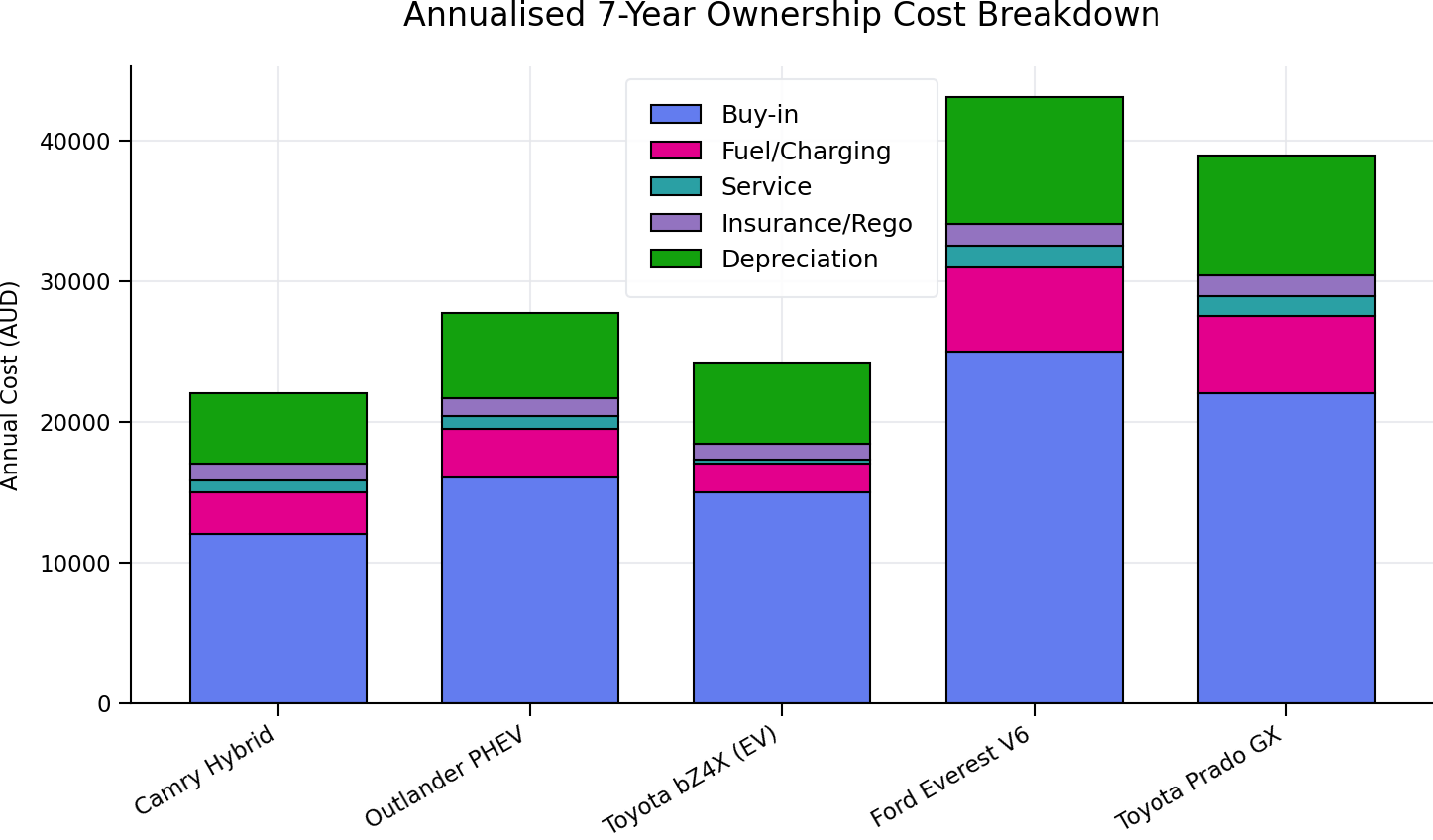
Figure 2 — Annualised 7‑Year Ownership Cost Breakdown.
Australians often justify large vehicles based on capability, safety, towing or the "once a year" holiday. But economics works on distance, not aspiration. Converting total outlays into cost per kilometre exposes the structural inefficiency of diesel SUVs over time.
The hybrid stays at the bottom of the cost curve. The EV closes the gap quickly as charging and maintenance savings accumulate. The Everest and Prado remain the most expensive options every single year, jumping sharply in Year 7 when depreciation crystallises.
.png)
What happens when oil really jumps? A warning from the future from two scenarios applied to the seven‑year ledger: Scenario A (+25 per cent petrol and diesel) and Scenario B (+50 per cent petrol and diesel, +15 per cent electricity). The Everest V6 adds $6,700 in Scenario A and $13,400 in Scenario B. The Prado GX adds $6,025 and $12,050 respectively.
The Camry Hybrid rises only modestly; the bZ4X EV barely moves. In a world where conflict can spike oil prices 20-30 per cent in a single trading session, this is not a theoretical model. It's a preview.
A cost‑of‑living issue we created ourselves and which we can control - our choice. Australian households consistently rate cost of living as their number one concern. Yet for five years we have been choosing vehicles that increase our vulnerability to global price shocks — often by $30,000 to $60,000 over seven years compared with more efficient options. The most expensive household cost can be the one in the driveway.
Bottom line: irrational choices have rational consequences
One narrow waterway on the other side of the world can move global prices by a quarter in a day. In such a world, buying a heavy diesel SUV is not a hedge against uncertainty — it is exposure. Choosing a hybrid or EV is not about virtue; it is about insulation, predictability and household security.
James Reynolds is a Waanyi Gangalidda person from the Gulf of Carpentaria and founder of Mirabou Energy, a Supply Nation registered business. He has more than 23 years' experience in Australia's energy markets and infrastructure services industries.
Mr Reynolds is also a member of the Investment Advisory Committee to the Clean Energy Finance Corporation (CEFC) Board on the Rewiring the Nation Fund, and a member of the Transaction Advisory Committee to AEMO Services Limited on Commonwealth Capacity Investment Scheme Tranche 4 and 5 and NSW Long Duration Contract Tender.



