




The head of the national voice for Aboriginal and Torres Strait Islander children says curfews should not be part of the policing tool kit, as criticism over the latest Alice Spring lockdowns begins to take hold.
On Monday, the Northern Territory Police Commissioner enacted a three night curfew in Mparntwe/Alice Springs, after four off-duty police officers were allegedly assaulted on Sunday morning.
It is the second time this year a curfew has been enacted for the town, but unlike the one in March, this will encompass everyone, not just youths.
It has been able to be enacted after the NT government introduced controversial legislation in May to enable the easier implementation of curfews, describing it as a "common sense plan to reduce crime and anti-social behaviour".
On Tuesday, SNAICC chief executive Catherine Liddle said he was disappointed the curfew had been implemented in the town and argued "punitive measures" were not sustainable solutions for community or child safety.
She said the terms "circuit breaker" - used to describe the lockdown in March/April - and "lockdown," were getting mixed up.
"The April Alice Springs curfew was a circuit breaker, not a solution," the Arrernte-Luritja woman said.
"Experience from then showed many families were crying out for support.
"A focus on investing in family and children during the early years is an approach that works and can turn the tide for communities like Alice Springs."
She told Guardian Australia that everyone needed to be looking at "sustainable solutions," which has been articulated at a meeting organised by the NT and federal governments in April.
"SNAICC said at the time this meeting should have been the first step in designing community-led solutions to issues that have been decades in the making. This does not seem to have happened," Ms Liddle said.
"Concerns were also raised at the meeting about how $250m, plus another $48.8m in federal funding commitments was hitting the ground. There seems to be a lack of transparency and accountability to the community."
Liddle was adamant that there is "no evidence that snap curfews like this work", and told ABC News Breakfast that during the circuit breaker lockdown, there were support workers on the street, with efforts made to ensure families had somewhere to go when they needed help.
"What [police] found during that period of time was that every child that they came into contact with had a family who said, 'thank you for coming, let's talk to you about what we need to do to help our children,'" Ms Liddle said.
"That was the responses that needed to be invested in."
SNAICC have been advocating for more help, with Ms Liddle arguing the organisation has "raised the need for community-run child and family hubs to deliver early education and care," to support older children to access school and education, as well as "connect to other services such as accommodation, therapeutic care, finance, employment, return to country, DSS and other supports".
"This would be a game-changer for struggling families," Ms Liddle said.
"Getting children and families the support, they need to thrive and be safe is what will make the change now and into the future."
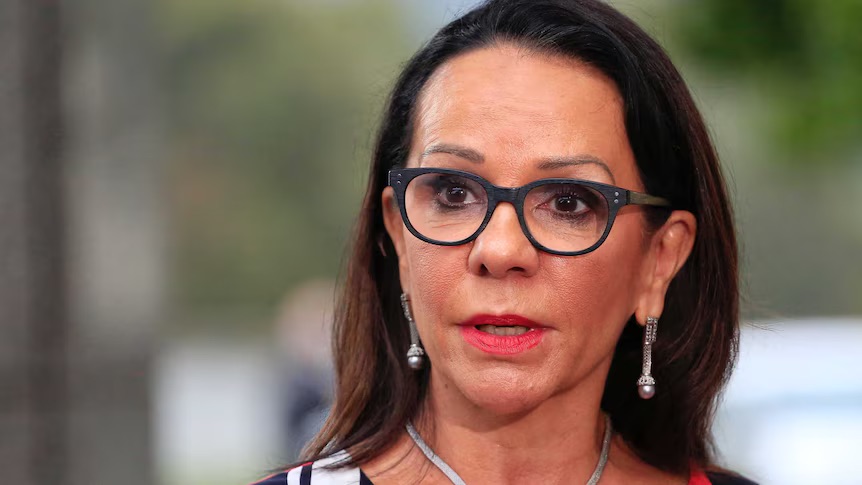
Minister for Indigenous Australians, Linda Burney said politics needed to be left out of the discussion in Alice Springs and said her government was providing long-term funding to address the systemic issues.
Appearing on ABC News Breakfast, the Minister stated: "I always try to put myself into the shoes of people involved in the situation".
"And if you imagine you're a 15-year-old Aboriginal person in Alice Springs living in shocking conditions where the poverty is absolutely grinding and you can't see a future, probably with FASD [Fetal alcohol spectrum disorder] condition then they're the shoes that we need to stand in.
"I think the really important thing is to take the politics out of this."
Burney said that whilst the curfew was "important," it was not the "be-all and end-all".
"You can't arrest your way out of this," she said.
"The judicial system is not the answer, but the community working with government is the answer. And that's very much the way in which I'm pursuing the issues."
The shadow minister for Indigenous Australians, Senator Jacinta Nampijinpa Price, spoke from Alice Springs on Tuesday, and echoed what she said on Monday, telling ABC News Breakfast that curfews are "really only temporary measures".
"A lot of the kids that are on our streets – I think I've been arguing for some time now that we need boarding facilities built for these kids," Ms Price said.
"The Yipirinya School [where Price's mother, Bess, is on the staff], the Elders from that school, have been calling for boarding facilities so that they can assist in the lives of these kids. These kids come from town camps and they're some of our most marginalised.
"We need to look at the problem starting with them before they head down the road toward incarceration and the sorts of behaviour we're seeing carried out on our streets."
It was revealed despite initial reports believing the people who allegedly attacked the four off-duty police officers were youths, the majority were adults.
The senator said she expected the curfew to extend beyond three days.
"I think it will probably be longer than three days. And if it is just three days, I have no doubt there'll be another snap curfew, because the underlying problems aren't fixed through a curfew," Ms Price said.
On Monday, Police Commissioner Michael Murphy said if he believed there was a need for an extension to the 72-hour curfew, he would be "writing to the [police] minister about the reasons why I think that should occur".
New legislation means the minister will decide before any extension takes place.



