



When the National Gallery of Victoria unveiled their inaugural Indigenous Fashion Commission, the fashion world's jaw collectively dropped.
The couture dress with masterful draping and a beautifully weaved bodice was modelled on Awabakal model Charlee Fraser.
The piece by director and founder of Maara Collective, Julie Shaw, was a one-of-a-kind.
Drawing inspiration from the Golden Age of Couture and the likes of fashion houses such as Balenciaga and Givenchy in the 1950s, the Yuwaalaraay designer immediately wanted to create something similar with an Australian, First Nations flair.
However, Shaw's journey to the magnificent gown spans the lengths of the continents.
As part of Melbourne Fashion Festival, Shaw sat down with the Curator of First Nations Arts at NGV, Southern Kaantji and Umpila woman Shonae Hobson to discuss the two years in the making of this dress.
It was here Shaw said her inspiration really came from a photo shoot with woven hats.
"We did a shoot with Aboriginal model Kiesha Bovill and for one of the shots she just held the hat right against her chest," she said.
"And the woven fronds came sweeping over her shoulder.
"I certainly remember in that moment looking at that and seeing the photos and going it would be incredible to have a woven dress and I just had that vision in my mind."
Having previously worked with artists at Bula'bula Arts, Shaw was especially interested in weaving from Arnhem Land.
She first travelled back to Yuwaalaraay Country, Lightning Ridge in New South Wales to work with her father to create metal wire frames to hold up the bodice.
Altogether, seven metal frames held up the bodice.
"There's a process of deconstruction and reconstruction and then hand stitching all the panels together together with the template," Shaw said.
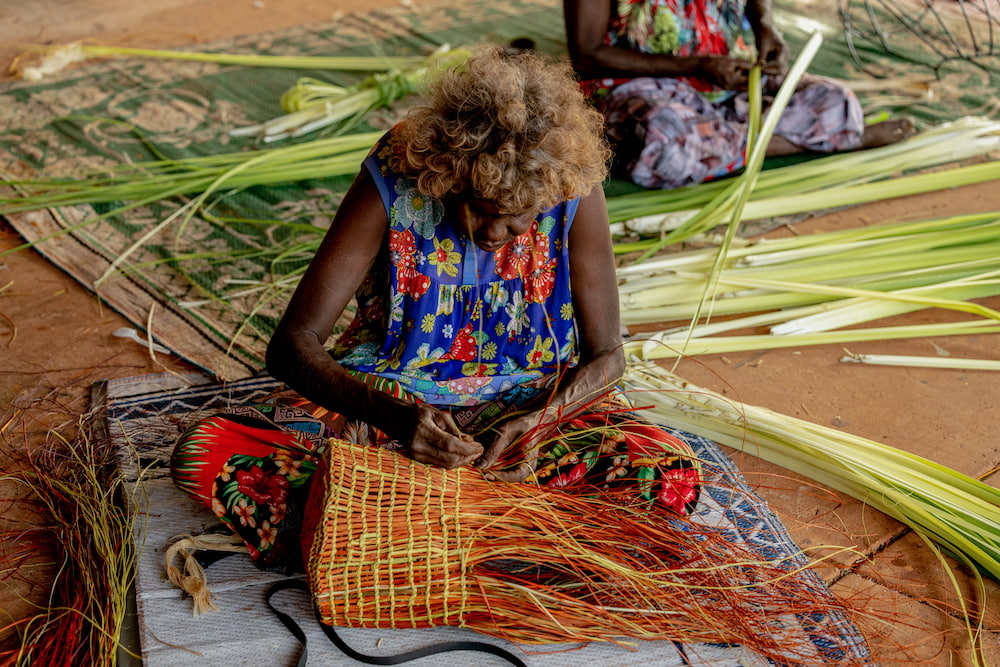
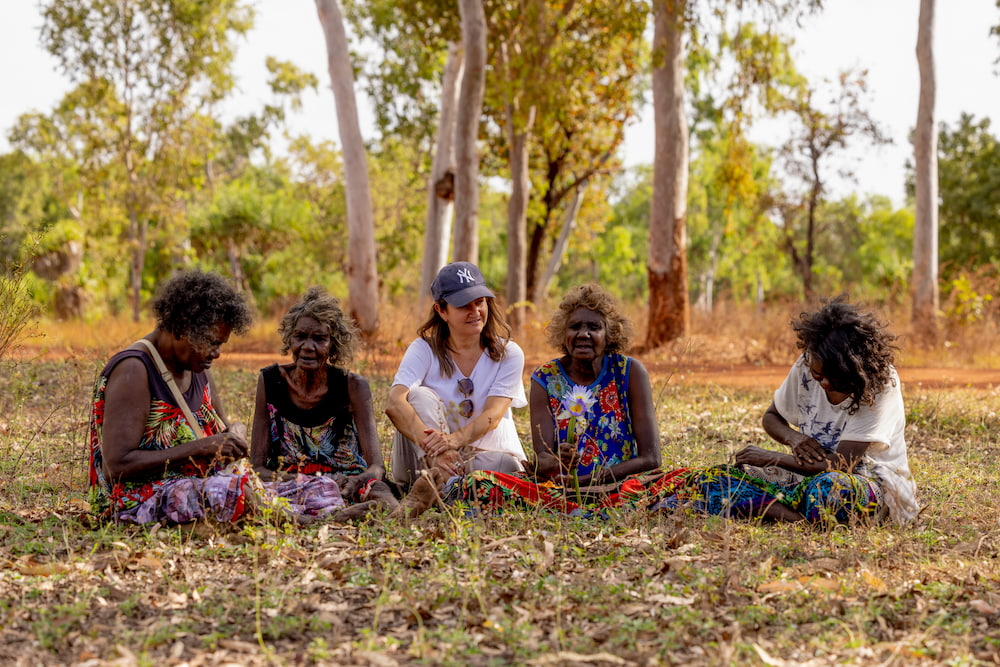
From Lightning Ridge, she travelled to Northeast Arnhem Land to work with the artists themselves.
She spent some of the dry season in July with the artists harvesting materials, sourcing natural dyes and talking through sketches, fabric swatches and inspiration.
Once the bodice was put in place, Shaw travelled to Boorloo (Perth) to work with master draper and former Alexander McQueen pattern maker Alice Cliff.
"We spent about three days in the apartment just draping fabric onto the mannequin," Shaw said.
"Both of us were hands on draping, hand-stitching and creating a new shape, but also figuring out how the model would fit into it and how'd they'd close it up.
"At the end of the three days I packed it all up on the plane with me because I was terrified someone would lose it."
After a trip around Australia the piece was finally coming together.
For the final touch, Shaw paid homage to the Bula'bula artists in couture tradition.
"There is a bit of a tradition in couture where they would embroid the name of the maker inside the bodice and also where it's made," she said.
"And I thought I'm going to do that here and I had them hand stitched into ribbon and hand sewed them on the inside.
"It's kind of speaking to the actual process but also acknowledging and making sure that they are always credited.
"It is country meets couture and I see the weavers as the couturiers and Country as their atelier."
The artists involved in this partnership are Evonne Munuygu, Lisa Lalaywarra Gurrulpa, Serena Gubuyani, Mary Dhapalany and Margaret Djarbalarbal Malibirr.
The gown is currently on display at the NGV.



