




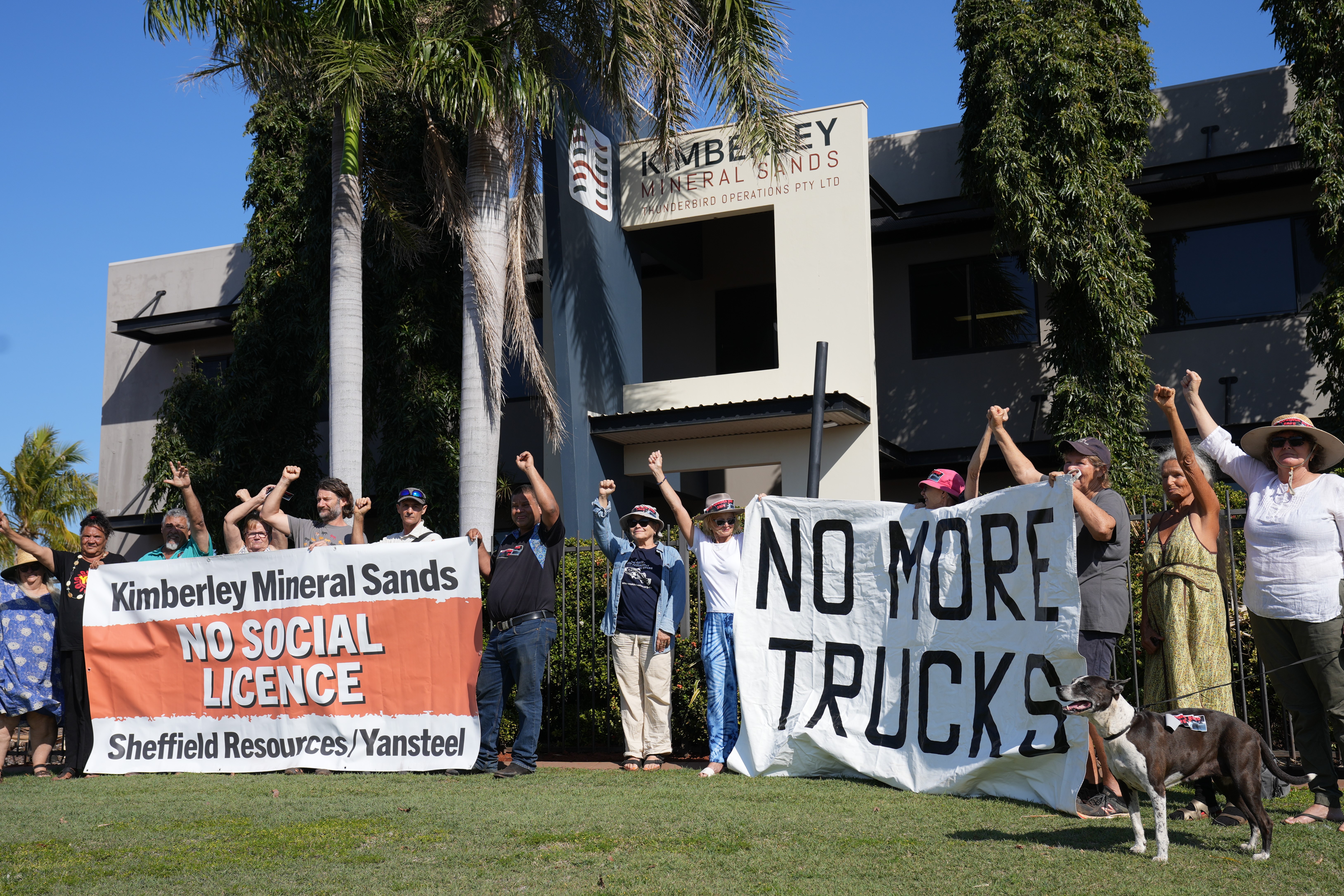
Traditional Owners and other Kimberley locals protested outside the office of Kimberley Mineral Sands Wednesday morning, voicing their concerns over the management of the Thunderbird mine project.
Nyikina Mangala Traditional Owner Rosita Shaw told National Indigenous Times the company was not being supportive of Traditional Owners or operating in the spirit of their agreements.
"Part of the co-existence agreement (between the company and Walalakoo Aboriginal Corporation) is helping us with the contracts, but we have been putting in for tenders as Traditional Owners and they keep knocking us back, and have been giving contracts to non-Indigenous contractors, and to some people from the Pilbara and Goldfields area. We keep putting in a lot of work to put in the tenders," she said.
"They are on our own traditional land and we get knocked back, they are not respecting us as Traditional Owners."
Ms Shaw said Traditional Owners wanted to bring benefits to the youth in their community, and to ensure the community benefited from the wealth being extracted from their own land.
She said a very small percentage of the company's spend on the Thunderbird mine had gone to Native Title holders.
"Regarding contracts, there was $484million spent by Kimberley Mineral Sands and $1.4million went to Traditional Owners, this is not a social license to operate," she said.
"They are working on our land, our heritage, and they are not respecting us."
Ms Shaw noted that in a recent meeting with company representatives in Broome, she told them: "you are taking out, digging out stuff from our Country, do we have to be from Pilbara or be non-Indigenous to get a contract? We have been putting in every time we get knocked back, we put in a lot of work, we include everything required, and we get rolled over."
She said the company "needs cultural awareness out on country" and stressed the importance of face to face cultural engagement "so they understand why our heritage is so important to us".
Kimberley Mineral Sands is a 50/50 joint venture between Sheffield Resources Ltd (ASX:SFX) and Chinese-owned YGH Australia Investment Pty Ltd (Yansteel).
Nyikina man Wayne Bergmann spoke at the protest and said the community "can't trust" the mine operators.
"They are misleading the community. They are misleading Traditional Owners. Their reports say that they are doing a good job employing Aboriginal people. The reports say they have 100 people employed and 25 are Indigenous. But when you look at the facts on their website, they say 350 people, and when you consider that they've employed seven per cent Indigenous, and just three per cent Traditional Owners of the Country on which the mine sits," he said.
Mr Bergmann, who is a co-owner of National Indigenous Times, said the company had cleared land without the proper process.
"They are not working with Traditional Owners… They've cleared land without heritage surveys, without environmental approvals, and they're trying to force Traditional Owners to indemnify them by Indigenous land use agreements from illegal clearing that's already happening," he said.
"If we can't trust Kimberley Mineral Sands on their word in agreements with Traditional Owners, how can we trust Kimberley Mineral Sands when they say they're going to keep the Broome community safe? They're not welcome here. They need to go back to Derby where they were welcome."
Protestors also raised concerns about the impact of truck traffic through the town, the potential risk of storing low-level radioactive material in an area which floods every wet season, and the impact of an influx of mine workers and truck drivers on the already high cost of housing in Broome.
Kimberley Mineral Sands chief executive Stuart Pether told National Indigenous Times the Thunderbird Coexistence Agreement "sets out specific targets for Aboriginal businesss pend, including $5 million per year spend with Aboriginal-owned businesses during the construction period, which have been met".
"We are working with the Joombarn-Buru Aboriginal Corporation on initiatives to build capacity amongst Traditional Owners to participate in the long-term opportunities. This includes upcoming business workshops and a dedicated local business/content staff member," he said.
"Our tender and evaluation process is thorough and rigorous to meet our business needs. We use a process of assessing price, risk and social benefits to deliver the best overall value outcome. However, the price needs to be competitive, and the contractors need to have the technical skill and work safely."
Mr Pether named 11 Indigenous-owned businesses with contracts at Thunderbird.
"As the mine moves from construction in production there will be many future opportunities for Traditional Owners to develop businesses and business capacity suited to the long-term contracts available. As of 30 August, KMS directly employs 101 people, of which 25 per cent identify as Aboriginal, and 11 people are Joombarn-Buru. In addition, 40 Aboriginal people work for our contractors," he said.



