Can you remember the excitement the first time you visited the lolly shop when you were a kid? I've had a similar experience of late but on repeat. For the past month I've been flying around the Kimberley in a chopper looking for plants. I wake up every morning excited, not knowing what new adventure awaits.
My work has entailed carrying out flora surveys in different vegetation types, generally in pretty rugged country. Each plot with a unique set of plants to suit its environment.
We were nearing the end of a long day and had one more site to survey before heading home. As we hovered waiting to land I gave the area a bit of a once over, a grassy site on a high rocky ridge. Pretty non-descript was my tired observation. We disembarked and wearily walked up the stony rise and down the other side to a site nestled in between some massive sandstone boulders.
As I rounded the first rock, my pace picked up, there hidden beneath the shadow of these imposing rocks was a veritable food larder. In no time I spotted several plants that contained edible parts including wild grape Ampleocissus acetosa, lemon grass Cymbopogon sp. and green mango Buchanania obovata. However, it was the bright red fruit hanging beneath the canopy of a small evergreen tree that caught my eye.
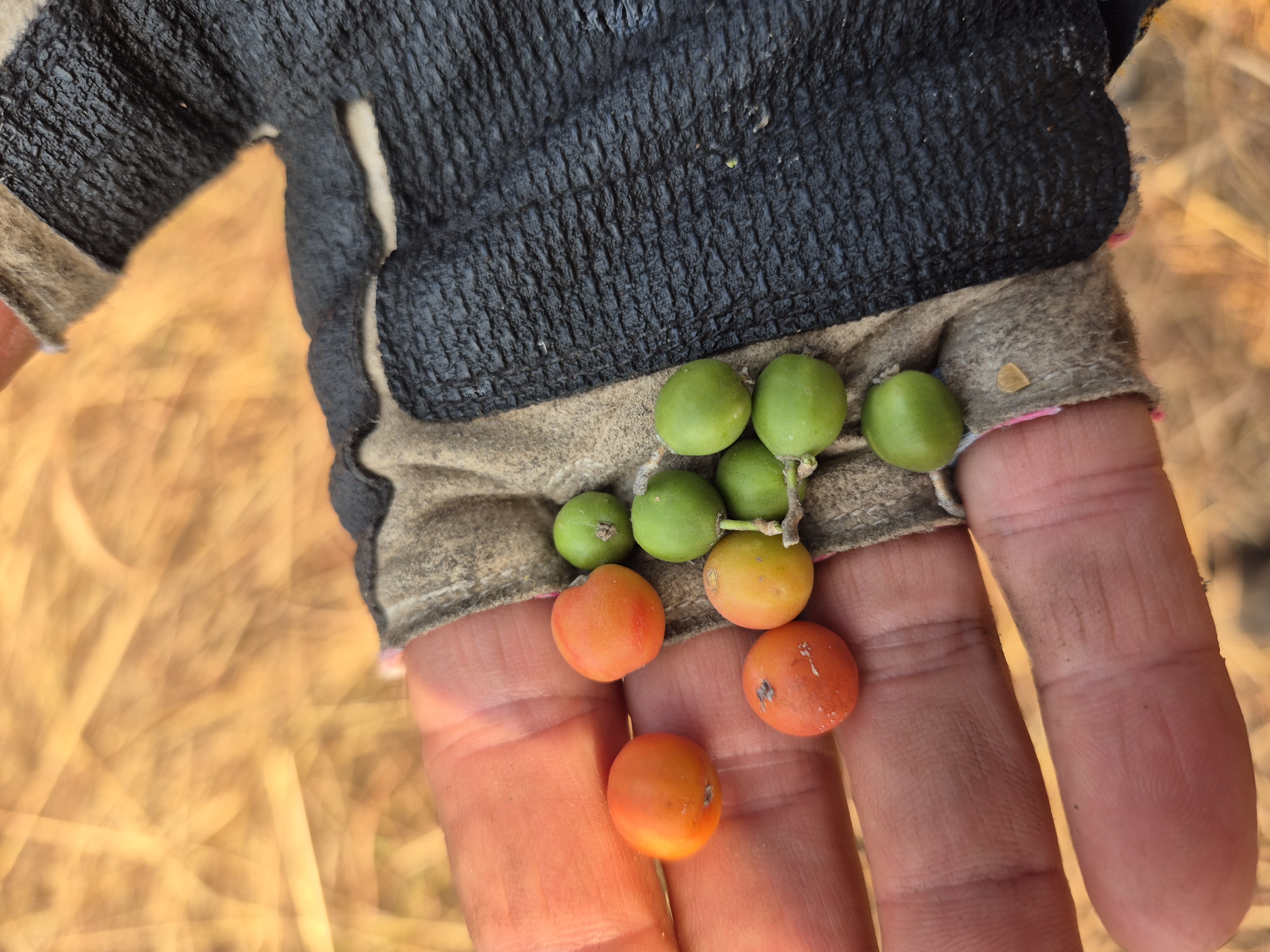
It was the fruit of Celtis strychnoidies, a pea sized drupe, deliciously dry and sweet. I was first introduced to goonj by a mate from Bardi country on the Dampier Peninsula, where it grows in coastal Monsoon Vine Thickets. It also can be found on dry scree slopes in the East Kimberley where the lack of grass and surrounding rocks protect it from fire.
A hardy tree with ovate leathery leaves and speckled white bark, Celtis strychnoidies will grow quickly into a compact small tree with dense foliage and buttress roots, especially with the addition of extra water in its early years. A welcome addition to any garden, it is attractive not only to roosting birds but also provides sustenance for the caterpillars of the common aeroplane and tailed emperor butterfly.
Edible Celtis species, known universally as hack berries are found on all continents except Antarctica and have been a staple diet of many indigenous people around the world. The Pawnee people of North America picked Celtis occidentalis, pounded the fruit and nut together, added water to make a paste, mixed in fat and corn and then fashioned it into a biscuit and cooked it on the open fire.
Fresh seed germinates within a month, seedlings grow quickly ready to plant at the end of the dry to take advantage of the looming rain. If they are looking a little yellow around the gills add some iron chelates or dynamic lifter. Galiya, I've got to fly....