



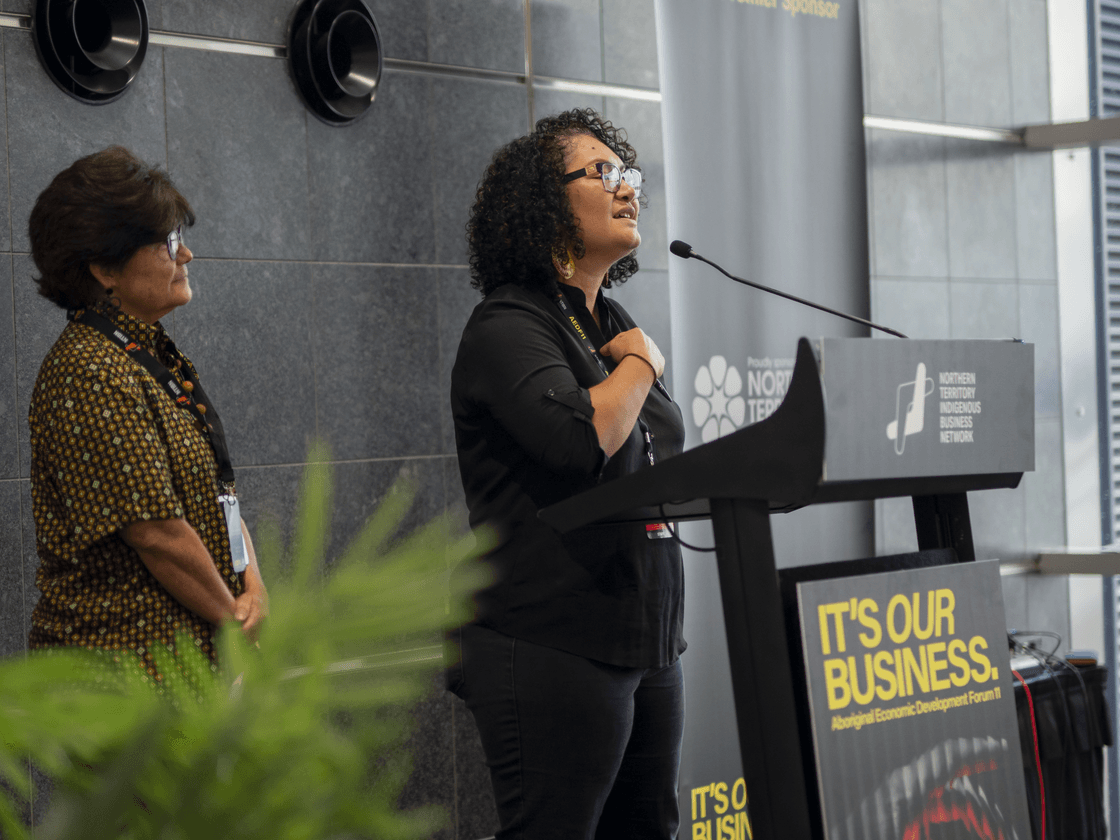
The Northern Territory Indigenous Business Network has responded to the NT Budget with a call to position Aboriginal businesses at the centre of the Territory's economic growth.
With record level capital infrastructure investment, NTIBN says the focus must now shift to ensuring Aboriginal businesses are supported to participate in and benefit from this growth.
Noting that Aboriginal Territorians represent more than 30 per cent of the population, the Network said equitable participation in procurement and mainstream economic opportunities are "essential to inclusive outcomes".
NTIBN said on Tuesday it will advocate for a 30 per cent per capita increase in Aboriginal business participation in government procurement, particularly in major remote investment areas such as flood recovery, remote roads and housing.
NTIBN chief executive Naomi Anstess said "record infrastructure investment must translate into record participation for Aboriginal businesses".
"This is where the greatest opportunity sits; Ensuring that investment in remote communities directly supports local Aboriginal enterprises, builds capability and drives long-term economic and employment outcomes," she said.
Service delivery can only do so much - economic participation is critical
Ms Anstess noted that while continued investment aligned to Closing the Gap across housing, health, education and community services remains essential, "long-term outcomes will be driven through economic participation".
"Closing the Gap cannot be achieved through service delivery alone. Economic participation, business ownership and wealth creation must be treated as core economic priorities and embedded across the Territory's growth agenda," she said.
Research highlights substantial untapped potential
A research project undertaken by NTIBN in partnership with Yamagigu Consulting and Deloitte Access Economics confirmed Aboriginal businesses are a major economic force: with the sector contributing, an estimated $3.4 billion to total economic activity in 2024-25 - equivalent to 10.1 per cent of Gross Territory Product - making it the third largest economic contributor in the Territory, behind only mining and public administration and safety.
The sector also plays a critical role in employment, supporting approximately 11,500 full-time equivalent jobs, including around 10,000 Aboriginal employees, representing more than eight per cent of total Territory employment.
In addition, the research found Aboriginal businesses contribute significantly to government revenue, generating an estimated $840 million in taxation.
"If the Indigenous business sector were supported to grow to approximately 30 per cent of the Territory economy by 2035, reflecting population parity, it could deliver an additional $6 billion in net present value to the Northern Territory economy," the NTIBN noted.
The full report will be released in May 2026.
NTIBN emphasised that "realising this opportunity will require stronger pathways for Aboriginal business participation across major projects and supply chains, ensuring that economic investment delivers both growth and local benefit".
Limited access to capital is still a barrier
The organisation also raised concerns regarding access to capital, noting the continued absence of the Aboriginal Business Development Grant, which plays a critical role in enabling businesses to scale and participate in larger economic opportunities.
NTIBN highlighted the need for coordinated, Territory-led investment in regional and remote Aboriginal economic development, ensuring businesses in these areas are equipped to engage in and benefit from growth.
"If Aboriginal businesses are expected to participate in the economy, the structures that support them must also be in place," Ms Anstess said.
Aboriginal economic development must be 'embedded' across all agencies
NTIBN's budget response calls for Aboriginal economic development to be "embedded across key government portfolios", supported by "coordinated, long-term strategies and strengthened participation mechanisms", including consistent implementation of the Aboriginal Procurement Policy across all agencies.
"The Territory is investing billions into industry and infrastructure. The opportunity is to ensure that investment delivers full economic return by embedding Aboriginal businesses within it," Ms Anstess said.
"This is Aboriginal land. Aboriginal businesses should be central to its economy. Ensuring this happens will strengthen outcomes for all Territorians."
Government touts 'law and order' budget
The Country Liberal government has highlighted their budget's record $1.73 billion spend on police and prisons, saying the measure support "safer streets, stronger communities and a more secure future for Territorians".
Chief Minister Lia Finocchiaro said Territorians voted for action on crime, and her government was delivering it.
"Territorians wanted a government that would listen, and act to restore community safety," Mrs Finocchiaro said.
"This Budget delivers record investment in law and order, while we tackle the root causes of crime.
"We promised to reduce crime, rebuild the economy and restore our unique Territory lifestyle, and we are getting on with the job."
A missed opportunity for Territory's services
Social service sector leaders in the Territory described the NT Budget as a missed opportunity to provide relief to Territorians.
NTCOSS chief executive Sally Sievers said that after a year of crisis and skyrocketing cost of living the Territory government had the chance to deliver a budget that improved the quality of life in the NT and supported frontline services sustainably.
"The Treasurer and Chief Minister have said that this is a budget for everyday Territorians, that targets the root causes of crime," she said.
"The everyday Territorian is struggling to find affordable housing, worried about a health system at breaking point and wanting to see families connecting with the supports that allow them to thrive.
"Frontline services on the ground across the NT provided fully costed and sustainable recommendations that would improve the Territory quality of life. The Government needs to listen to those who are working directly with Territorians, to understand the areas of greatest need."
Sector analysis on Tuesday's NT budget found "key shortcomings" in relation to housing, early supports for children and families, education, healthcare, mental health and Alcohol and other drugs, youth services, and addressing the domestic family and sexual violence crisis.



