

Aboriginal people in South Australia are disproportionately entangled in the justice system, including being over 12 times as likely to be imprisoned, which is likely to be having an impact on their ability to serve as a juror.
Previous criminal history is among key barriers to serving on juries identified in a new report, with that lack of access certain to be looked back on by future generations as a true injustice, according to one of Australia's most accomplished and respected legal figures.
A research report out of the South Australian Law Reform Institute (SALRI) has found there is no one cause, neither deliberate intention, behind barriers to participation, though they are systemic and ongoing.
SARLI published its report: 'The 'Many Knots' of a 'Jury of Your Peers': Indigenous Juror Participation in South Australia', this week.
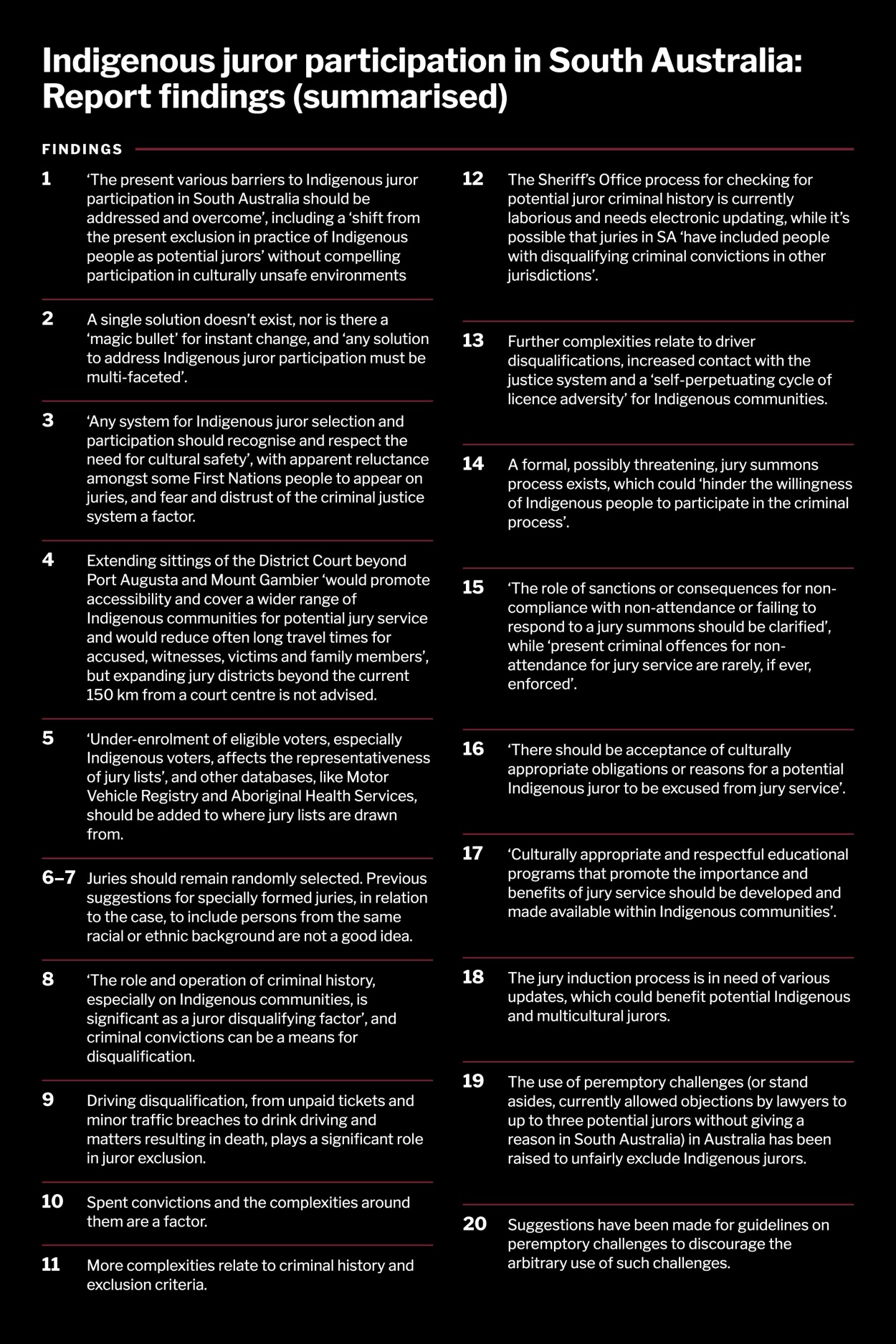
It makes 34 recommendations for reform to improve First Nations participation.
"SALRI's research has identified several key barriers to Aboriginal Peoples' participation on juries," report co-author Katelin Lawrie said.
"These include issues with electoral enrolment, from which the jury pool is drawn, practical difficulties serving jury summonses in regional and remote communities, and the disproportionate effects of criminal history juror disqualification, particularly for driving offences.
"Other barriers include complex cultural issues, alienation from the legal system, a reluctance among some, but not all, Aboriginal Peoples to serve as jurors, and the formal language of the present jury summons."
Both Lawrie and South Australia Minister for Aboriginal Affairs and Attorney-General Kyam Maher noted the considerable reality of First Nations people being overrepresented in criminal justice statistics, and underrepresented on juries.
Findings largely relied on anecdotal evidence, given limited data available.
One example was in Port Augusta, where across four induction sessions over two visits, only three of 115 potential jurors 'appeared' to possibly be First Nations, though it is noted this is not a reliable way of identification.
In the 2021 census, 20 per cent of the local population identified as First Nations.
Compulsory enrolment and voting at federal elections was extended to Aboriginal Peoples in South Australia in 1983, but "the general electoral roll is not a reliable means to select Aboriginal jurors", report co-author and SALRI director Professor John Williams said.
Jurors are currently randomly selected from the state's electoral role.
A recommendation included in the report is to expand the database used for juries, with the inclusion of Aboriginal Health Services suggested.
"SALRI believes the systemic barriers to Aboriginal Peoples' participation on juries, though unintentional, have directly contributed to Aboriginal Peoples not being afforded an equal opportunity to participate," SARLI Deputy Director Professor David Plater said.
While not deliberate, barriers to Aboriginal Peoples' jury participation were found to be systemic, including lack of equal opportunity to participate in various respects.
"Removing these barriers is important to ensure that the South Australian jury system can strive to establish a broadly representative jury pool," Professor Platter said.
Currently in South Australia, lawyers can object to up to three potential jurors without giving a reason by what is called peremptory challenges.
This was not found to be a factor in Aboriginal Peoples' participation on juries, something noted as 'surprising' by SARLI.
A recommendation included in the report is to not change the ability for peremptory challenges, but for it to be recorded and overseen going forward.
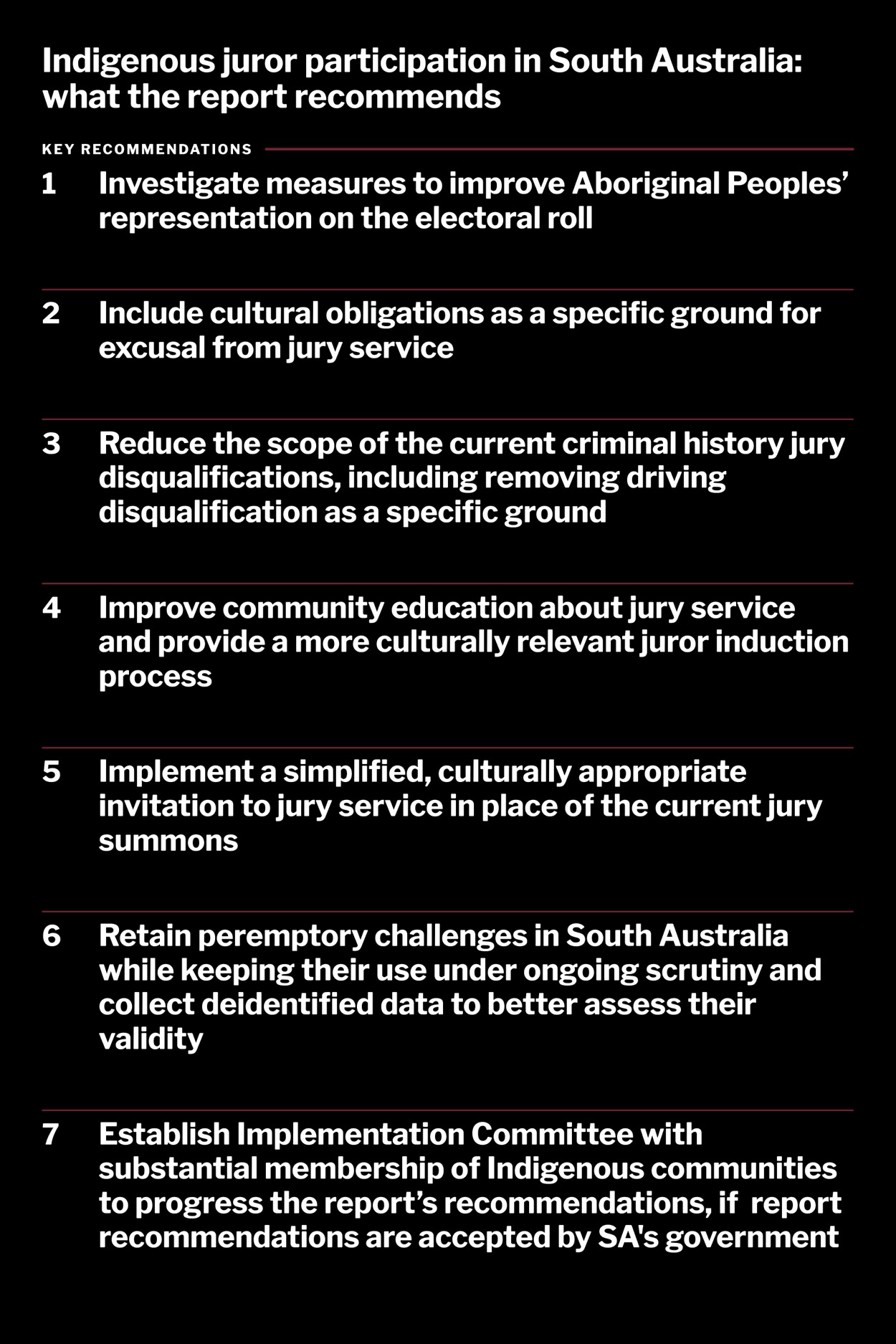
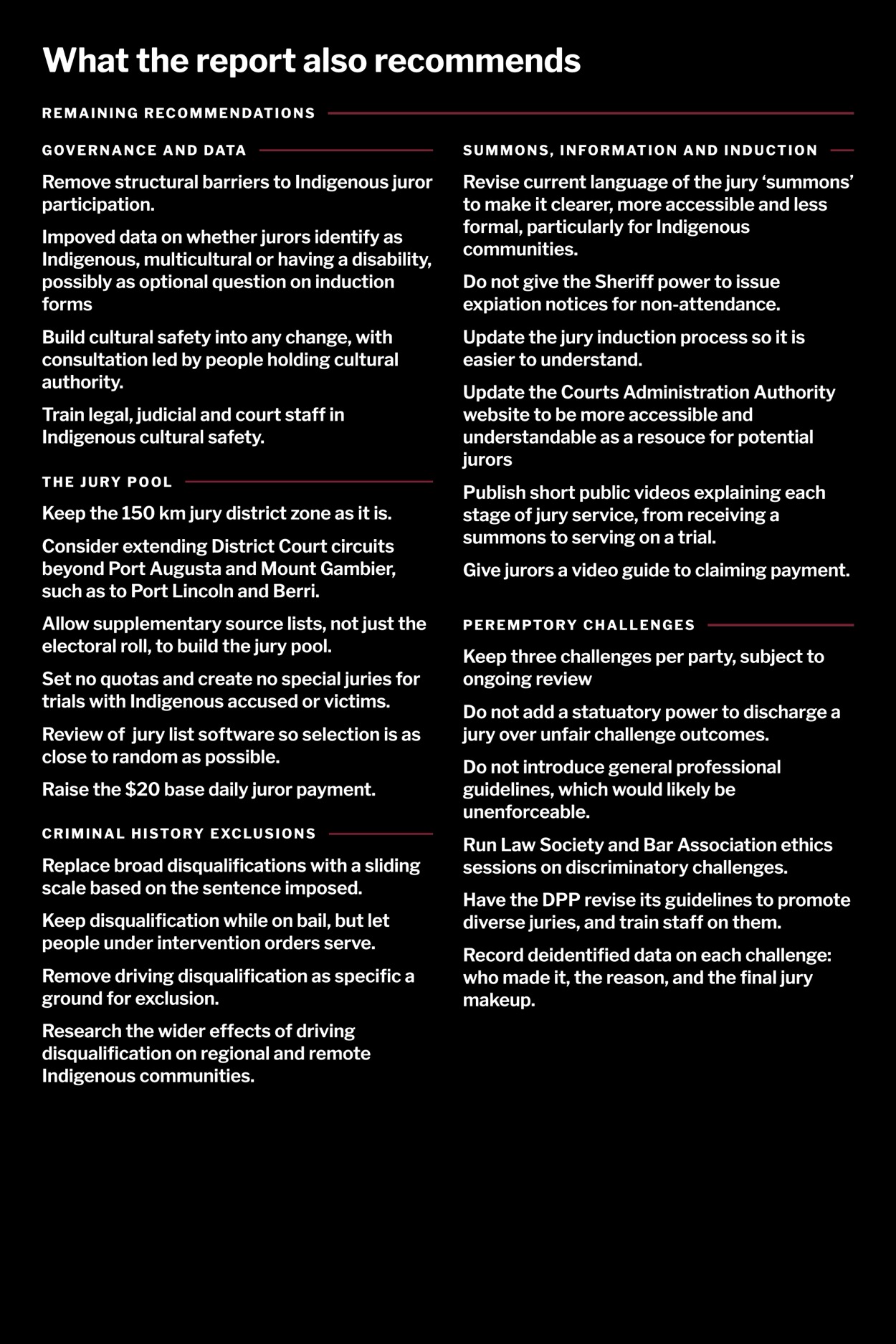
Provisions to potentially include First Nations people on juries in cases where First Nations people are accused or victims in a matter was recommended against by SARLI.
State Attorney-General, South Australian Courts, South Australian Sheriff, Victorian Juries Commissioner, and Aboriginal Legal Rights Movement. SALRI also received wide support from the Australasian Institute of Judicial Administration (AIJA) supported SARLI in conducting the review.
In the report's forward, Wirdi man and Australia's first Indigenous senior counsel Tony McAvoy forecast future critical reflections on the current lack of representation.
"I have no doubt that, in years to come, historians will regard the denial of First Nations peoples' access to juries as we now regard the denial of Aboriginal and Torres Strait Islander peoples' right to give evidence in the 1800s - and will see the tangled impediments said to stand in the way of remedying injustice just as illusory," he said.