




Artificial dens are being built for the djungarr (northern quoll) in Far North Queensland by Aboriginal rangers to entice the species to return to 'quoll country'.
Terrain NRM, Gulf Savannah NRM, Australian Wildlife Conservancy, James Cook University and Western Yalanji Aboriginal Corporation have begun working together in far north Queensland to deliver artificial dens, genetic research and cultural burning.
The djungarr can be found in Western Australia's Pilbara region, the Northern Territory and in Far North Queensland.
Since the introduction of non-native species such as cane toads and feral cats, the djungarr in Far North Queensland has suffered an 80 per cent decline.
Multiple methods will be trialled in an attempt to draw the species back to their habitats by Traditional Owners and rangers from the Western Yalanji Aboriginal Corporation who have helped set up the dens and are perform cultural burning in that area.
Western Yalanji Aboriginal Corporation executive officer Brad Grogan said artificial dens could be built to keep animals safe from predators.
"We got real bad issues with feral cats and a lot of other animals that are encroaching on their habitat," he said.
"And with these dens we can restrict the access to those cats into them and so it gives them a better chance of breeding."
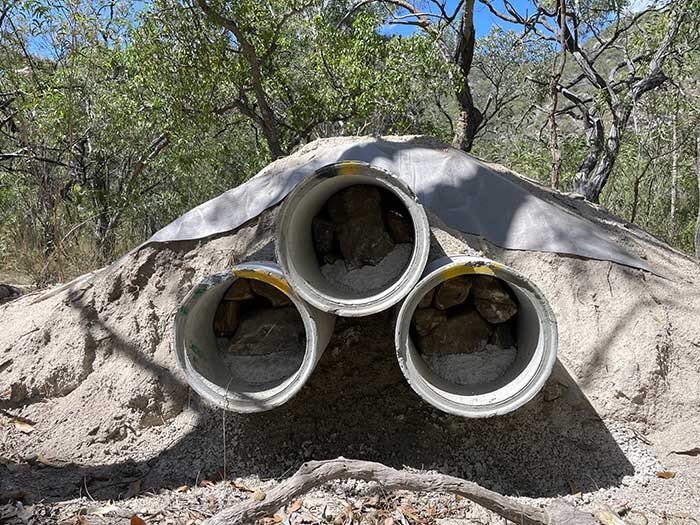 An artificial den for the northern djungarr in far north Queensland. Photo: Terrain NRM.
Terrain NRM project leader Andrew Dennis said if the artificial dens in far north Queensland were successful, they could be implemented in WA and the NT.
"If this trial works, the lessons learnt could be applied in the Northern Territory and in Western Australia, where there is an ongoing rapid decline," he said.
"Northern quolls are listed in the top-100 priority threatened species in Australia. Females use seven to 10 hectares as a home range, while males need 70 hectares and more.
"We want to get them back on the savannah lands, reconnecting isolated populations and keeping genetics healthy while also performing their ecological role there as an apex predators."
Mr Grogan said looking after the reserve for the cultural survival of the species was important to the rangers.
"One of the problems we've got is the rainforest encroaching in because nobody's maintaining and keeping the burns happening," he said.
"So because these animals they live on that boundary of the rainforest, when it's not maintained you have the rainforest encroaching in on that area and the habitats are gone.
"So the fire helps keep all that back."
The Western Yalanji rangers will be taking over the cultural burning of the Brooklyn Nature Reserve where the artificial dens are located.
"The area was burned in mainly during the hot season which was the wrong time of the year for that area to be burned," Mr Grogan said.
"So next year we're taking over the cultural burning of the area which you will see a big significant change.
"And just doing patches of burning instead of the whole station...that's the aim of our burning on Brooklyn (Nature Reserve) is to bring it back to its former self."
The artificial dens are part of an overarching djungarr project aimed at trialing conservation methods, building on previous genetic sampling and fire management work.



