


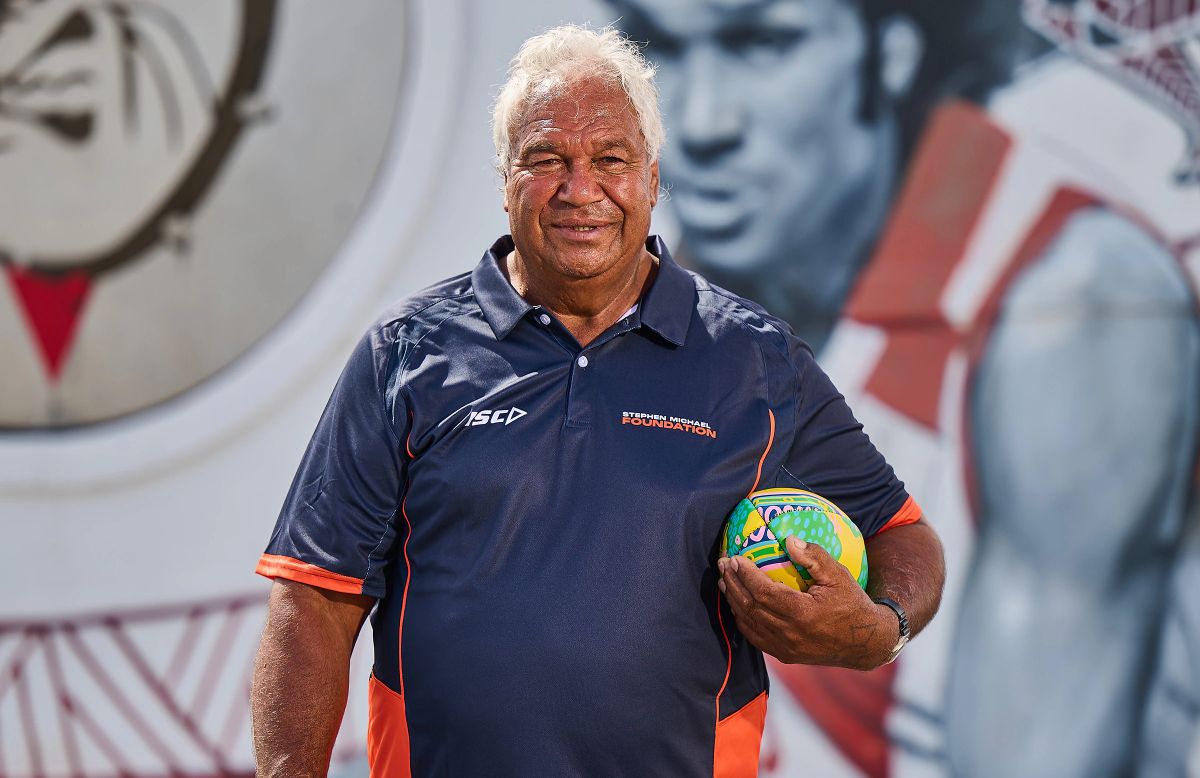
WAFL great Stephen Michael's career in football speaks for itself, so much so the Noongar man is the 2025 Sir Doug Nicholls Round honouree.
Across 243 games for South Fremantle, Michael collected two Sandover Medals, five best and fairests and a flag alongside 17 appearances for his state, ending with a Simpson Medal as State of Origin's best player in 1983 - the same he was named captain of the All Australian side, without ever crossing to Victoria.
Still, his proudest achievement is outside the game.
Growing up around 250 kilometres south-east of Perth in Kojonup, Michael was "a big boy in the country," playing junior football "and I'm a big boy now," he told National Indigenous Times.
In South Fremantle's zone, the dominant ruck and future Bulldogs, WA Football and Australian Football Hall of Famer and Indigenous Team of the Century member arrived at the club as an 18-year-old, playing 200-plus consecutive games from 1975.
He doesn't remember his first senior appearance, Michael admitted, as, at the time, he took "each week as a new ball game".
"I wouldn't say it was easy (the transition). The first part was very, very sad. Because you leave your family at home and you've got to put your own roots out for where you're going to be and where you're going to go in life," Michael said.
"I was very fortunate with the footy club, they supported me 110 per cent."
Being a phone call or a two-hour drive from Kojonup was some reprieve from homesickness.
It was also the key factor in why Michael never headed to any of the Victorian clubs who showed great interest in the star. Often regarded as one of the best footballers never to play in the VFL, rumours of big money offers have persisted.
He feels for kids today who make the big move after being drafted to chase their AFL dream.
"I owe a lot to my parents," he said.
"At the end of the day, my parents drove us miles to play junior football, even senior football, and they support you. I'm just returning a favor with accolades I achieve…this pays the debt to them."
He holds no regrets for staying closer to home in WA, and what he achieved at South Fremantle and across state games in yellow and black.
"I wouldn't change it for the world," he said.
At the Bulldogs, Michael shared the field with fellow icons and Indigenous players who "set the world on fire" with the likes of Basil Campbell, Benny Vigona, William Roe, Nicky Winmar and Sebastian and Maurice Rioli.
Phil Narkle and Jim and Phil Krakouer were others playing across the state competition, and would later become nationwide names, among some of Michael's teammates, after crossing to the VFL/AFL.
"It was different in those days. We used to go back to the clubrooms and have a cup of tea with opposition players, and we caught up with each other then," Michael said.
They were young men, mostly from the country and interstate, "playing with so much drive to do very well for their club and they set a legacy for their family".
Michael's son, Clem, followed in his footsteps playing in a WAFL premiership at the Bulldogs before joining the then-newly-introduced Dockers at AFL level.
Post-career, the Stephen Michael Foundation has engaged with thousands of young people across the state, of all backgrounds, delivering school and community programs to empower them with confidence and positive behaviours helping them 'reach their full potential.
Sport plays a role in their work, but not as an exclusive pillar.
To see kids be kids and be happy is the foundation's greatest ambition, he said.
After team success and all the personal accolades in football, Michael's proudest achievement is those he holds closest.
"I'm proudest of my seven kids, 27 grandkids and two great-grandkids. And still having my mum alive," Michael said.
His fondest memories of football and South Fremantle are the "good people" he met along the way and the legacy he carved out for kids, not just his own, to inspire their own ambitions.
It's an overwhelming and humbling opportunity to join names Graham 'Polly' Farmer, Michael Long, Syd Jackson, Bill Dempsey, Glenn James and Sonny Morey as honouree to Sir Doug Nicholls Round, he said.
"Some of these kids look up to it and say, 'Right, I want to do that. I want to achieve that. I want to know how to go about it and do it,' Michael said of its impact each year.
"It's a great game, our game. And I think the more it's promoted to young people the better off they're going to be."



