




The organisers of two years of fieldwork and analysis by the Murujuga Rock Art Monitoring Program released this week say that while there is no definitive conclusion gas giant Woodside's operations are directly damaging Murujuga's ancient and world renowned Indigenous rock art at this time, there is evidence of concern and risk factors that warrant ongoing scrutiny, particularly in relation to airborne industrial emissions.
The program's Research Lead, Professor Ben Mullins, said on Friday that further investigations are underway "into the processes leading to rock porosity, the potential link to historic emissions and to confirm that the porosity is stable or only changing through natural processes".
The findings of the Murujuga Rock Art Monitoring Program: Monitoring Studies Report 2024 supported the development of the interim environmental quality criteria for ensuring the ongoing protection of rock engravings on the Burrup Peninsula and Dampier Archipelago in northern Western Australia.
The program – led by Murujuga Aboriginal Corporation and WA's Department of Water and Environmental Regulation and delivered by a team of scientists working with Murujuga Elders and specialist Rangers – is the most extensive scientific study to date to examine the potential impact of industrial air emissions on the engravings, which are one of the world's oldest and most prolific records of human interaction with a cultural landscape.
Murujuga Aboriginal Corporation is made up of five Traditional Custodian groups - the Ngarluma, Mardudhunera, Yaburara, Yindjibarndi, and Wong-Goo-Tt-Oo peoples – and are the organisation responsible for oversight and protection of the precious rock art.
The program's Year Two report, published Friday, enabled interim thresholds of safe air quality, known as Environmental Quality Criteria (EQC), for the rock art to be established.
Murujuga Aboriginal Corporation chairperson Mr Peter Hicks protection of Murujuga's cultural heritage, including the rock art, "is vital to our Members, and critical to achieving our long-held aspiration to achieve World Heritage Listing for the Murujuga Cultural Landscape".
"The latest findings show that past emission levels may have affected some of the rock types. We are confident that we have got a robust scientific program, that is clarifying these processes so that we can achieve lasting protection of the rock art," he said.
"While research is ongoing, we are excited to be at a stage where we have interim EQC for the first time. MAC will continue to hold government to their commitment to protecting the rock art."
As the research continues, it will refine and determine final EQC, with monitoring to continue long-term to ensure ongoing protection of the engravings.
Among the key findings, the upper layer of granophyre, one of five rock types being investigated, has elevated porosity - open spaces in rocks - in a region close to Dampier.
The authors of the report said this is likely a response formed over many years that may have been accelerated in the 1970s, particularly from the former Dampier Power Station.
The processes that lead to elevated rock porosity "are complex, involving natural weathering, microbial activity and chemical or chemo-microbial acceleration".
The report also found that an acid rain/deposition theory proposed by earlier research is not supported by data from the program, and that air quality data collected by the program generally align with previous modelling and measurements, while showing a reduction in nitrogen dioxide and sulfur dioxide since 2014.
The report's assessment against the interim EQC indicate emissions are currently below levels that may affect rock art.
Murujuga Aboriginal Corporation vice-chairperson Belinda Churnside said Murujuga's ancient rock art "depicts the everyday living of our ancestors, and we still have strong connection and cultural ties to it".
"MAC has been involved in every aspect of establishing and implementing the Rock Art Monitoring Program, through our Board and Rangers, guided by the senior, cultural, knowledgeable Elders," she said.
"The collection of data by cultural and scientific experts will allow us to better understand and manage the ngurra today, tomorrow and forever."
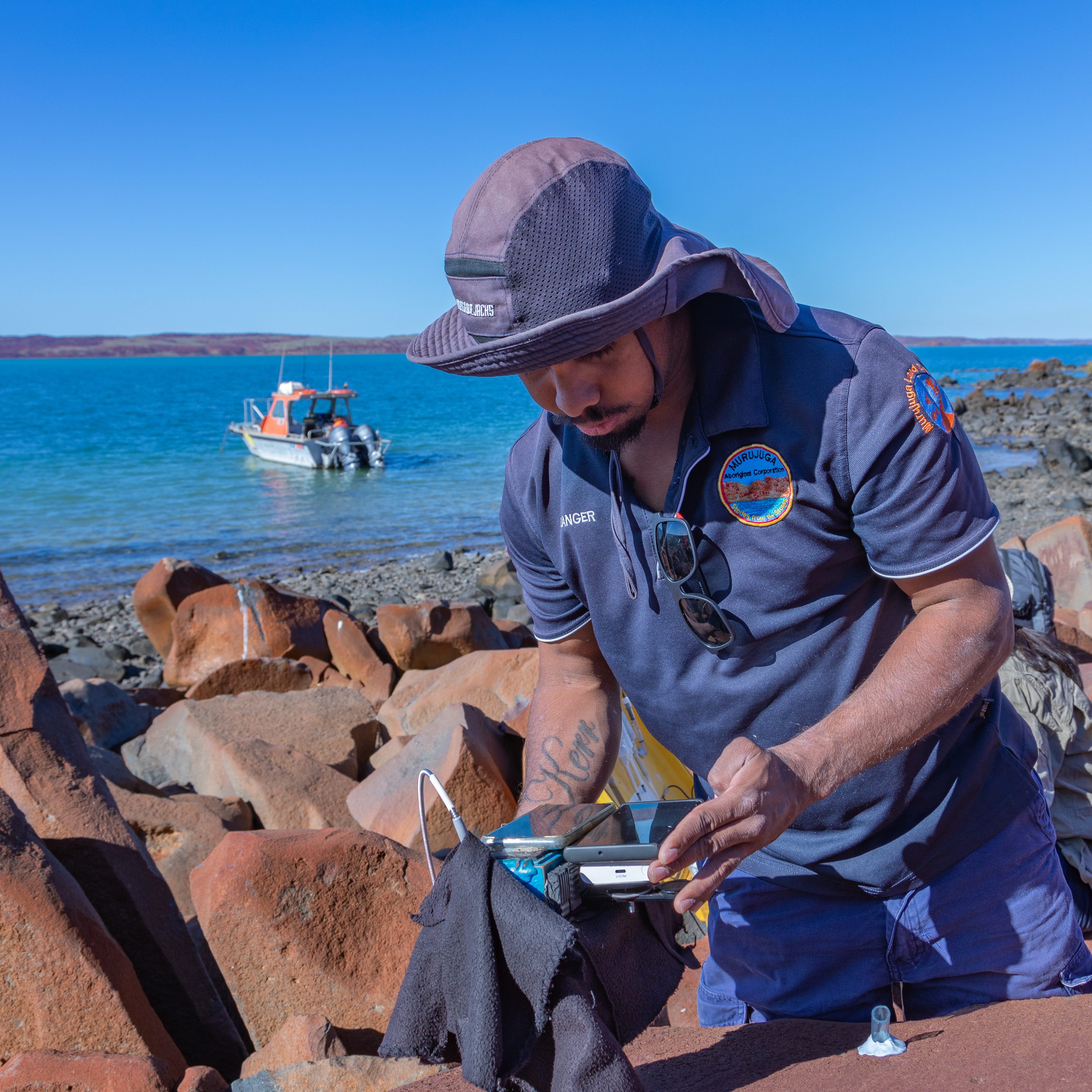
Professor Mullins said the first two years of research involved extensive fieldwork on 54 rock art panels across Murujuga and the collection of air quality, rainfall and deposition data from 21 monitoring stations; more than 66,000 rock surface, elemental, porosity and electrochemical measurements, and examination of microbial samples and the physical, chemical and geological composition of sample rocks.
"The data from this program do not support the acid rain or acid deposition theory proposed by earlier research. Measurements of rainfall and wet or dry deposition over the past two years have been found to be neutral or slightly alkaline," he said.
"Colour and photogrammetric monitoring of the rock art is ongoing, however so far, the data have not shown major or systematic change in the rock art surface."
The monitoring network consists of 18 solar/passive stations and four mains-powered air quality monitors.
The report identified higher-than-expected levels of ammonia (NH₃) and ozone (O₃) in the airshed, as well as significant black carbon (soot) levels. The pollutants are likely to be anthropogenic, with industrial operations being the major source. Ozone and formaldehyde are noted as potential risks to the microbiome on rock surfaces.
Part of the reason for the need of further studies is that computational fluid dynamics simulations show pollutants often travel in narrow plumes, potentially exposing specific areas—like gorges rich in engravings—to higher pollutant concentrations. This suggests point-source emissions, such as those from industrial stacks, may locally increase the risk of damage even if regional averages appear within safe limits.
The research project is on track to transition into a long-term monitoring phase managed by Murujuga Aboriginal Corporation and DWER, combining Indigenous ecological knowledge, high-tech monitoring systems, and scientific analysis to ensure the protection of one of the world's most significant rock art collections.
Woodside have long maintained that the Browse Project is important to Western Australia and the Asia Pacific to help meet growing energy demand, "while supporting the decarbonisation of economies". The company has noted gas in Western Australia is increasingly used to replace coal in generating electricity.
Woodside cites "stringent and world-class" federal and state environmental laws and regulations designed to minimise environmental impact, and maintains that since referring the Browse Project to environmental regulators in 2018, the company has continued to collect scientific data and monitor advances in industry best practice environmental measures.
Friends of Australian Rock Art Co-Convenor Judith Hugo said the group was "glad the (WA) government has finally released the Murujuga Rock Art Monitoring Report after more than six months of deliberate delay".
"The report confirms there has been damage to the Murujuga rock art from industrial emissions," she said.
"Given the report is 800 pages long, we will wait for independent experts to review the evidence and conclusions… We urge Environment Minister Murray Watt to wait for independent review of the report before making any decision on Woodside's North West Shelf proposal."
The WA government said the Murujuga Rock Art Monitoring Program has delivered "the largest and most reliable data set on rock art globally, tracking air quality, rock surface chemistry, rainfall, and pH levels affecting the area's ancient rock art".
"Findings from the program have informed the development of interim Environmental Quality Criteria, which are now being used to guide regulation of industrial emissions on the peninsula. The monitoring program and EQC form part of the Murujuga Rock Art Strategy, which has been implemented by MAC and the WA Government since 2019," the WA government said in an official statement.
"Regular public reporting against the interim criteria will begin in 2025, alongside continued research and data collection.
"The WA Government, in partnership with MAC, will continue routine monitoring and assessment of air quality against the EQC, with management responses to be implemented if thresholds are exceeded.
"Data gathered over the next two years will be used to establish scientifically robust final criteria to ensure long-term protection of the rock art."
WA Environment Minister Matthew Swinbourn said the development of the interim EQCs "could not have been achieved without the knowledge and support of the Murujuga Circle of Elders, MAC Board, rangers and other personnel; a large team of 55 highly-credentialled scientists; a panel of independent, expert peer reviewers; and the Murujuga Rock Art Stakeholder Reference Group".
Murujuga Rock Art Stakeholder Reference Group Independent Chair Professor Stephen Van Leeuwen said the Reference Group "applauds the transparency and integrity which underpins the Program as validated through the peer-review process to provide highly credible evidence-based outcomes that inform management".



