




Victoria's former Treaty commissioner says national truth-telling processes can help educate Australians about the need to change the date of Australia Day from January 26.
Last year, Victoria's Yoorrook Justice Commission — the nation's first truth-telling body — delivered its final report, finding that "death, violence, disease, dispossession and government control changed the landscape" for First Peoples across the state. Whilst other states have stalled on their truth-telling initiatives, a campaign for a federal body continues.
Gunditjmara Elder and CEO of the Victorian Aboriginal Community Controlled Health Organisation (VACCHO), Jill Gallagher, says she hopes more Australians will be educated about the history of First Peoples since colonisation, with truth-telling playing a vital role in that process.
"I believe a lot of Australians will either hear or read some of those stories — because none of that's taught — and have a different understanding...[on] why we want to change the date and why it's important to us as first peoples of this country," she told National Indigenous Times.
Even as protests and commemorations around January 26 have grown year on year, there has been no broad ongoing move to change the date. Efforts to shift away from January 26 — including initiatives by private organisations — have attracted backlash from conservative commentators, with some media outlets regularly attacking those who link the date, or Australia's colonial founding, to racism.
Ms Gallagher points to Canada's Truth and Reconciliation Commission, established in 2008 to educate Canadians about the residential school system for Indigenous children run by governments and churches from the 1830s to the 1990s, including through education programs in schools.
"So, people got to hear it and see it," she says. "I saw a movie of what happened in Canada, and it actually made me fully understand what happened over there, and how I related it to what happened here."
Concerning January 26, she says it is "very important" to educate Australians on why the date is hurtful.
"I think if Australians have that under their belts, they'll fully understand the colonial history of this country; like it wasn't peacefully settled," Ms Gallagher says. "I think they'll have a different view and say, 'Well, you know what? I agree with them [First Peoples], I think we should change the date.'"
Whilst January 26 — which recognised the arrival of the First Fleet in 19788 — has only been an official public holiday since 1994, in 1938, Yorta Yorta man William Cooper called for the date to be recognised as a day of mourning, citing the massacres, dispossession and violence inflicted on First Peoples since colonisation.
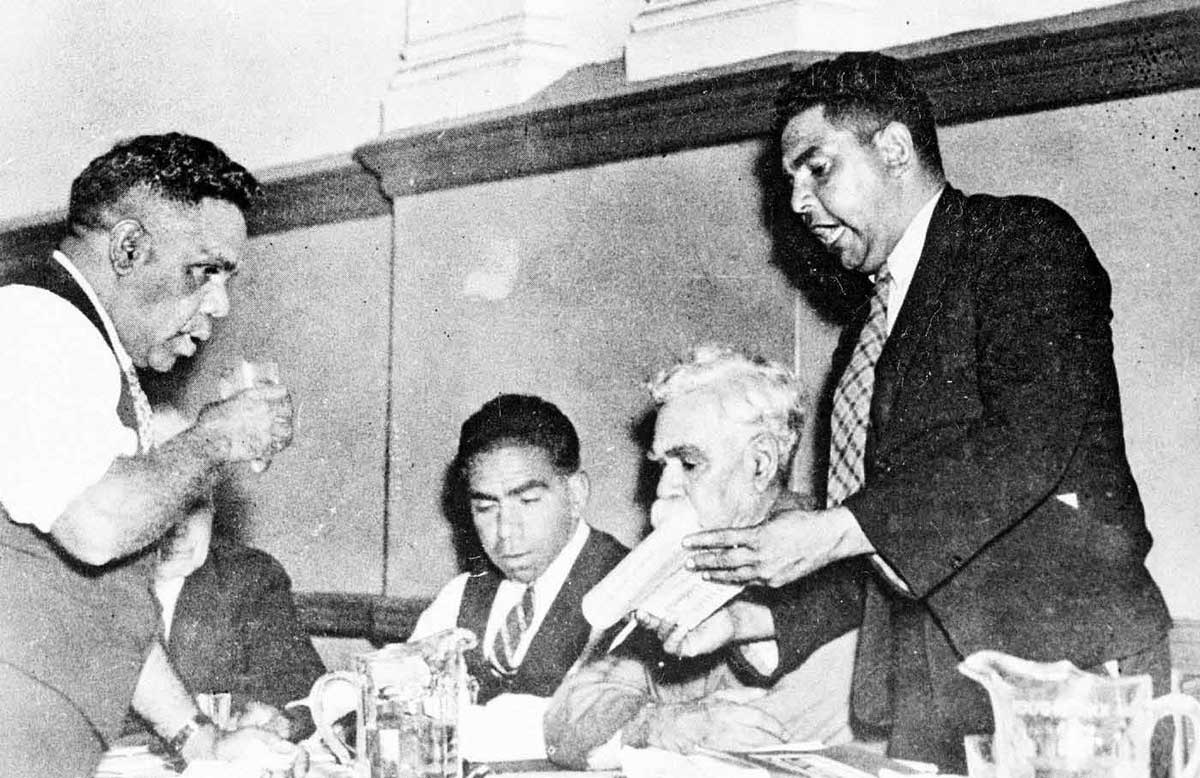
Ms Gallagher says the relatively short time January 26 has been legislated as a national holiday pales in comparison to how long First Peoples have mourned its significance.
"How can you say... 'It's our tradition' after 32 years," she says.
"Prior to that, we as First Nations people, we marched, we did what we could to highlight the fact of the day of mourning, when you looked at all our elders, all those old photos."
Laughing, she adds: "And yet, when it came time to unify, to have one date for all Australians, the wisdom of the day chose the 26th [of January]."
A range of alternative dates for a national day have been proposed. One proposal, led by Wurundjeri Country-based fashion label Clothing the Gaps, calls for an Australian long weekend on the second-last Monday in January, with the public holiday falling between January 18 and January 24.
"This is a small but meaningful shift that offers a practical, unifying alternative - one that reduces harm and respects the lived experiences of First Nations communities," the petition states.
Ms Gallagher says she doesn't mind what date a new national day might be, so long as it is unifying.
"Everyone loves the long weekend," she laughs. "And wouldn't it be amazing to have a long weekend every year — Saturday to Monday — and we can all participate in the celebrations."



