




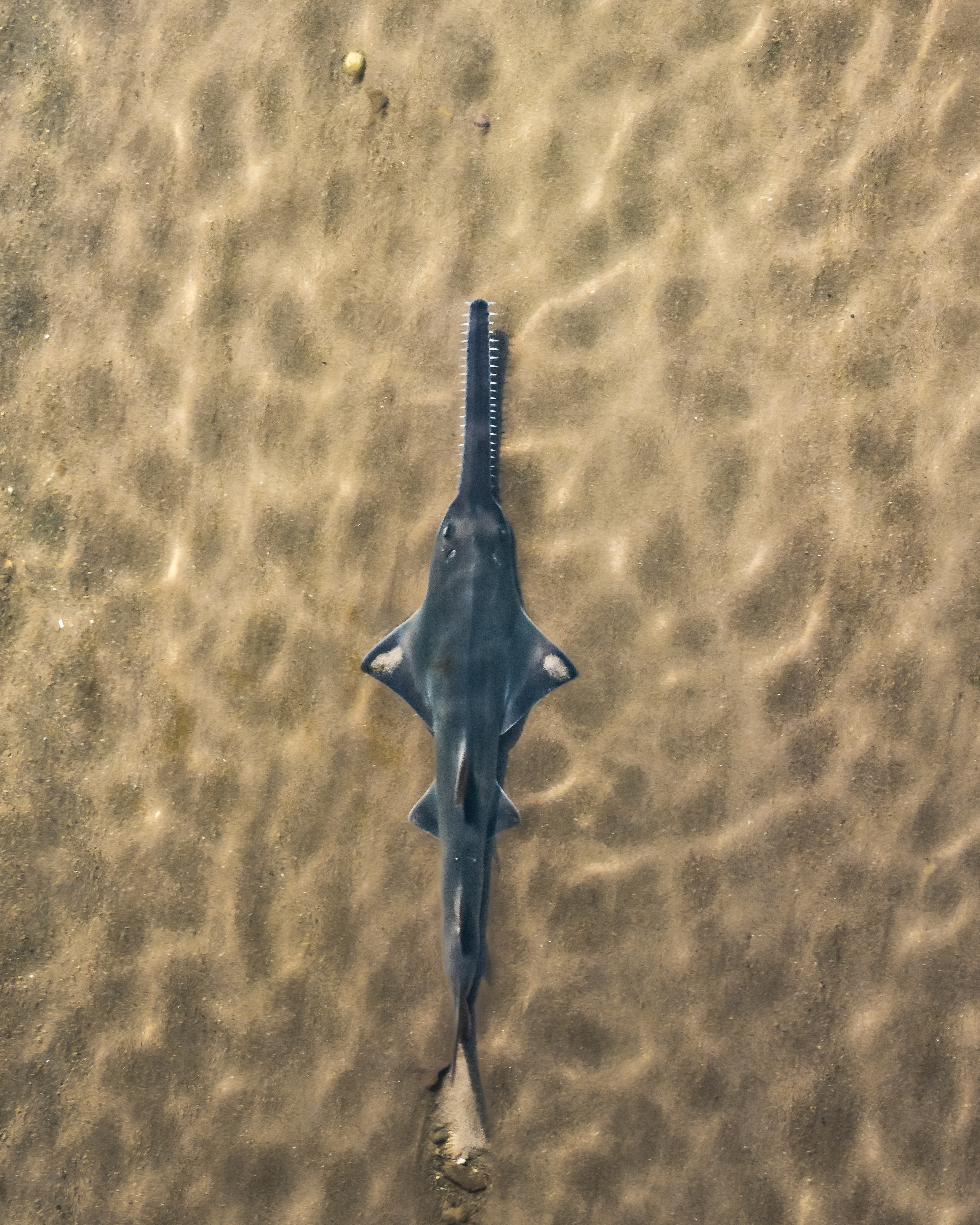
Conservation groups are calling on the WA government to take urgent action on World Sawfish Day to protect the critically endangered freshwater sawfish and its last stronghold the culturally and environmentally significant Martuwarra Fitzroy River.
The Kimberley – Like Nowhere Else alliance is urging Water Minister Simone McGurk to review the ongoing impacts of infrastructure and barriers on the lower reaches of the Martuwarra Fitzroy River and the risks to freshwater sawfish and to protect the river.
The alliance raised concerns with Minister McGurk earlier this year after it was revealed in May that 17 sawfish had died on a dry floodplain on Liveringa Station - a pastoral property with a licence to pump water from a tributary of the river - in November 2023.
In October 2023, Minister McGurk made a milestone policy commitment to stop further surface water extraction from the river. However, nearly a year later the next steps for implementing the policy have not been announced, leaving the long-term future of the river uncertain.
The renewed call for action comes today on World Sawfish Day and after several mass sawfish and barramundi kills near Liveringa Station over the past five years.
Environs Kimberley acting chief executive Martin Pritchard said an investigation into the impacts of infrastructure was needed, with consultation from Traditional Owners and Aboriginal Rangers.
"We need to know the true implications that irrigation infrastructure and barriers are having on water flow and what impacts this has on the Martuwarra Fitzroy River and the sawfish," he said.
"The government must follow through on their commitment to ensure no further infrastructure is built along the river for irrigation.
"We are calling on government to review the management of water licences and irrigation infrastructure in the catchment against the Sawfish and River Sharks Multispecies Recovery Plan, with a particular focus on barriers, habitat alteration and water extraction."
Mr Pritchard said with only an estimated 2000 adult freshwater sawfish left in the wild and the Martuwarra Fitzroy River being their last stronghold, it was crucial more was done to protect them and their habitat.
"We've heard reports that further strandings and deaths of sawfish have occurred this dry season on the same floodplain on Liveringa Station – the only place along the river with a licence to take water," he said.
"We've been told these sawfish have died of natural causes, but it doesn't look like a coincidence that these fish kills have occurred where irrigation infrastructure exists."
Freshwater sawfish have roamed rivers and oceans across the globe since the time of dinosaurs, but due to overfishing, habitat destruction, irrigation development and climate change, the population of the species has disappeared by 80 per cent of its former range.
The CSIRO revealed in 2023 that sawfish were now considered to be extinct in many places worldwide and are mostly only found in Northern Australia, specifically in the Kimberley's Martuwarra Fitzroy River – the species' last stronghold and its most important nursery ground.
A WA government spokesperson told National Indigenous Times the state government is committed to protecting the environmental and cultural values of the Fitzroy River, including the iconic sawfish.
"This has been demonstrated through the release of the Water allocation planning in the Fitzroy: Policy Position Paper (2023) which will form the basis for the future Fitzroy Water Allocation Plan," she said.
"The policy positions outlined in this paper were developed following extensive consultation and scientific studies across the Fitzroy River catchment, and reaffirms the state government's commitment not to dam the Fitzroy River or its tributaries, with no additional surface water to be made available.
"In response to the sawfish deaths in November last year, an investigation was completed by the Department of Water and Environmental Regulation, which revealed the deaths were due to natural causes. During the wet season, floodplains become inundated and provide passage for sawfish to move away from the main channels and into pools, where they become trapped as water recedes.
"To improve our understanding of why sawfish are stranded and to implement a response to future stranding events, the government is committed to working with the Nyikina Mangala Traditional Owners and key stakeholders on this important issue."
The Kimberley – Like Nowhere Else spokesperson and Pew Charitable Trusts Australia acting director Tim Nicol said further protection was needed for the sawfish.
"We welcome the commitment made last year to protect the Martuwarra Fitzroy River, but we urge government to take action by working in consultation with Traditional Owners to ensure strong, long-term protection for the river and to help safeguard the freshwater sawfish," Mr Nicol said.
He said the Murray-Darling River remained a warning of what can happen when an irrigation industry is established along a river system.
"The natural flows of water, the floods and dry cycles of the river is what makes it a perfect habitat for sawfish," he said.
"The sawfish need the river to be protected from changed flows and pollution from irrigated agriculture, or we risk further driving this iconic endangered species towards extinction."



