




The proposed closure of the Northern Territory's largest supported homelessness accommodation program is difficult to reconcile with the government's Closing the Gap commitments, advocates say, with fears hundreds of vulnerable people in the Territory will be at risk of homelessness.
This week, it was reported the Country Liberal Party (CLP) Government had given Yilli Rreung Housing Aboriginal Corporation 90 days to vacate its short-stay accommodation premises.
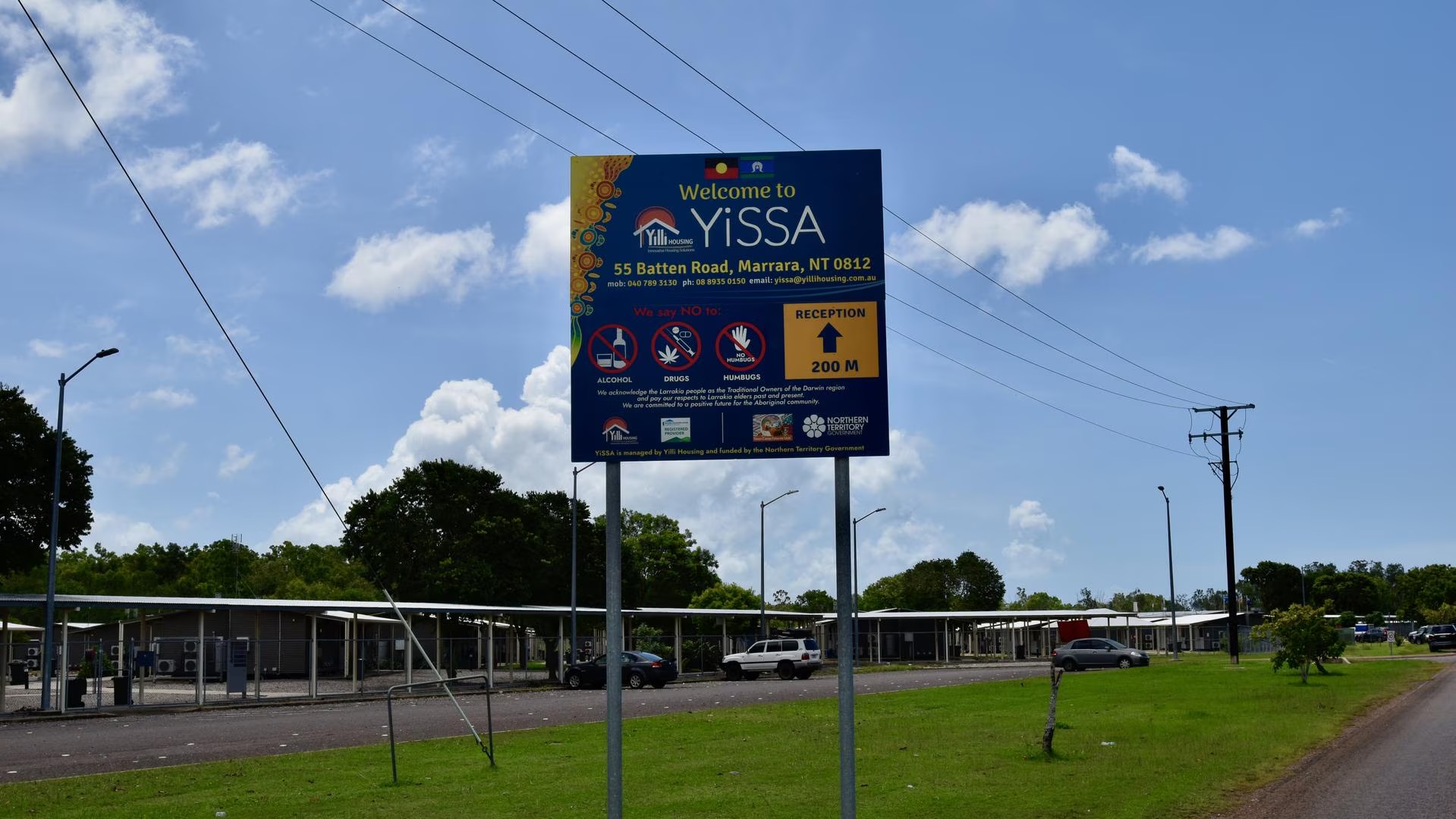
Currently, there are 383 people, including 145 children, living at YiSSA at the shelter on Batten Road in Marrara — many from remote communities. There is no certainty any current occupants will have a place to go.
A further 300 people, including 89 children, are awaiting accommodation, whilst at least 25 staff also face the likelihood of losing their job.
A former resident noted that they slept in their car before arriving at the site.
"When I came to YiSSA, they gave me somewhere safe to stay and helped me start rebuilding my life," they said.
In a joint statement, Yilli Housing and Mission Australia said the numbers highlight the "continuing demand for homelessness services across Greater Darwin and the significant scale of this transition".
"People supported by YiSSA are among the Territory's most vulnerable, experiencing homelessness, domestic and family violence, mental ill-health, alcohol and other drug dependency, disability and complex health needs," they said.
"For many, YiSSA has provided not only safe accommodation, but the support needed to rebuild their lives."
A coalition of Northern Territory legal services responded to the news this week, warning it will leave hundreds of vulnerable families without critical support and could increase child protection intervention.
In a joint statement, the North Australian Aboriginal Justice Agency (NAAJA), North Australian Aboriginal Family Legal Service (NAAFLS), Darwin Community Legal Centre and Top End Women's Legal Service criticised the uncertainty surrounding what services, if any, will replace YiSSA.
"Whether families lose access to the service altogether or the service is transferred away from Aboriginal community control, the uncertainty is deeply concerning," they said, arguing it conflicts with national commitments to strengthen Aboriginal community-controlled organisations under the National Agreement on Closing the Gap.
The Northern Territory has the highest rate of homelessness in the country, almost 12 times the national average. Indigenous people comprise 87 per cent of the homeless population in the Territory.
Yilli Housing and Mission Australia said they recognised the significant housing difficulties in the Territory and would continue to work "constructively with the NT Government to ensure the best possible outcomes for vulnerable Territorians".
"Without careful planning and significant commitment," they argued, "transitioning almost 400 residents within three months will increase pressure on emergency accommodation, social housing, hospitals, child protection, police and frontline community services, while increasing the risk of overcrowding and rough sleeping for vulnerable families."
Children and Families Minister Robin Cahill said a transition plan was in place, telling reporters on Wednesday the government "offered a fair market price in an effort to be able to continue to function at that site" to the owners of the facility's infrastructure, but it was rejected.
"Let's just say that their response was far from fair and far from conducive to a good, smart economic decision, so we will have to transition those people out," she said, the NT News reports.
"We're not reducing services; it will simply be a realigning of services to other areas."
The property sits on Crown land, but the buildings are owned by Ausco and leased to the NT Government on a five-year deal.
.jpg)
Minister for Indigenous Australians Malarndirri McCarthy urged the NT government and Ausco to "get back to the table as quickly as possible to resolve this matter".
"The uncertainty and the speed of this decision has blindsided these families and the staff at the facility," she said.
"It is these families, and the employees, who need to be the focus right now."
Despite assurances from the Department of Children and Families at a recent parliamentary inquiry that the controversial child protection reforms pushed by the CLP Government would not expand child protection interventions, the coalition of legal services warned it is already seeing more child protection cases in which housing insecurity is the primary concern.
"The loss of a major homelessness service raises serious questions about how that commitment can be maintained," they wrote.
NAAFLS PLO Clara Mills added: "It is difficult to reconcile assurances that child protection intervention will not expand with decisions that reduce access to one of the Territory's key homelessness services."
NAAJA chief executive Ben Grimes said housing is one of the most significant protective factors for children.
"When families lose access to safe accommodation, the risks to children's wellbeing increase dramatically," he said.
"We are already representing families where the central issue is not abuse or neglect, but the absence of safe and stable housing."



