




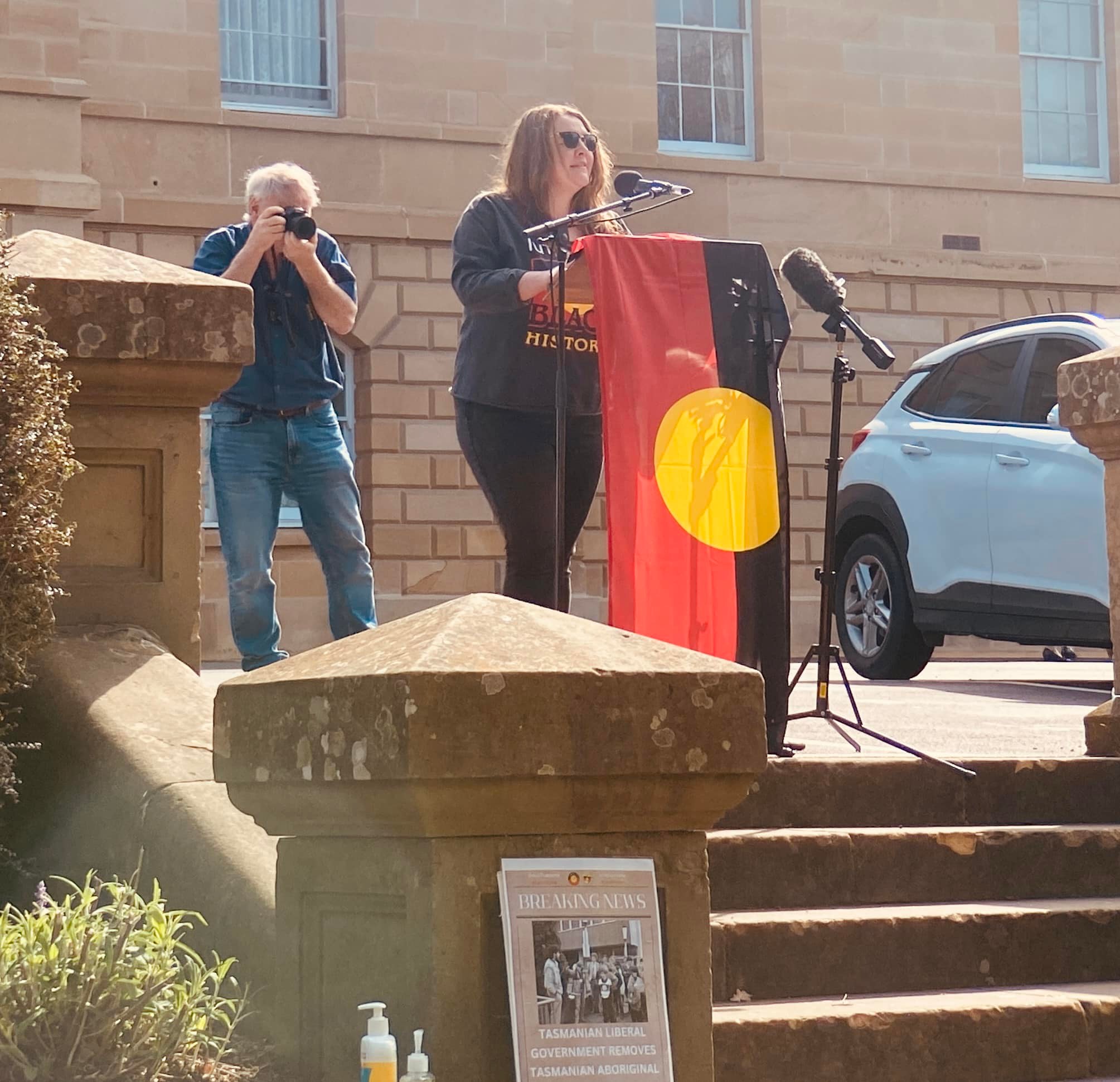
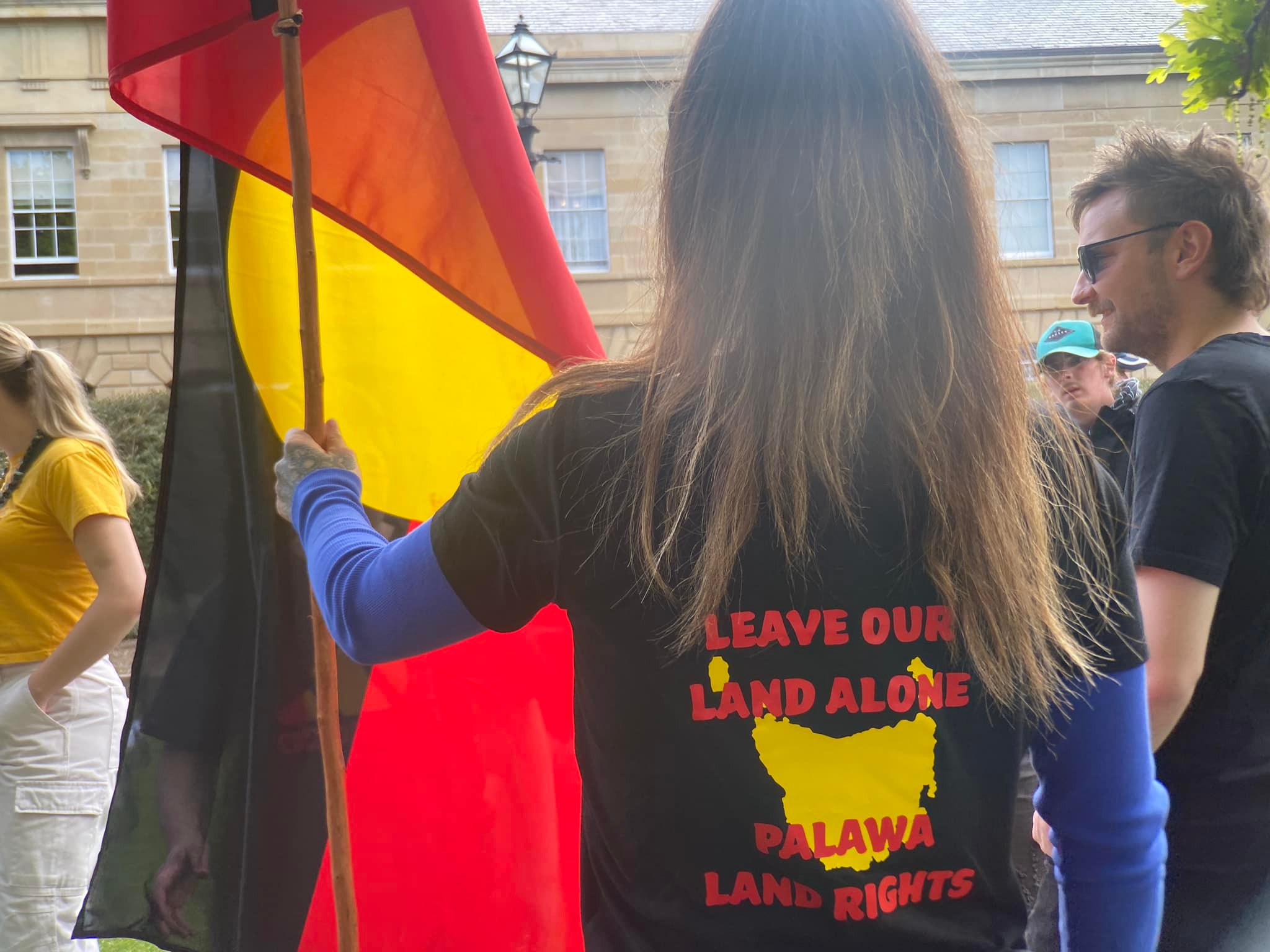
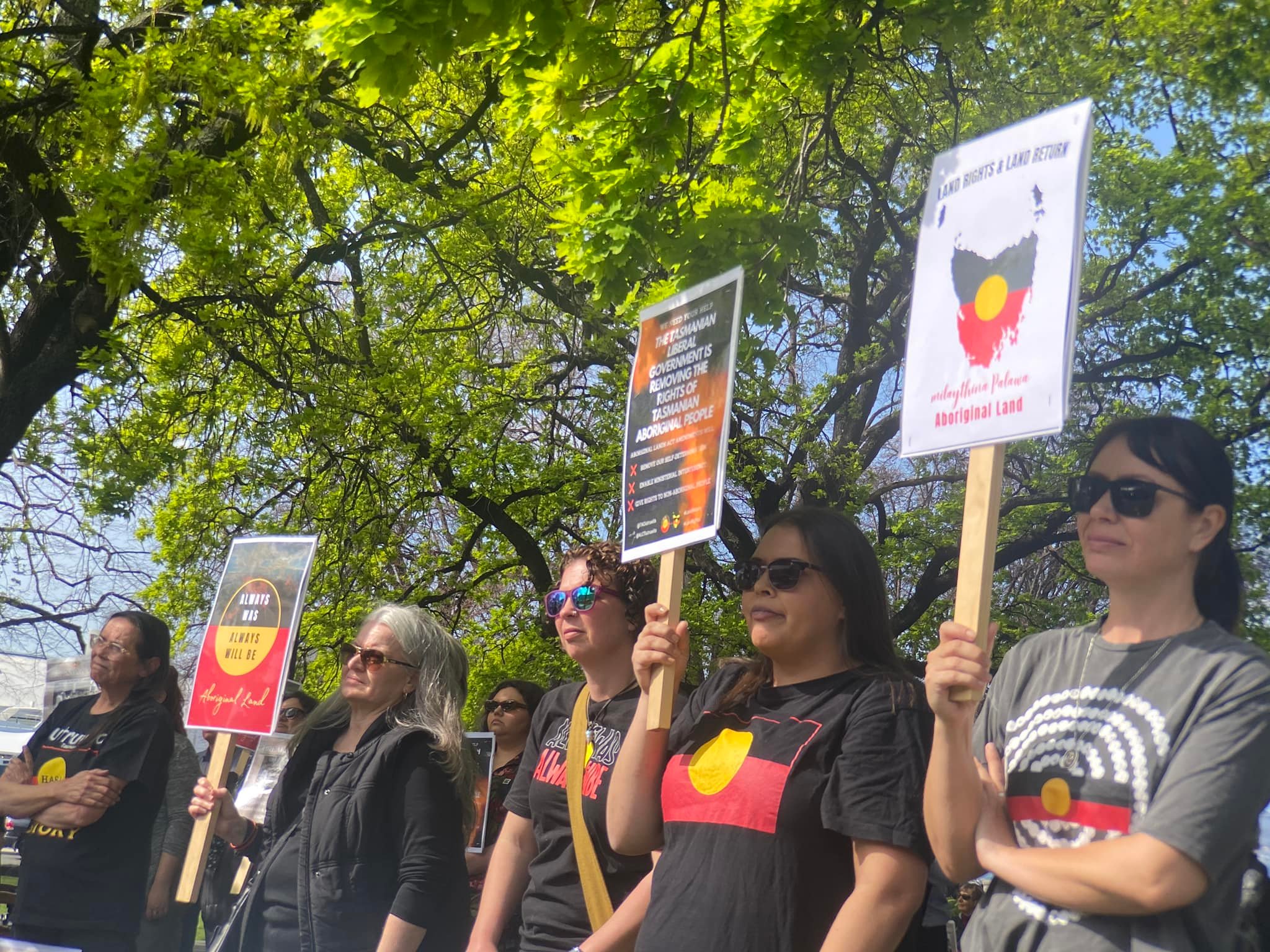
Members of the Tasmanian Aboriginal community have rallied on the lawns of Parliament House, protesting proposed changes to the Tasmanian Aboriginal Lands Act.
Approximately 300 people attended the rally, calling for the Tasmanian government to abandon planned amendments to the act.
Proposed changes include revisions of the Aboriginal Land Council of Tasmania (ALCT) electoral roll process, establishing a more consistent process for land returns, increasing inclusivity of local Aboriginal groups in the involvement of Aboriginal land management, and reforms to the management of Aboriginal land.
Speakers at Thursday's rally included truwana Rangers Coordinator Fiona Maher, Pakana ranger David Lowery, Tasmanian Aboriginal Centre campaign manager Nala Mansell, and ALCT manager Rebecca Digney-Mansell.
Ms Digney-Mansell told rally attendees her community were staunchly against the proposal, suggestion a small number of people had encouraged the government to amend the lands act bill.
"Who has asked for this reform? Because the people I speak to, the people in my community, have expressed their opposition from the first we heard of it," Ms Digney-Mansell said.
"A handful of people have urged the government to come in and take back the rights that our people have fought for, for the last 220 years."
Tasmanian Greens Leader Rosalie Woodruff also spoke at the rally, labelling the proposed legislation "a dog of a bill".
"It gives the minister, a non-Aboriginal person, the power to hand back land to Aboriginal ownership with significant complicated, controversial strings attached," Ms Woodruff said.
"The minister could even decide who was allowed to manage returned lands."
Following extensive public consultation, Tasmanian Minister for Aboriginal Affairs, Roger Jaensch, released the act's exposure draft in August.
He said the Tasmanian government is committed to returning more land to Tasmanian Aboriginal people.
"The Review into the model for returning the land highlighted that the current process does not work for all Tasmanian Aboriginal people," Minister Jaensch said.
"Some feel excluded from the process of electing the body that is meant to hold the title for Aboriginal land on behalf of all Aboriginal people.
"Others report having been excluded from Aboriginal land itself, which is why amendments to the Act are needed."
The Aboriginal Lands Amendment Bill proposes to remove the objection clause and introduce a requirement for all applicants to meet the three-part Aboriginality test, making it less adversarial, more consistent and fairer for Aboriginal people seeking to join the ALCT Elector Roll.
The Tasmanian Aboriginal Centre (TAC), who promoted Thursday's rally, say the Aboriginal community is opposed to the proposed amendments.
In a draft template on the TAC website designed to assist community members prepare their own response to proposed government changes, the TAC say the community does not want any revisions to the ALCT election process.
Comparing an ALCT election roll application to applying for employment benefits or a driver's licence, the document states the application process should be no different.
"The current process gives Aboriginal people the opportunity to challenge anyone applying to get on the roll who are not Aboriginal," the submission reads.
"Anyone challenged must prove their eligibility through an Aboriginal Panel appointed by the Tasmanian Electoral Commissioner. This is the most appropriate, transparent, and fair process."
The document states the Tasmanian Aboriginal community is also calling for the Aboriginal people to decide how land is returned and managed and for land management roles for local or regional Aboriginal community organisations.
They say all Crown Land should be returned to Tasmanian Aboriginal people.
However as the final day for submissions in response to the proposed amendment nears, other publicly-shared draft submissions say the TAC speaks for a minority of Aboriginal people in Tasmania.
One publicly-shared submission, which is circulating on social media, details "major concerns" about the process of Tasmanian Aboriginal Land Council amendments.
The submission, shared by a "representative of all non-TAC based Tasmanian based Aboriginal corporations and their peoples" suggests the TAC represents 19 per cent of the Tasmanian Aboriginal community, and proposed changes to the act "will be at the disadvantage of 81 per cent of our Aboriginal peoples in Tasmania".
"The greater Aboriginal community believe, that there are rather poor elements of bad policy and that of interference by the TAC, its leaders and has had great sway towards a negative light in regards to the Tasmanian Aboriginal Lands Council amendments," the publicly-shared submission reads.
"It is clear … that the Governments draft amendment is designed to keep non-TAC based Aboriginals from voting, and out of dire fears of being rejected from the electoral roll comes with consequences of never being able to step foot on Aboriginal held land(s) here in Tasmania."
Minister Jaensch said feedback from this consultation process will inform the final version of the Bill that will be introduced into Parliament.
Final submissions in response to the proposed amendment are due by 19 September, 2023.



