




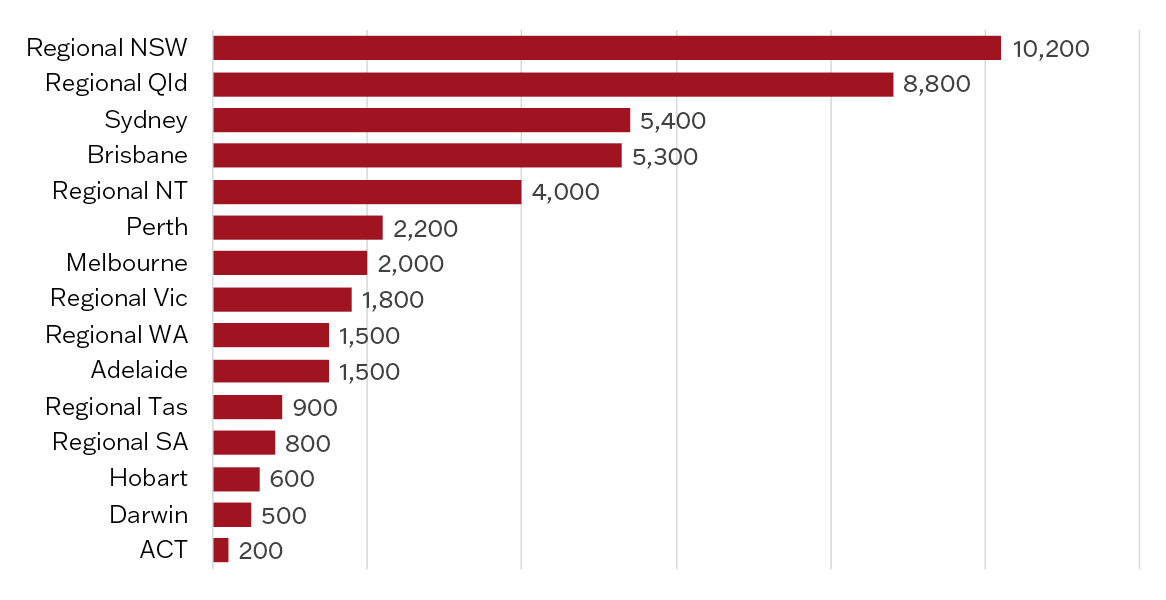
A major long-term study by AHURI has revealed that one in eight of all Aboriginal and Torres Strait Islander households (45,700 households) had unmet housing needs in the most recent national Census.
The study, which examined more than 20 years of Census data to identify trends, found that more than 81 per cent of Aboriginal and Torres Strait Islander households with unmet need are living in unaffordable rental housing; and 14 per cent in severely overcrowded housing areas with the greatest unmet need include New South Wales and Queensland and remote Australia.
The study marks the first comprehensive review of First Nations housing governance, resources and regulation in Australia.
"Our research revealed 45,700 low-income Indigenous households had unmet housing needs, representing 13 per cent of all Indigenous households," lead author of the research, Associate Professor Megan Moskos from the University of Adelaide, said.
"For comparison, that is almost double the rate for all Australian households, which sits just below seven per cent."
Most of the unmet need stems from First Nations households living in unaffordable rental housing (81 per cent), while 14 per cent results from severe overcrowding (mostly in social housing) and four per cent from inadequate housing conditions.
Unmet need is measured for households earning in the lowest 40 per cent of income levels.
The study found private rentals on the whole are too expensive for First Nations households on very low incomes.
79 per cent of First Nations households with very low incomes face rental stress, with families particularly affected due to higher rental costs for suitable accommodation.
Around one-quarter of First Nations households depend on social housing, compared to roughly four per cent of non-Indigenous Australians.
First Nations households make up more than 30 per cent of new public housing tenancies nationwide.
To meet current and projected needs from low income First Nations households, social housing must grow by nearly four per cent annually, adding 3,600 dwellings each year for the next 20 years. This expansion would house 137,000 First Nations households in social housing by 2041.
Associate Professor Moskos said that in some locations mainstream social housing is increasingly supporting larger numbers of Indigenous households.
"While all support is important, this has major implications for the delivery of housing services. Mainstream housing providers don't always have the capacity to meet the specific needs of Aboriginal and or Torres Strait Islander tenants," she said.
Under 'Closing the Gap' initiatives, state and territory governments have promised more culturally appropriate housing services.
High rates of homelessness, overcrowding and housing affordability stress among First Nations households, along with housing quality and suitability, remain key issues to be addressed.
AHURI said Australian governments and policy makers need the best understanding of First Nations housing need—especially the cause, type and geography of unmet need— to formulate effective responses.
The research, 'Indigenous housing support in Australia: the lay of the land', was undertaken for AHURI by researchers from University of Adelaide, UNSW Sydney, University of Sydney and University of Tasmania.
The report is available online.



