



Aboriginal and Torres Strait Islander readers are advised this article contains mentions of discrimination and violence against Indigenous people.
The latest episode of ABC Four Corners, "Guarded," dives into the growing presence of private security in the Northern Territory, highlighting cases of Indigenous people subjected to searches, assaults, and loss of liberty by private security personnel.
The prominence of private security contractors in the Northern Territory is growing rapidly, due to claims of rising crime rates.
A closer examination of data from the Australian Bureau of Statistics and public safety surveys spanning from 2005 to 2023, along with police records, reveals a mixed pattern in crime-related trends during this period.
The Northern Territory stands out as one of the few places in Australia where private companies are contracted by the government to perform tasks traditionally carried out by law enforcement agencies.
These contracted guards possess limited authority and receive minimal training, resulting in what has been characterised as a form of "quasi law and order," also being funded by tax-payer money whilst keeping exactly how much is being spent commercially in confidence.
The ABC program obtained footage of several disturbing incidents, including a Indigenous woman being punched in the face, another woman being forcefully pushed to the floor and dragged across the ground, and several other events.
"They don't administer any by-laws," Lord Mayor Kon Vatskallis told Four Corners.
"They can't, legally; the only thing they do is they detect a problem."
The "Blue shirt mob" called Territory Protective Servicies (TPS), are on patrol 24/7 and step in when "police aren't available."
The patrol program was established in 2019 to patrol the CBD.
It was later extended to Darwin's outer suburbs such as Karama, Malak and Palmerston under the Public Order Response Unit which is run by a security company called Neptune NT.
The PORU strongly resembles a police outfit and are seen carrying pepper spray and accompanied by canines.
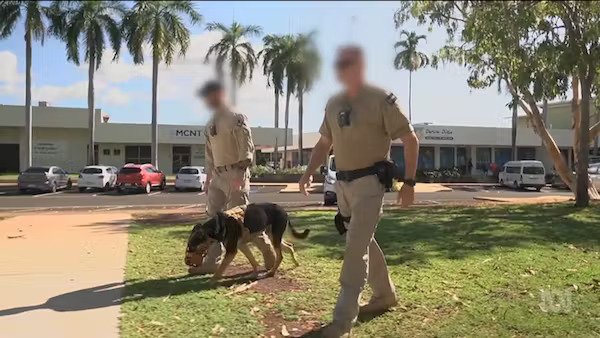
Street sweeping efforts have particularly singled out Indigenous people experiencing homelessness.
One incident examined involved an Indigenous man who endured a severe altercation, leaving him struggling to breathe after being thrown to the ground.
Despite the extensive implementation of the private policing model in the Northern Territory, there is a notable absence of legislation governing the powers and authority vested in private security guards. Furthermore, a regulatory framework for their behavior and the judicious use of force and weaponry remains conspicuously absent.
Professor Thalia Anthony, Faculty of LAW, UTS told ABC reporter Brooke Fryer: "There's no law that enables them to move on people, the laws related to move on are to be administered by police."
"They're using their image as police, their uniform to enforce that power that doesn't appear to have a legal basis. There would at least need to be legislation that enables private security to operate patrols."
Professor Anthony said there is no law enabling the firms to operate patrols.



